If your business paid tariffs under the International Emergency Economic Powers Act (IEEPA), you are legally entitled to recover those funds. The United States Supreme Court ruled that imposing tariffs under these emergency powers was unlawful, which forced U.S. Customs and Border Protection (CBP) to process full duty refunds along with statutory interest. To handle this multi-billion dollar repayment effort, CBP built an automated system inside the Automated Commercial Environment (ACE) portal called the Consolidated Administration and Processing of Entries (CAPE) system.
According to formal court filings and analysis from Baker Tilly's IEEPA Refunds Insight Update, CBP has approved well over $100 billion in total duty repayments. Despite this massive progress, tens of thousands of importers are still waiting for their money due to simple missing banking setup files or software holds placed on CAPE Phase 3. Understanding how this program works, where your entries fit into the timeline, and what requirements you must meet will keep your money from getting stuck.
The Broader Legal Background Behind IEEPA Tariff Refunds
This refund program stems directly from executive actions that placed emergency tariffs on foreign goods starting in early 2025. Importers across various industries were required to pay extra fees at the time of entry based on the origin of their goods. The trade community challenged these emergency duties in federal court, arguing that emergency statute laws did not give the executive branch constitutional authority to levy broad commercial taxes.
The legal battle reached the U.S. Supreme Court, which struck down the emergency tariffs as an improper use of executive power. Following that major ruling, the U.S. Court of International Trade (CIT) ordered CBP to set up clear, mandatory procedures to return every dollar collected under the illegal rules. Because manual processing of tens of millions of customs entries would take millions of work hours, CBP designed the automated CAPE tool inside the ACE portal to handle mass submissions, automated entry recalculations, and direct electronic payouts.
CAPE Phase 3: What It Is and Who It Affects
While CAPE Phases 1 and 2 are fully active and processing claims every day, Phase 3 remains on temporary hold while CBP updates its computer software.
What is Phase 3?
Phase 3 is CBP's intended automated system to issue refunds on finally liquidated entries. These are older import shipments that have finished the standard 314-day liquidation cycle and passed the 180-day protest deadline. Under basic customs regulations, closed entries cannot be reopened administratively unless a court order specifically mandates a reliquidation.
CBP delayed Phase 3 because it must write custom system checks inside ACE. Government developers must make sure the system only alters the specific IEEPA duty lines ordered by the court. The software must not accidentally mess up other valid duties, anti-dumping rates, or standard merchandise processing fees. The system also needs extra logic to correct entries where importers listed the tariff numbers incorrectly on their original paperwork.
Who is affected by Phase 3?
Phase 3 directly impacts importers who sued the government in the U.S. Court of International Trade (CIT) and secured court orders directing CBP to reliquidate their closed shipments. It also affects any business holding older, finally liquidated import entries that fall outside normal administrative protest windows and require active judicial orders to trigger duty repayments.
What you need to do to qualify for Phase 3
Importers waiting for Phase 3 must make sure their filing details are completely clean before system validation begins:
You must obtain exact, well-defined court orders that clearly identify the affected entries and duties, because vague legal language will cause automatic computer rejections.
You must audit past import entries to find and correct any paperwork mistakes before queuing your filings.
You must resolve or separate any active administrative protests, pending duty drawback claims, or antidumping cases attached to those shipments.
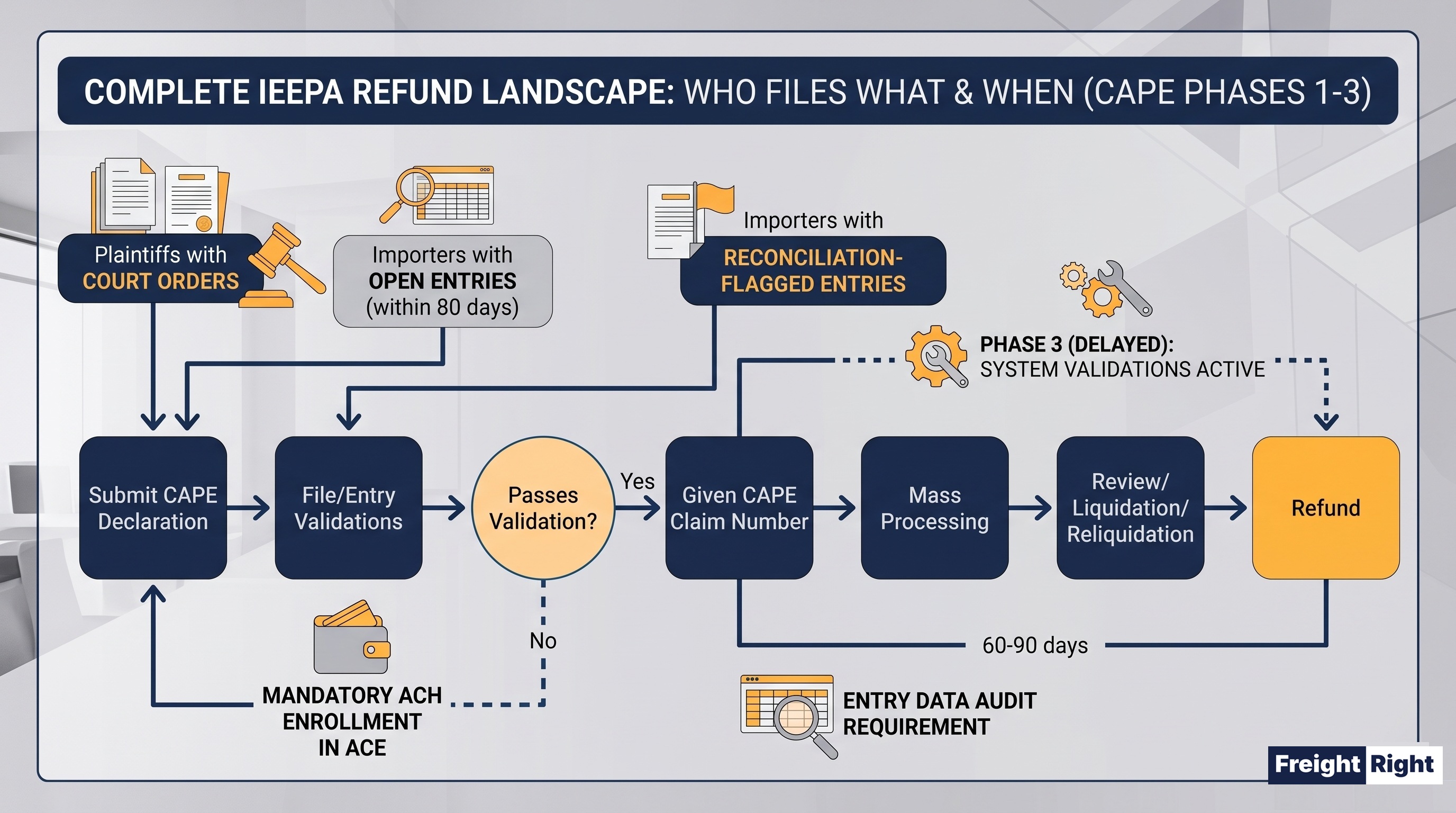
Under federal mandate (91 FR 21), CBP strictly requires all duty returns to be paid out electronically. If you do not set up Automated Clearing House (ACH) direct deposit in your ACE Secure Data Portal Account, CBP cannot send your money. As documented in court status reports, CBP is holding roughly $1.7 billion in approved payments across more than 22,000 refunds simply because importers have not added valid bank details.
Comparing the Three CAPE Refund Phases
To avoid filing errors, importers must understand how the three CAPE system phases divide import shipments based on entry status:
Phase 1 (Active): Covers open, unliquidated entries as well as entries liquidated within the last 80 days. It allows importers and customs brokers to submit simple batch declarations to collect original duties plus statutory interest.
Phase 2 (Active): Expands eligibility to underlying entries that were flagged for customs reconciliation (Type 09), provided those entries remain open or fall within the 80-day post-liquidation window.
Phase 3 (Delayed): Covers finally liquidated entries that are completely closed under normal administrative rules and rely strictly on specific court orders to force a reliquidation.
What You Should Do Right Now
Trade compliance teams should take direct, practical steps today to safeguard their money while Phase 3 system updates finish:
Group your imports by entry status: Review your entire entry history and divide your shipments into unliquidated entries, entries within 80 days of liquidation, reconciliation entries, and closed entries. Matching each entry to its correct CAPE phase prevents processing delays.
Watch your filing order on reconciliation entries: Do not file a formal Reconciliation Entry (Type 09) summary before submitting your CAPE refund claim. Submitting reconciliation first can permanently destroy your eligibility for automated recovery on those underlying shipments.
Set up ACH direct deposit immediately: Log into your ACE portal and confirm that your ACH direct deposit banking details are set up correctly. Setting up a fresh ACE account can take up to six weeks, so waiting until your claim is approved will delay your payment.
Protect your protest deadlines: Pay close attention to standard 180-day protest windows for entries that are liquidating right now. Do not let normal administrative deadlines expire while waiting for automated system tools to deploy.
Refer to this guide to better understand the process of how to effectively file for an IEEPA refund.
Timeline of Key Events
The following timeline details how the IEEPA refund process developed through court mandates and CBP technical releases as documented in Baker Tilly's IEEPA Development Timeline:
February 4, 2025 – Tariffs Take Effect: Emergency tariffs become active for covered imports entered for consumption on or after this date. Applicability relies strictly on the official entry date or warehouse withdrawal date.
February 20, 2026 – Supreme Court Strikes Down Tariffs: The U.S. Supreme Court rules that imposing tariffs under emergency powers is illegal. The CIT takes charge of overseeing CBP refund procedures.
March 4, 2026 – Court Mandates Automated Plan: The CIT orders CBP to stop collecting emergency duties and present an operational plan to refund open import entries.
March 12, 2026 – CAPE System Framework Introduced: CBP officially introduces the CAPE system inside ACE, dividing the automated software into claim submission, mass processing, reliquidation review, and refund modules.
March 27, 2026 – Scope Expands to Closed Entries: The CIT orders CBP to expand refund procedures so that older, finally liquidated entries can also receive repayments.
April 20, 2026 – CAPE Phase 1 Goes Live: CBP issues bulletin CSMS #68396594, launching Phase 1 in ACE for unliquidated entries and entries within 80 days of liquidation.
June 29, 2026 – CAPE Phase 2 Goes Live: Phase 2 deploys successfully, opening automated refund processing to reconciliation-flagged entries.
August 25, 2026 – Phase 3 Temporarily Paused: In a formal status declaration, CBP reports over $106 billion in refunds certified for Treasury disbursement, but confirms Phase 3 is paused while engineers refine system validation checks for court-ordered entries.
Common Mistakes That Delay Refunds
Even after Phase 3 launches, simple operational errors can freeze your duty recovery. The most common mistake is failing to complete the ACH banking setup in ACE, which causes approved funds to sit idle at the U.S. Treasury. Another common issue is submitting entry data with minor typos in tariff numbers, entry numbers, or port codes. When entry data in a CAPE submission does not match historical records exactly, the automated system rejects the file and forces manual review.
Importers also run into trouble when they ignore the relationship between CAPE claims and other duty programs. If you have open duty drawback claims or active administrative protests on a shipment, filing a standard CAPE claim without isolating those lines can lock up the entire entry summary. Reviewing your historical entry records with a qualified trade compliance team before filing ensures your business collects its full refund without technical delays.
Why Claiming Your Refund Requires Legal Expertise and How Freight Right is Helping Importers With This Need
As Phase 3 unfolds, the legal mechanics create a unique hurdle for importers with closed entries. Custom rules dictate that when an entry liquidates after 314 days, the file officially closes. Importers have a 180-day window to file an administrative protest with CBP. Once that 180-day window closes, CBP loses all legal authority to reopen the file on its own.
The Justice Department has made it clear that CBP cannot issue Phase 3 refunds without a specific court order that names the individual importer.
This means every business with closed entries past the 180-day mark must file a formal lawsuit in the U.S. Court of International Trade to compel a reliquidation.
Why Going Straight to an Attorney Is Expensive
Filing a trade lawsuit directly through a law firm can quickly get expensive. Trade attorneys charge high hourly rates to perform the manual labor required before drafting a complaint. They must pull historical entry logs, audit liquidation dates, verify duty payments, check protest statuses, and compile clean line-item data across all past broker filings.
When law firms handle this groundwork, legal fees can easily climb past $11,000 per lawsuit just to cover basic research and data entry.
Freight Right Has Partnered with Nationally Recognized International Trade Law Firm to Help Importers Secure Liquidated Refunds.
To remove this financial barrier, Freight Right created a complete Phase 3 preparation and legal handoff package. As a licensed customs broker with deep trade data access, Freight Right performs all the detailed research work at customs brokerage rates rather than legal rates.
Comprehensive Entry Audit: Freight Right reviews your historical import entries across all brokers, identifies closed entries past the 180-day protest mark, and audits duty lines to build a pristine case summary.
Structured Handoff to Trade Counsel: Freight Right compiles the entire financial and customs file into a clean legal template and hands it directly to experienced trade attorneys.
Flat-Fee Package Pricing: By taking over the tedious research and document prep work, Freight Right reduces the attorney's workload. By partnering with Freight Right, importers get a turnkey solution that organizes their data, slashes legal costs, and secures the court order required to collect their Phase 3 refunds.