- Home
- >
- News
- >
- Ocean Freight Rates Double Since March as Carriers Aggressively Squeeze Capacity - TFX Update wk. May 18, 2026
Ocean Freight Rates Double Since March as Carriers Aggressively Squeeze Capacity - TFX Update wk. May 18, 2026
The Lead:
Mid-May 2026 saw a dramatic intersection of legal reprieve, aggressive threats, and targeted diplomacy defining global commerce. The US executive branch successfully stabilized its immediate economic policy as an appellate court paused a ruling that had briefly neutralized the nation's 10% global surcharge. Empowered by this judicial lifeline, Washington escalated its transactional pressure on Europe by threatening to raise tariffs on EU automobiles to 25%, citing unmet trade concessions.
However, the week’s most significant breakthrough occurred in Asia, where a high-profile summit culminated in China committing to buy $17 billion annually in U.S. agricultural goods. This massive purchase agreement offers a strategic cushion to American farmers, even as China's overall share in the U.S. import market continues to crater under the weight of a near-37% effective tariff rate.
This Week’s Ocean, Air & Freight Markets
China-US Ocean Freight Market:
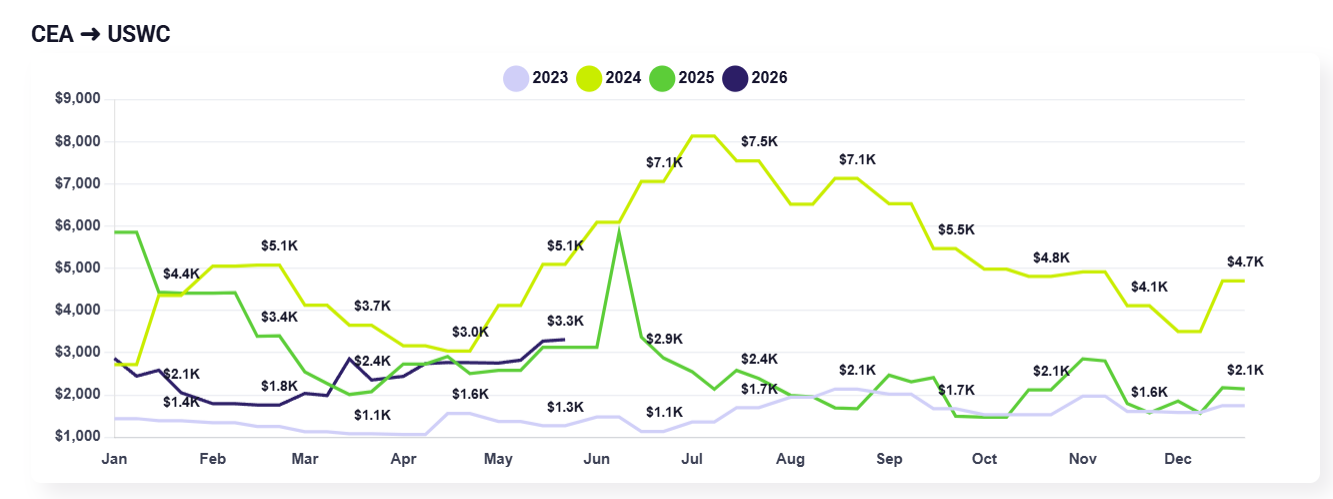
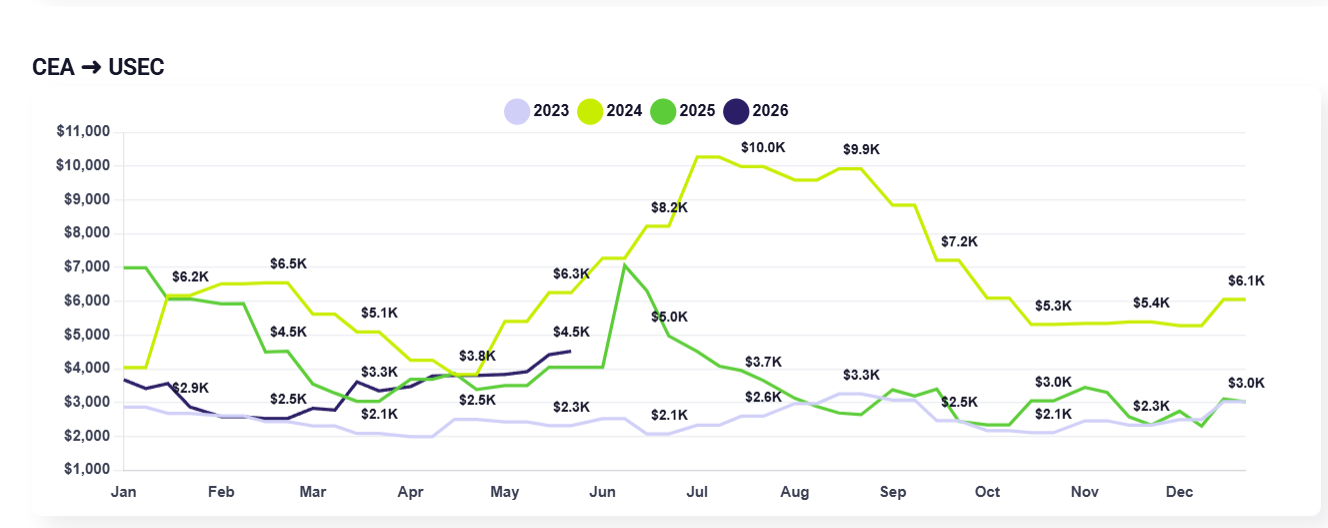
The ocean freight market has experienced sharp week-over-week rate increases across major lanes from China/East Asia (CEA) to North America. Spot rates to both coasts have surged, effectively doubling compared to early March baselines where pricing sat around $1,600 to $1,700 per container.
CEA to USWC: Rates increased by roughly $500 to $600, bringing the current pricing to $2,800–$3,400 per container.
CEA to USEC: Rates have climbed to $3,700–$4,500 per container.
While a few special agency rates remain scattered across the market, ocean capacity is severely constrained.
Freight Right’s Lowest Rate indicators are finding that importers can find spot rates as low as $2,800 from China to US West Coast and $3,787 from China to US East Coast. Talk to your freight forwarder about options available to you.
Read more about the state of the ocean freight spot market with Freight Right’s TrueFreight Index.
What Happened This Past Week
Artificial Capacity Cuts: The sudden spike in rates is not driven by an influx of consumer demand or improving market volumes, which remain relatively flat. Instead, carriers have intentionally pulled vessels out of rotation, creating an immediate space shortage that has forced prices upward.
Extreme Space Tightness and Rolled Cargo: Vessel space is extraordinarily tight across all major shipping lanes. Carriers are heavily restricting space approvals, resulting in a massive surge of rolled shipments across the industry.
Involuntary "Summer Product" Shipments: Importers of highly seasonal summer goods have reached a critical point in their product lifecycles and have no choice but to ship immediately to avoid missing their sales windows.
Looking Ahead:
The short-term outlook indicates further friction for typical importers. Carriers have already signaled intent to push rates even higher moving into June, a sign that they anticipate capacity restrictions will successfully hold.
If this upward trajectory persists through June, it could fundamentally disrupt the traditional Q3 peak season (July through September). Because shippers are scrambling to pull demand forward right now out of fear of future space shortages, the industry may see a flat or non-existent peak season later this summer. This would mark the second or third consecutive year where traditional seasonal shipping patterns have dissolved in favor of artificial, carrier-driven market cycles.
A potential demand buffer may arrive in approximately two months as government tax refunds flow back into the market, potentially stimulating consumer spending and easing liquidity constraints for smaller importers. Until then, only enterprise brands with massive negotiating leverage or seasonal shippers with zero scheduling flexibility will maintain consistent volume, leaving the rest of the market sidelined.
In the News:
Bloomberg: US Asks to Keep Collecting Trump’s Tariffs After Court Loss
New York Times: Trump Touts ‘Fantastic Trade Deals’ With China, but Details Are Scarce
https://www.nytimes.com/2026/05/15/business/economy/trump-china-deals.html
AP News: Trump and Xi dialed down the trade war, but challenges lurk at their China summit
https://apnews.com/article/trump-xi-china-summit-trade-tariffs-2eee658298ba8f064fe232e8832bd2ea
Reuters: China signals tariff cuts, advances in farm market access after Trump-Xi summit
WSJ: China Says It Has Agreed With U.S. to Set Up Trade and Investment Bodies
More News
Late-June Front-Loading Exacerbates Severe Transpacific Space Crunch
Late-June front-loading has triggered a severe transpacific space crunch. Discover how carrier rate hikes are driving ocean freight costs to new heights as shippers scramble for limited vessel capacity.
East Coast Premium Narrows: China–US Ocean Market Turns More Competitive - TFX Update wk. November 17, 2025
China-US ocean freight rates continue to decline, with the East Coast premium narrowing as carriers compete for limited volume. Get the key market drivers and outlook in this week’s update.
Looming Tariffs and Softening Volumes Push Ocean Rates Down - TFX Update wk. July 20, 2026
Track weekly ocean freight rate trends for China to USWC and USEC. Read key insights on carrier rate adjustments, tariff updates, and shipping forecasts.

Ocean Freight Rates Retreat as Tariff Uncertainty Freezes Import Demand - TFX Update wk. July 13, 2026
China-to-US ocean freight rates fell by about $1,000 this week as carriers lowered prices to stimulate demand. Read the latest Freight Right market update on CEA to USWC and USEC rates, tariff uncertainty, and the outlook for the remainder of the 2026 pea

Carriers Hold Firm on Fuel Surcharges Despite Emerging US-Iran Peace Plans - TFX Update wk. June 15, 2026
Transpacific ocean freight rates soared past $6,000 to the USWC and hit the mid-$7,000s to the USEC. Discover how front-loading and severe space constraints are driving this week's market update.

China-US Ocean Rates Hold Steady at $3K/$4K Baseline Ahead of Threatened June Spikes - TFX Update wk. May 25, 2026
Ocean freight rates hold steady, but massive June GRIs loom. Discover how carrier blank sailings and terminal capacity constraints are driving up transpacific shipping costs.
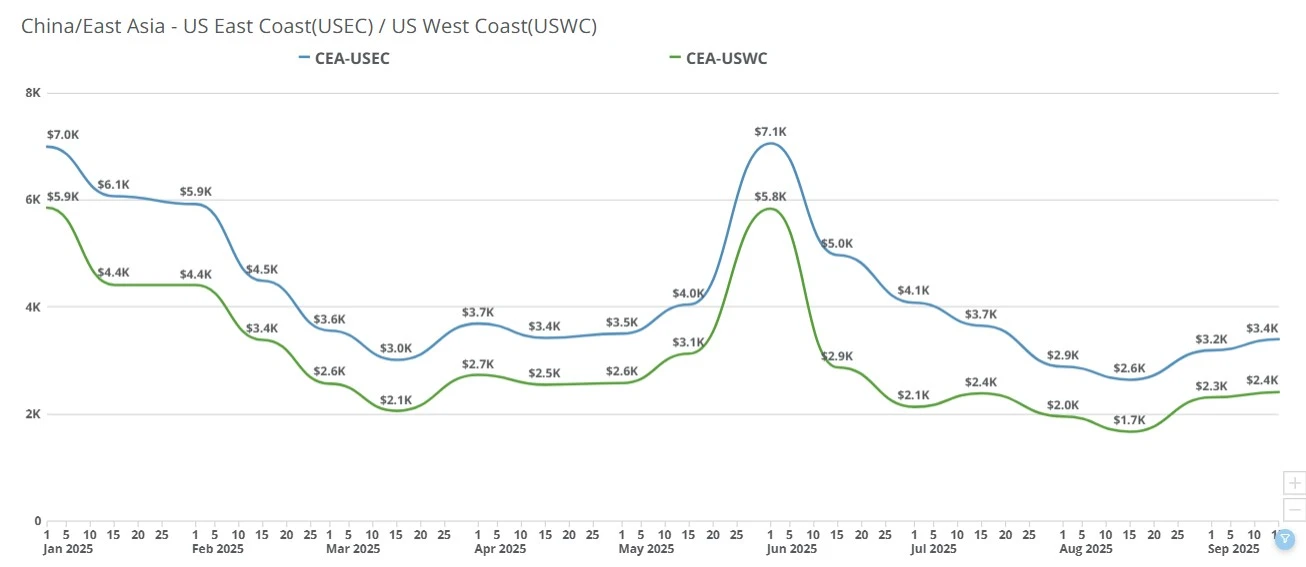
Carriers Rollback September's GRI and Competition Among Forwarders Heats Up - TFX Update wk. September 15, 2025
China–US freight rates spiked up to $900 to start September but,in a rare move, promptly rolled back to pre-GRI amounts this week to entice bookings.
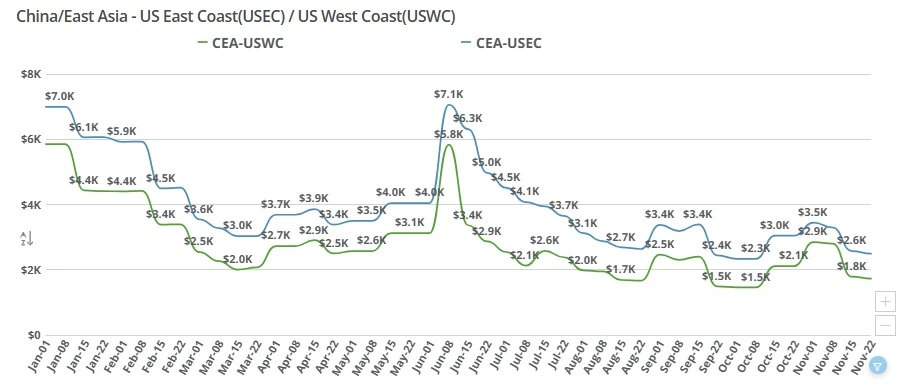
Spot Rates Plunge on Both Coasts With Short Holiday Week and Weak Imports - TFX Update wk. November 24, 2025
Transpacific ocean freight rates dropped sharply this week as weak import demand and the Thanksgiving holiday slowdown pushed China–US West and East Coast spot prices to new lows. Get the latest market drivers and outlook.

Importers Race Against July Tariff Deadlines, Throwing Supply Chains Into Chaos - TFX Update wk. June 8, 2026
Ocean freight rates skyrocket past $6,000 to USWC and $7,000 to USEC. Discover how carrier blank sailings, space deficits, and tariff front-loading are driving this early peak season crunch.
China-US Freight Rates Dip as Carriers Battle for Sparse Cargo - TFX Update wk. March 30, 2026
Discover why ocean carriers are shifting to weekly rate cycles, the status of the upcoming Emergency Fuel Surcharge, and current rate benchmarks for China to US East and West Coasts.