- Home
- >
- News
- >
- China-US Freight Rates Dip as Carriers Battle for Sparse Cargo - TFX Update wk. March 30, 2026
China-US Freight Rates Dip as Carriers Battle for Sparse Cargo - TFX Update wk. March 30, 2026
The Lead:
The end of March 2026 signaled a definitive splintering of the global trade system. The failure of the 14th World Trade Organization (WTO) Ministerial Conference to extend the moratorium on ecommerce duties marks the end of an era of digital tax-free trade, effectively green-lighting digital borders. While the US continues to manage its trade through a 15% flat surcharge and targeted green-tech investigations, China has responded with its own sophisticated lawfare, investigating US barriers to its clean-energy exports. This week confirmed that the "consensus-based" model of the WTO is being replaced by a "multi-speed" trade world: one where a core group of 66 nations attempts to maintain digital rules, while major powers like the U.S. and China settle disputes through unilateral tariffs and domestic industrial investigations.
This Week’s Ocean, Air & Freight Markets
China-US Ocean Freight Market:
The freight market is experiencing a period of high volatility as carriers attempt to balance dwindling volumes against rising operational costs..
CEA to USWC: Rates have dipped slightly, now averaging between $1,800 and $1,900 per FEU.
CEA to USEC: Rates for the East Coast are currently holding between $2,800 and $2,900 per FEU.
In a departure from the traditional bi-weekly or monthly rate cycles, carriers are currently only releasing rates on a one-week basis. This ultra-short-term approach allows carriers to remain agile, either slightly lowering rates or extending previous ones to capture what little volume is available in the market.
Air freight, meanwhile, is breaking the $8.00/kilogram threshold, up from last week's $6-7.00/kilo and up from $4.00 in mid February.
While rates have dipped slightly week-to-week, importers, according to our TrueFreight Index, can still find rates as low as $1,650 China to US West Coast and $2,450 China to US East Coast. Talk to your current freight forwarder for options.
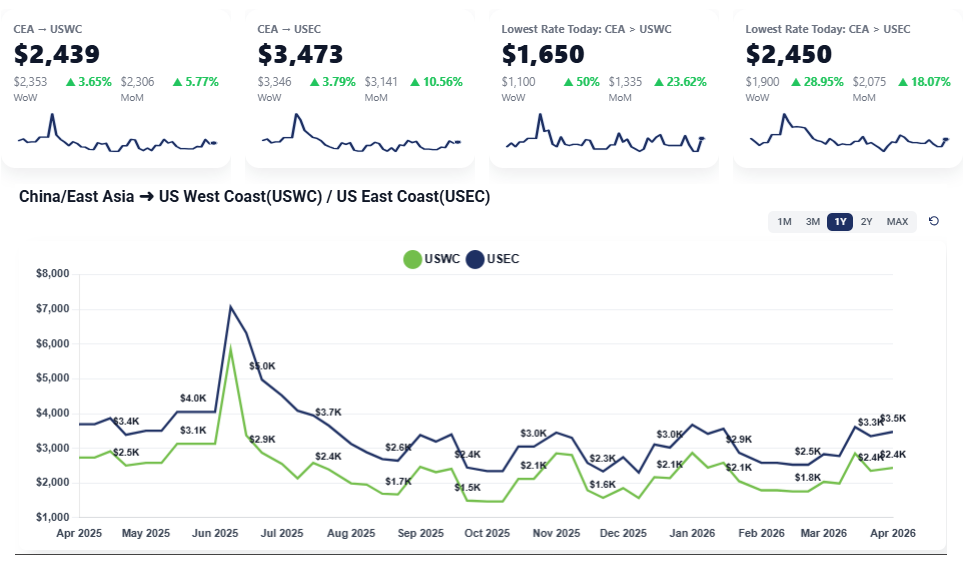
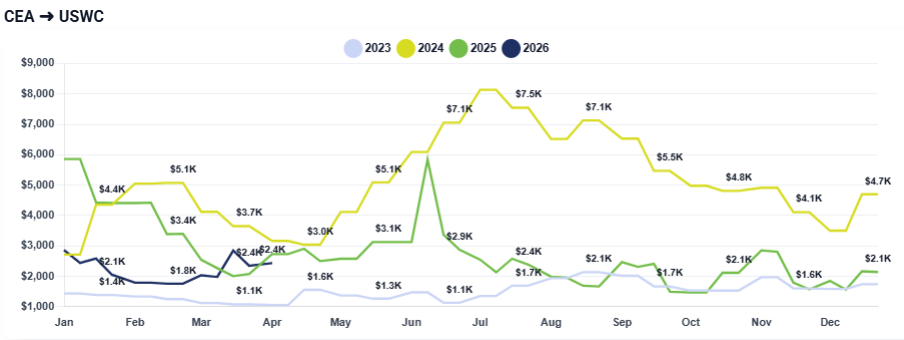
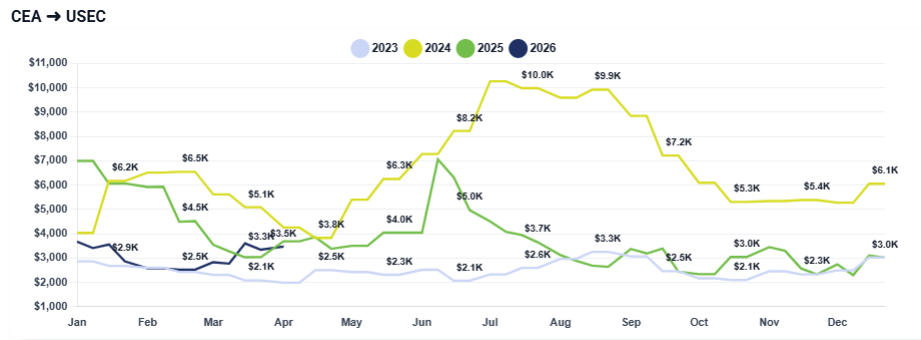
Read more about the state of the ocean freight spot market with Freight Right’s TrueFreight Index.
What Happened This Past Week
The current rate environment is being shaped by a tug-of-war between low demand and geopolitical instability
Carrier Desperation for Volume: After attempting to jack up prices in late March, carriers saw volume vanish, forcing them to pivot and lower rates slightly to attract any available cargo.
Short-Term Rate Validity: By only committing to seven-day rate windows, carriers are protecting themselves against sudden spikes in fuel or further drops in demand.
Fuel Price Volatility: Unlike Air Freight, which feels the impact of oil prices almost immediately, Ocean Freight is seeing a delayed reaction due to existing bunker fuel stocks.
Looking Ahead:
The industry is entering a high-stakes waiting game centered on mid-April. Carriers have already announced an Emergency Fuel Surcharge (EFS), tentatively scheduled to roll out around April 11th or 12th. However, there is significant internal hesitation among carriers regarding the implementation of this surcharge.
Carriers are currently trying to have it both ways, lowering base rates now to fill ships while keeping the EFS as a defensive go-ahead if fuel costs become untenable. If cargo volumes do not recover by the second week of April, carriers may be forced to further delay the EFS to avoid permanently turning off the few shippers still active in the market. Expect continued weekly rate updates as the industry monitors if and when factory activity returns to normal levels.
In the News:
Bloomberg: A Winner in Early Trump Tariffs, Vietnam Thrives in Trade War 2.0
https://www.bloomberg.com/graphics/2026-vietnam-trump-tariffs-supply-chain/
Reuters: US vows to seek WTO alternatives after Cameroon meeting fails to renew e-commerce moratorium
https://www.reuters.com/world/americas/wto-suffers-fresh-blow-reform-push-hits-wall-cameroon-meeting-2026-03-30/
BBC: European Parliament gives conditional approval to EU-US trade deal
https://www.bbc.com/news/articles/c33l4e6vdrvo
WSJ: China Hits Back at U.S. With New Trade Probes Ahead of Trump-Xi Summit
https://www.wsj.com/economy/trade/china-initiates-probes-into-u-s-trade-practices-f02a8951
Reuters: US menus change as Trump's tariffs hit wine prices
https://www.reuters.com/business/us-menus-change-trumps-tariffs-hit-wine-prices-2026-03-30/
More News
Carriers Pivot to Weekly Rate Updates Amid Global Fuel Volatility - TFX Update wk. April 6, 2026
Ocean rates hit $2,700 as carriers implement $300 emergency fuel surcharges. Explore how geopolitical instability and weekly rate shifts are impacting China-to-US shipping lanes.
Ocean Rates Up as Volumes Continue to Sink - TFX Update wk. March 23, 2026
Understand why ocean freight rates are climbing despite record low volumes. Our March 2026 update covers the $600 rate hikes, new emergency fuel surcharges, and how blank sailings are impacting China-to-US shipping costs.
Ocean Freight Rates Hold Firm as Carriers Defend Pricing Into 2026 Contract Season - TFX Update wk. December 29, 2025
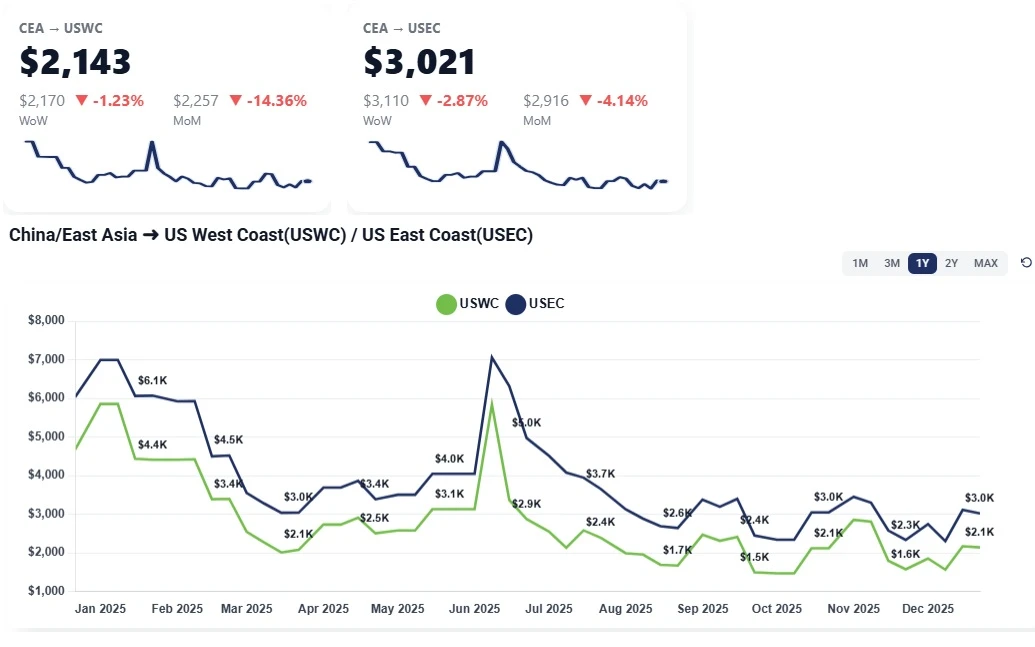
Transpacific ocean freight rates from China to the US West and East Coasts remained elevated week over week as carriers held firm through the holiday slowdown, positioning pricing ahead of Chinese New Year and upcoming contract season negotiations.
Spot Rates Dip Below 2024 Levels as Blank Sailings Ramp Up - TFX Update wk. August 18, 2025
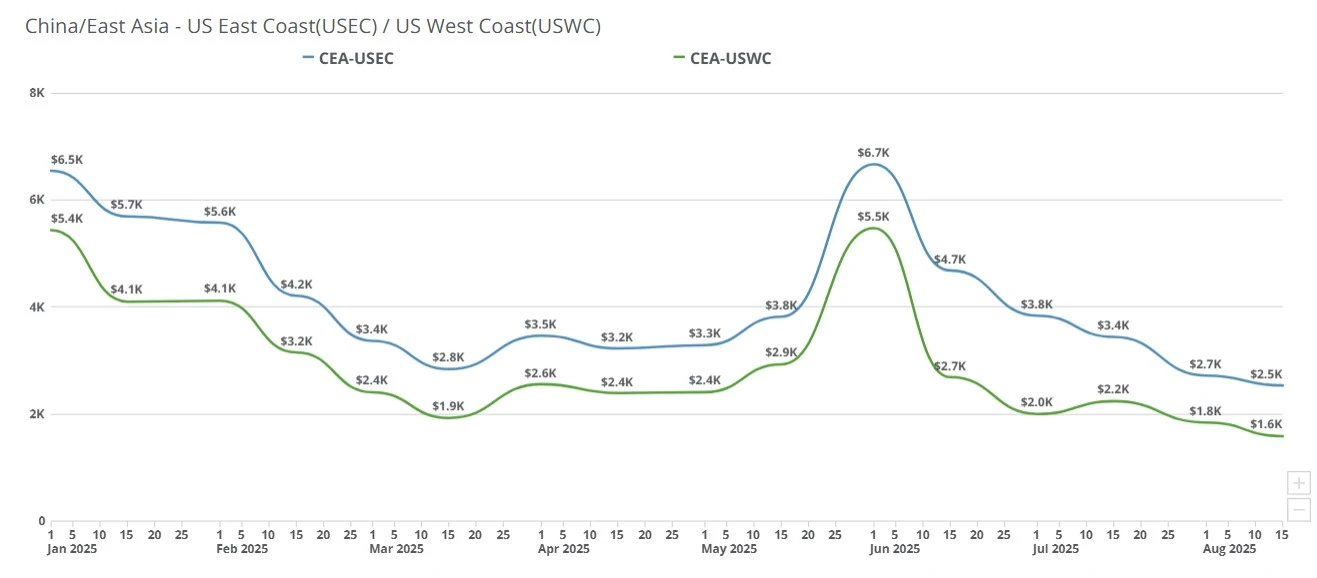
China-US freight rates dip to $1,520/FEU as carriers cut prices and blank sailings set up a $1,000 September GRI amid weak demand and tariff risks.
China–US West and East Coast Rates Hold Flat After Short-Lived December Rate Spike - TFX Update wk. December 1, 2025
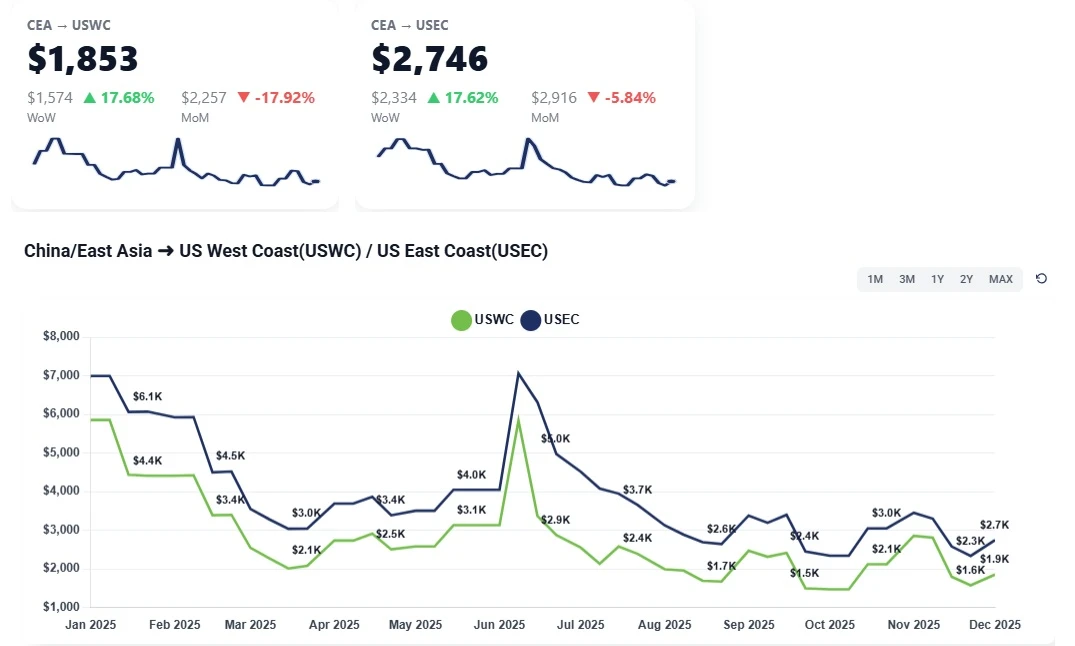
Weekly ocean freight update on China–US West and East Coast lanes as an early December GRI fades, leaving spot rates near November levels amid weak demand.

Ocean Freight Rates Double Since March as Carriers Aggressively Squeeze Capacity - TFX Update wk. May 18, 2026
Ocean freight rates double for USWC and USEC as carrier capacity cuts trigger severe space shortages and rolled cargo. Read the latest weekly freight market update on rising spot rates, premium expedited shipping surges, and the June GRI outlook.
Navigating LAX Air Cargo: Freight Right's Expertise as Customs Broker
Freight Right leads in LAX customs brokerage, managing over 100K tons of air cargo annually. Discover our role in LAX’s cargo efficiency and compliance.
Holiday Pause Masks January Price Pressure on China–US Lanes - TFX Update wk. December 22, 2025
China–US ocean freight rates to the West and East Coasts held steady this week amid a holiday slowdown. Learn what’s driving the flat market and why January GRIs could push prices higher.
Spot Rates Plunge on Both Coasts With Short Holiday Week and Weak Imports - TFX Update wk. November 24, 2025
Transpacific ocean freight rates dropped sharply this week as weak import demand and the Thanksgiving holiday slowdown pushed China–US West and East Coast spot prices to new lows. Get the latest market drivers and outlook.

Ocean Rates Hold Firm as China Factories Reopen - TFX Update wk. March 2, 2026
Ocean rates hold at $1,450-$1,500 for USWC as Chinese factories reopen. Explore why the post-holiday rate crash didn't happen and what to expect for the March recovery.