- Home
- >
- News
- >
- Transpacific Carriers Face Losses as Feb Bookings Close - TFX Update wk. February 2, 2026
Transpacific Carriers Face Losses as Feb Bookings Close - TFX Update wk. February 2, 2026
The Lead:
The transition into February was defined by the aggressive use of "energy-linked" trade penalties and a simultaneous race to secure alternative bilateral alliances. The United States’ introduction of secondary tariffs on countries supplying oil to Cuba, most notably targeting Mexico, signaled a high-risk expansion of trade as a tool of regime-change diplomacy. Conversely, the formalization of the EU-India FTA and the activation of the EU-Singapore Digital Trade Agreement demonstrate a concerted effort by the "Global Middle" to build resilient, rules-based corridors that bypass the volatility of US policy. However, the WTO’s drastic downward revision of trade growth to just 0.5% underscores a grim reality: the proliferation of these "tit-for-tat" measures is successfully decoupling major economies but at the cost of overall global prosperity.
This Week’s Ocean, Air & Freight Markets
China-US Ocean Freight Market:
The ocean freight market has entered a phase of significant decline as the industry moves through the Chinese New Year period. Rates have retreated further than market analysts initially projected, reaching levels that challenge carrier profitability.
CEA to USWC: Rates have continued their downward slide, dropping to approximately $1,450 – $1,500 per container. This represents a new low for the year, pushing pricing well below previous support levels.
CEA to USEC: East Coast rates also dropped this week, further highlighting that the overarching trend shows rates dropping across all lanes, with carriers now operating at or near breakeven levels to maintain volume.
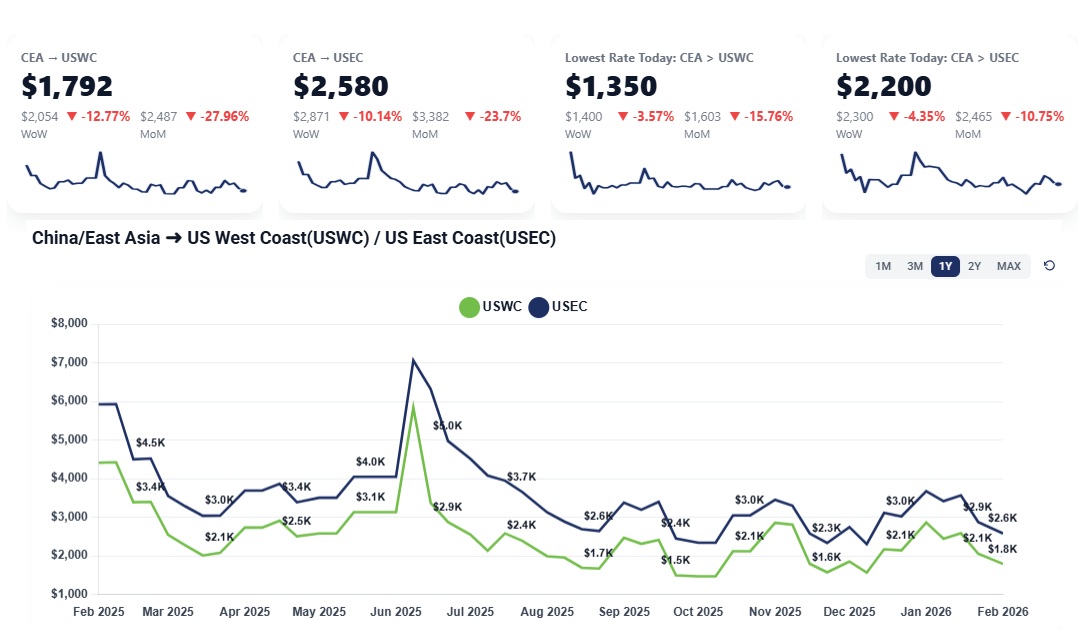
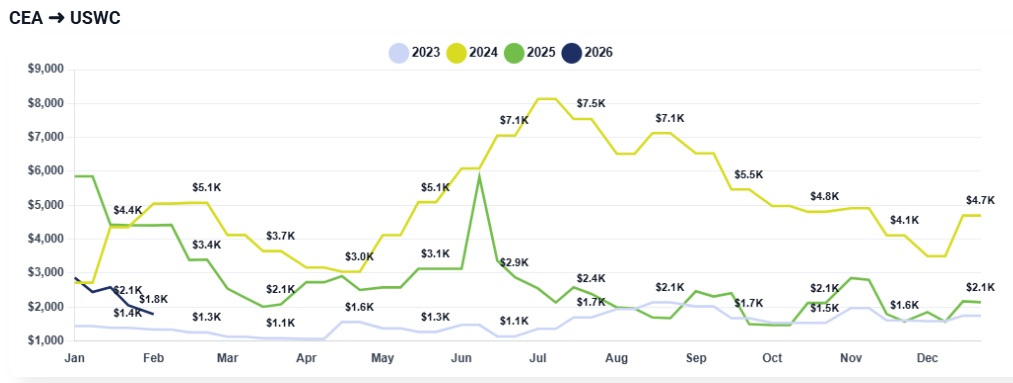
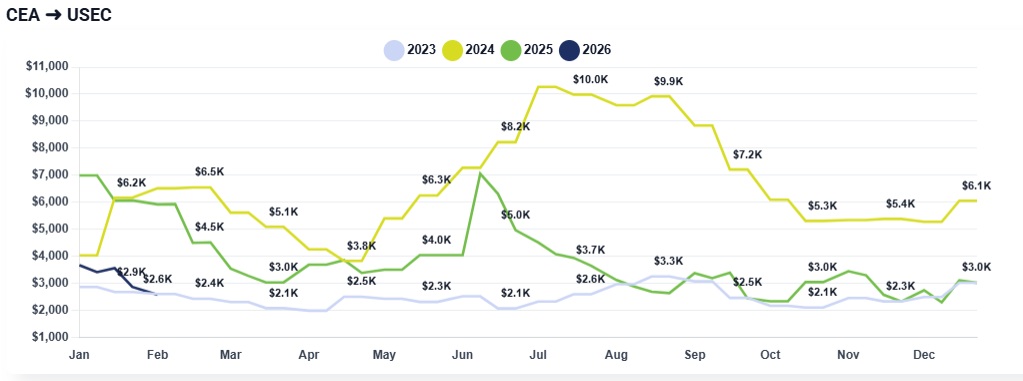
Read more about the state of the ocean freight spot market with Freight Right’s TrueFreight Index.
This Week Explained:
Late Lunar New Year Volume: Surprisingly, there was a minor uptick in bookings just before the holiday, as shippers waited until the very last possible week to move goods.
Carrier Desperation: Rates have fallen into the $1,450–$1,500 range, which is considered the "breakeven" point for many carriers; any further drops would result in carriers operating at a loss.
Booking Completion: The industry has essentially finished all bookings for the month of February, as the holiday shutdown in Asia effectively halts new manufacturing and shipping activity.
Air Freight Softening: Parallel to ocean freight, air freight rates have also begun to drop by 20–30 cents, with further declines expected as the post-holiday lull sets in.
Looking Ahead:
The market is expected to remain "dead" for the remainder of February as Asia observes the New Year holiday. Shippers and carriers are now looking toward the end of March for the next major market signal.
A critical factor to watch will be the upcoming contract negotiations. We noted that carriers will likely look for ways to stabilize the market if the current low levels persist into the end of March. If demand does not rebound significantly post-holiday, the industry could face a prolonged period of "at-cost" shipping, which may eventually force carriers to implement more aggressive capacity management, such as additional blank sailings, to push rates back up.
In the News:
Bloomberg: US Container Growth Vanishes with World Trade Flows Moving On
https://www.bloomberg.com/news/articles/2026-01-31/us-container-growth-vanishes-with-world-trade-flows-moving-on
Bloomberg: India’s Rupee, Stocks to Get Tariff-Truce Boost, Investors Say
https://www.bloomberg.com/news/articles/2026-02-03/india-s-rupee-stocks-to-get-tariff-truce-boost-investors-say
Global Trade Magazine: Mexico Heads Into 2026 With Momentum: A Nearshorer’s Outlook
https://www.globaltrademag.com/mexico-heads-into-2026-with-momentum-a-nearshorers-outlook/
Financial Times: The WTO needs an overhaul
https://www.ft.com/content/2ff1d4ce-4d63-4776-8e8c-ace6b3509f24
CNBC: Trump refuses to be outdone by Europe, signing his own U.S.-India trade deal
https://www.cnbc.com/2026/02/03/trump-us-india-trade-deal-europe-india-deal-compared.html
More News

Silence Before the Storm: Transpacific Market Braces for Chinese New Year Shutdown - TFX Update wk. January 26, 2026
Ocean freight rates from China to the US hit new lows as Chinese New Year approaches. With USWC rates falling to $1,600 and carriers selling space at cost, discover what's driving the market downturn and the outlook for February 2026

Shippers Face a Total Standstill in Transpacific Trade - TFX Update wk. February 23, 2026
Ocean rates remain frozen at $1,400-$1,600 to the USWC as the Lunar New Year shutdown halts all Chinese logistics. Discover why the market is at a standstill and what to watch for in March.

Ocean Rates Hold Firm as China Factories Reopen - TFX Update wk. March 2, 2026
Ocean rates hold at $1,450-$1,500 for USWC as Chinese factories reopen. Explore why the post-holiday rate crash didn't happen and what to expect for the March recovery.
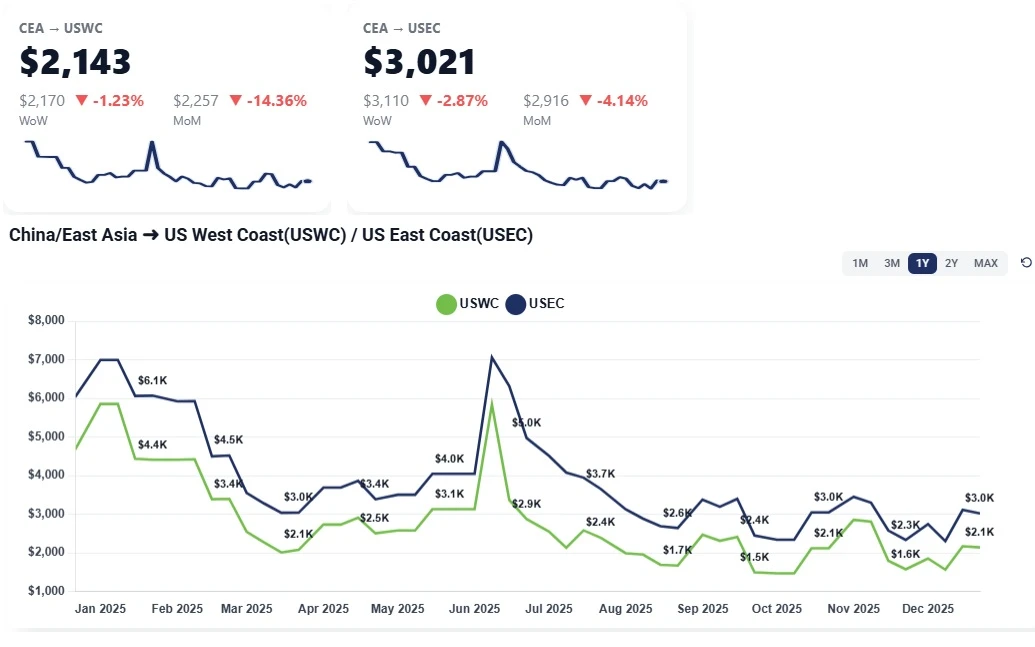
Ocean Freight Rates Hold Firm as Carriers Defend Pricing Into 2026 Contract Season - TFX Update wk. December 29, 2025
Transpacific ocean freight rates from China to the US West and East Coasts remained elevated week over week as carriers held firm through the holiday slowdown, positioning pricing ahead of Chinese New Year and upcoming contract season negotiations.

CEA-US Rates Hold Steady at Breakeven Levels - TFX Update wk. February 9, 2026
Ocean rates hold steady at $1,400-$1,600 for USWC as China’s pre-holiday shipping window closes. Explore the impact of high trucking costs and the upcoming total market shutdown.

Capacity Management & Holiday Rush Drive Transpacific Freight Rates Higher - TFX Update wk. August 31, 2026
Discover why strategic blank sailings and early holiday inventory shipments are driving Transpacific container rates up to $10k per FEU this September
Carriers Hold the Line at $1,500 Floor - TFX Update wk. March 9, 2026
Ocean rates hold steady at $1,500 for USWC as Chinese factories reopen. Explore why the post-holiday rate war never arrived and what this means for April contract negotiations.
Ocean Rates Up as Volumes Continue to Sink - TFX Update wk. March 23, 2026
Understand why ocean freight rates are climbing despite record low volumes. Our March 2026 update covers the $600 rate hikes, new emergency fuel surcharges, and how blank sailings are impacting China-to-US shipping costs.

Late-June Front-Loading Exacerbates Severe Transpacific Space Crunch
Late-June front-loading has triggered a severe transpacific space crunch. Discover how carrier rate hikes are driving ocean freight costs to new heights as shippers scramble for limited vessel capacity.

Tariff Fears and Tepid Demand: Why the Transpacific "Mini-Peak" Never Arrived - TFX Update wk. January 19, 2026
Ocean freight rates fall as carriers abandon GRIs due to weak demand and tariff uncertainty. USWC rates hit $1,700–$1,800 as the expected pre-Chinese New Year volume surge fails to arrive.