Ocean Rates Up as Volumes Continue to Sink - TFX Update wk. March 23, 2026
The Lead:
Last week was a transition from reactive trade policy to structural entrenchment. In the US, the focus shifted to the massive logistical challenge of refunding $175 billion in invalidated IEEPA duties, even as the administration fast-tracked new Section 301 investigations to ensure high tariffs return on a more permanent legal footing by July. This aggressive posture was mirrored in Washington's pre-WTO report, which effectively issued an ultimatum for reciprocal reform at the upcoming ministerial conference in Cameroon. Meanwhile, the global trade landscape was further complicated by the Hormuz Crisis, forcing nations like Turkey and China to implement emergency duty waivers and price controls to manage the inflationary pressures of a high-tariff, energy-strained global economy.
This Week’s Ocean, Air & Freight Markets
China-US Ocean Freight Market:
Ocean freight market is experiencing a sharp upward trajectory as of late March 2026. Following a rate increase that began around March 20th, ocean freight costs have climbed by approximately $400 to $600 per container.
CEA to USWC: Rates have risen to approximately $2,100 – $2,200 per container. Factoring in standard margins, the total cost for importers is approaching the $2,500 – $2,600 range as we move into April.
CEA to USEC: Rates for East Coast destinations have surpassed the $3,000 mark. This route is currently facing more severe capacity constraints due to significant blank sailings.
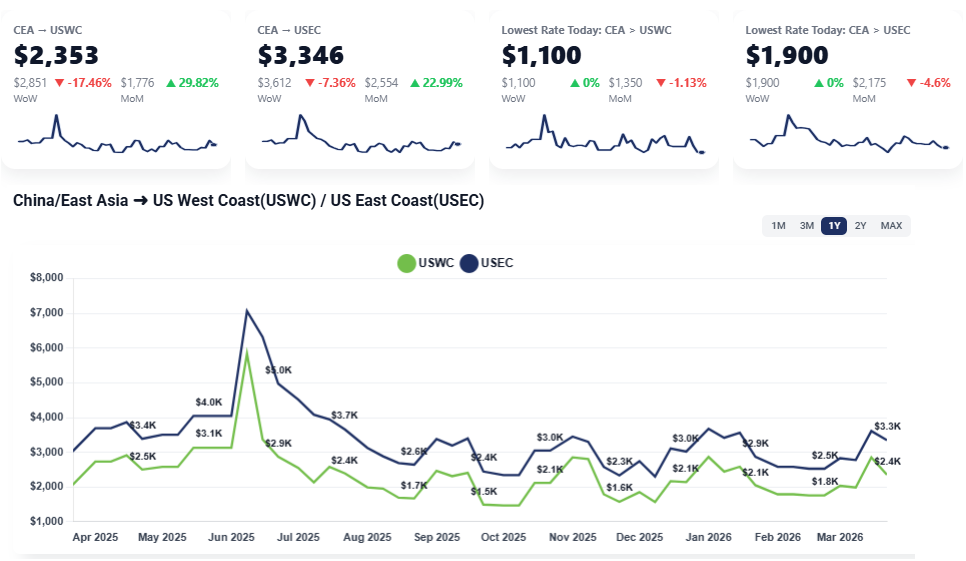
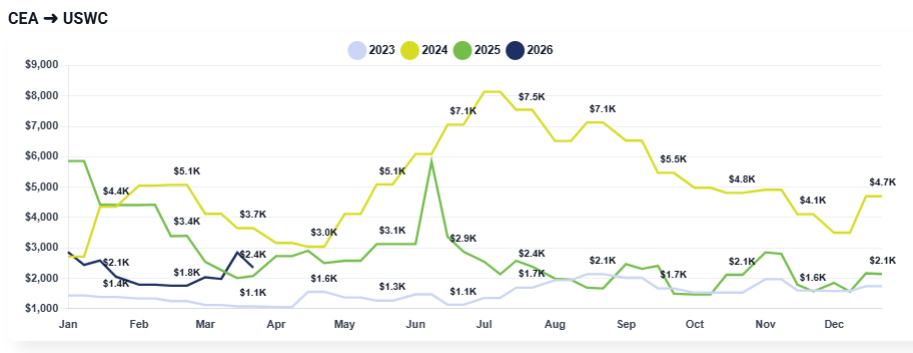
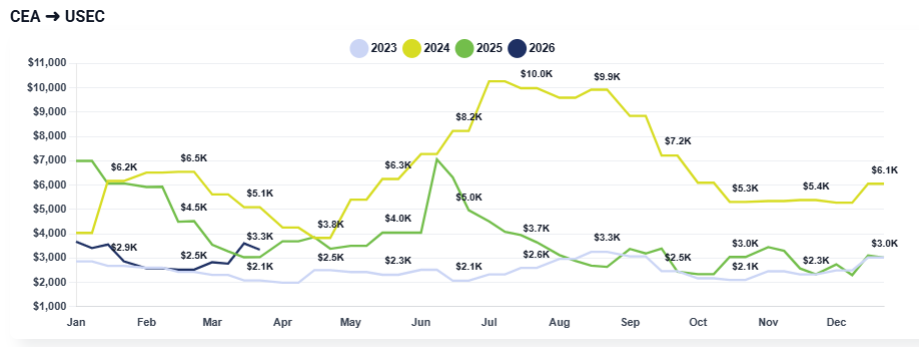
Read more about the state of the ocean freight spot market with Freight Right’s TrueFreight Index.
What Happened This Past Week
Global Fuel Price Surges: Rising oil prices are the primary driver behind recent rate hikes. Carriers are utilizing these costs as the justification for General Rate Increases (GRIs) and new surcharges.
Capacity Management: Carriers are aggressively implementing blank sailings (canceled port calls), particularly on East Coast routes, to artificially reduce capacity and support higher price levels.
Geopolitical Tensions: Ongoing instability in the Middle East continues to disconnect freight pricing from typical seasonal trends, maintaining a floor under market rates.
Air Freight Spillover: The fuel crisis is even more pronounced in air freight, where rates from China (PVG) have spiked from $4.50–$5.50/kg to upwards of $7.00/kg.
Low Market Volume: Paradoxically, these price increases are occurring during an off-peak period with very low organic volume. Even major importers, such as LA-based automotive part distributors, have reported canceling weekly shipments due to the prohibitive costs.
Looking Ahead:
The outlook for April 2026 suggests a stiff environment for importers. While carriers claim current surcharges are temporary and tied to oil price fluctuations, historical trends suggest that once these increases are integrated, they are rarely removed quickly.
With additional emergency fuel surcharges (EFS) set to take effect in early to mid-April, volumes are expected to remain depressed. The market is currently in a state of high uncertainty; unless Middle Eastern tensions resolve or fuel prices stabilize, importers should prepare for sustained high costs despite the lack of demand.
Upcoming Carrier Emergency Fuel Surcharges (EFS)
Carriers have announced a wave of new surcharges to be collected at destinations, largely effective between late March and mid-April 2026. These are generally separate from the standard bunker fuel costs already baked into freight quotes.
*Updated as of March 31, 2026
Carrier | Surcharge Name | Quantum (Currency: USD) | Effective Date | ||||||
Dry | Reefer | ||||||||
20'GP | 40'GP | 40'HC | 45'HC | 20'GP | 40'GP | 40'HC | (Gate-in date) | ||
MSK | Emergency Bunker Surcharge | 200 | 400 | 400 | 400 | 300 | 600 | 600 | 2026-03-25 |
ZIM | Emergency Fuel Surcharge | 250 | 500 | 500 | 633 | - | - | 750 | 2026-04-01 |
ZIM | Emergency Fuel Surcharge | 211 | 422 | 422 | 534 | - | - | 633 | 2026-04-01 |
ZIM | Emergency Fuel Surcharge | 250 | 500 | 500 | 633 | - | - | 750 | 2026-04-19 |
ZIM | Emergency Fuel Surcharge | 211 | 422 | 422 | 534 | - | - | 633 | 2026-04-19 |
CMA | Emergency Fuel Surcharge (BAF09) | 150 | 300 | 300 | 300 | 180 | 360 | 360 | 2026-04-08 |
CMA | Emergency Fuel Surcharge (BAF09) | 265 | 530 | 530 | 530 | 320 | 640 | 640 | 2026-04-18 |
CMA | Emergency Inland Fuel Surcharge (OCA17) | 100 | 100 | 100 | 100 | 100 | 100 | 100 | 2026-04-17 |
HPL | Emergency Fuel Surcharge | 160 | 320 | 320 | 320 | 225 | 450 | 450 | 2026-04-08 |
ONE | Emergency Fuel Surcharge | 160 | 320 | 320 | 320 | 210 | 420 | 420 | 2026-04-09 |
ONE | Inland Haulage Fee IHD (inbound) | 330 | 330 | 330 | 330 | 380 | 380 | 380 | 2026-04-18 |
ONE | Inland Haulage Fee IHD (inbound) | 200 | 200 | 200 | 200 | 380 | 380 | 380 | 2026-04-18 |
ONE | Inland Haulage Fee IHD (inbound) | 100 | 100 | 100 | 100 | 100 | 100 | 100 | 2026-04-18 |
ONE | Inland Haulage Fee IHD (inbound) | 430 | 430 | 430 | 430 | 480 | 480 | 480 | 2026-04-18 |
ONE | Inland Haulage Fee IHD (inbound) | 300 | 300 | 300 | 300 | 480 | 480 | 480 | 2026-04-18 |
ONE | Inland Haulage Fee IHD (inbound) | 150 | 150 | 150 | 150 | 300 | 300 | 300 | 2026-04-18 |
MSC | Emergency Fuel Surcharge | 136 | 272 | 272 | 344 | 204 | 408 | 408 | 2026-04-09 |
MSC | Emergency Fuel Surcharge | 215 | 430 | 430 | 544 | 322 | 644 | 644 | 2026-04-09 |
HMM | Emergency Fuel Surcharge | 150 | 300 | 300 | 300 | 195 | 390 | 390 | 2026-04-12 |
HMM | Emergency Fuel Surcharge | 200 | 400 | 400 | 400 | 260 | 520 | 520 | 2026-04-12 |
HMM | Emergency Fuel Surcharge | 260 | 520 | 520 | 520 | 338 | 676 | 676 | 2026-04-12 |
SML | New Bunker Surcharge | 232 | 273 | 307 | 346 | - | - | 307 | 2026-04-12 |
SML | New Bunker Surcharge | 402 | 473 | 532 | 599 | - | - | 532 | 2026-04-12 |
SML | Emergency Fuel Adjustment Factor | 232 | 273 | 307 | 346 | - | - | 307 | 2026-04-12 |
SML | Emergency Fuel Adjustment Factor | 402 | 473 | 532 | 599 | - | - | 532 | 2026-04-12 |
YML | Emergency Bunker Surcharge | 185 | 370 | 370 | 370 | 185 | 370 | 370 | 2026-04-13 |
OOCL | Emergency Bunker Surcharge | 184 | 230 | 259 | 292 | 276 | 388 | 388 | 2026-04-13 |
OOCL | Emergency Bunker Surcharge | 207 | 230 | 259 | 292 | 311 | 389 | 389 | 2026-04-13 |
OOCL | Emergency Bunker Surcharge | 376 | 470 | 529 | 595 | 564 | 793 | 793 | 2026-04-13 |
EMC | Emergency Bunker Surcharge | 200 | 400 | 400 | 400 | 550 | 550 | 550 | 2026-04-17 |
EMC | Emergency Bunker Surcharge | 200 | 400 | 400 | 400 | 550 | 550 | 550 | 2026-04-17 |
In the News:
Bloomberg: Global Trade to Slow Amid Opposing Forces of Energy Surge and AI
https://www.bloomberg.com/news/articles/2026-03-19/global-trade-to-slow-amid-opposing-forces-of-energy-surge-and-ai
WSJ: Global Business Activity Slows as Iran War Weighs
https://www.wsj.com/economy/eurozone-asian-business-activity-slows-as-iran-war-ramps-up-uncertainty-cba75259
BBC: Australia and EU agree sweeping trade deal in face of global uncertainty
https://www.bbc.com/news/articles/cly6g6l6lq7o
Global Trade Magazine: Strait of Hormuz Closure Disrupts Global Container Shipping
https://www.globaltrademag.com/strait-of-hormuz-closure-disrupts-global-container-shipping/
Reuters: World trade growth set to slow to 1.9% this year, Iran war may weigh more, says WTO
https://www.reuters.com/world/middle-east/world-trade-growth-set-slow-19-this-year-iran-war-may-weigh-more-says-wto-2026-03-19/
More News
Carriers Pivot to Weekly Rate Updates Amid Global Fuel Volatility - TFX Update wk. April 6, 2026
Ocean rates hit $2,700 as carriers implement $300 emergency fuel surcharges. Explore how geopolitical instability and weekly rate shifts are impacting China-to-US shipping lanes.
Space Tightens on China-US Routes Despite Weak Underlying Volume - TFX Update wk. April 13, 2026
Explore how aggressive blank sailings and new blended rate strategies are stabilizing CEA to USWC/USEC shipping costs despite weak demand. Stay informed on current ocean freight market updates and rate changes.

Carriers Hold Firm on Fuel Surcharges Despite Emerging US-Iran Peace Plans - TFX Update wk. June 15, 2026
Transpacific ocean freight rates soared past $6,000 to the USWC and hit the mid-$7,000s to the USEC. Discover how front-loading and severe space constraints are driving this week's market update.
Blank Sailings and Rollovers Dominate May Freight Market - TFX Update wk. May 4, 2026
China-US rates remain stable at $2,700-$3,800, but blank sailings and vessel overloading are causing record shipment rollovers and strategic rerouting through Busan.
China-US Freight Rates Dip as Carriers Battle for Sparse Cargo - TFX Update wk. March 30, 2026
Discover why ocean carriers are shifting to weekly rate cycles, the status of the upcoming Emergency Fuel Surcharge, and current rate benchmarks for China to US East and West Coasts.
Last-Minute Sailing Cancellations Push April Cargo into May - TFX Update wk. April 20, 2026
Carriers use aggressive blank sailings to maintain China-US rates at $2,700, while shippers withhold volume in anticipation of a May price drop. Explore the impact of fuel surcharges and booking rolls on your supply chain.
Looming Tariffs and Softening Volumes Push Ocean Rates Down - TFX Update wk. July 20, 2026
Track weekly ocean freight rate trends for China to USWC and USEC. Read key insights on carrier rate adjustments, tariff updates, and shipping forecasts.

Transpacific Carriers Face Losses as Feb Bookings Close - TFX Update wk. February 2, 2026
Ocean freight rates from China to USWC have hit a breakeven low of $1,450 per container. As the Chinese New Year halts Asian manufacturing, explore why rates are falling, the impact of late-week bookings, and the outlook for March contract negotiation.
Carriers Begin Small Rate Cuts as Transpacific Market Loses Momentum - TFX Update wk. July 6, 2026
China–US ocean freight rates from CEA to the US West Coast and East Coast softened slightly week over week as demand remained low, carriers tested modest reductions, and the market appeared to reach a near-term rate ceiling.
Late-June Front-Loading Exacerbates Severe Transpacific Space Crunch
Late-June front-loading has triggered a severe transpacific space crunch. Discover how carrier rate hikes are driving ocean freight costs to new heights as shippers scramble for limited vessel capacity.