- Home
- >
- News
- >
- Space Tightens on China-US Routes Despite Weak Underlying Volume - TFX Update wk. April 13, 2026
Space Tightens on China-US Routes Despite Weak Underlying Volume - TFX Update wk. April 13, 2026
The Lead:
During this week, the global trade landscape transitioned into a period of aggressive industrial restructuring. US formalized its 2026 agenda, signaling that it will use 100% pharmaceutical tariffs and 50% metal duties as leverage to force domestic onshoring and global "reciprocity." This move has effectively ended the era of global pharmaceutical exemptions and forced the European Union into an emergency expansion mode. By fast-tracking deals with Mercosur and Australia, the EU is attempting to build a resilient middle trade bloc that can survive the inflationary pressures of high energy costs and the U.S. surcharge. However, with the WTO's growth forecast falling to 1.9% and the U.S. trade deficit failing to narrow despite these measures, the week concluded with rising concerns that the world is entering a period of permanent "smarter trade" at a significantly higher cost to the consumer.
This Week’s Ocean, Air & Freight Markets
China-US Ocean Freight Market:
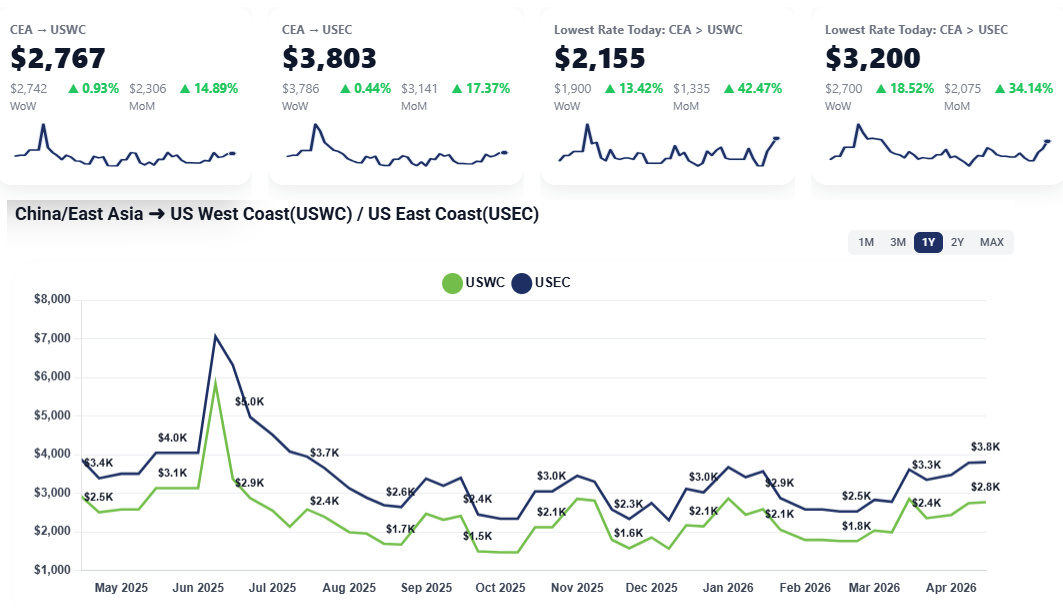
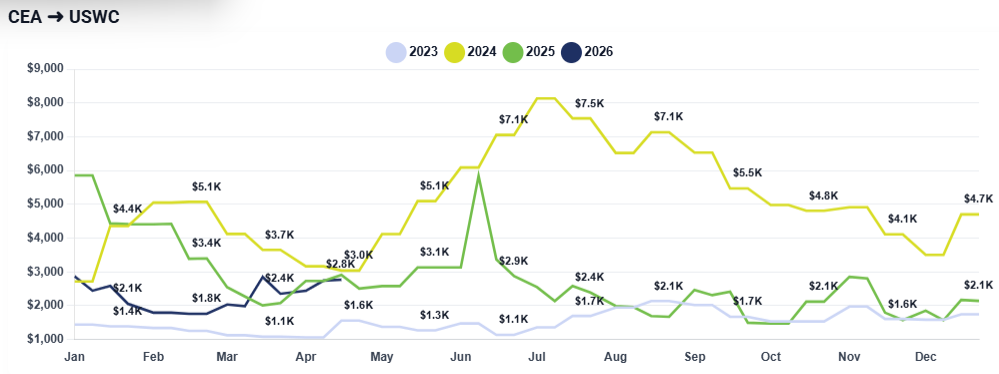
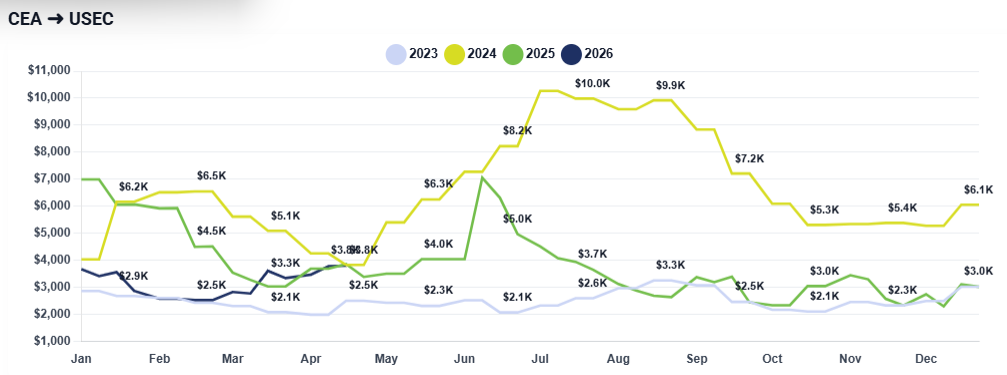
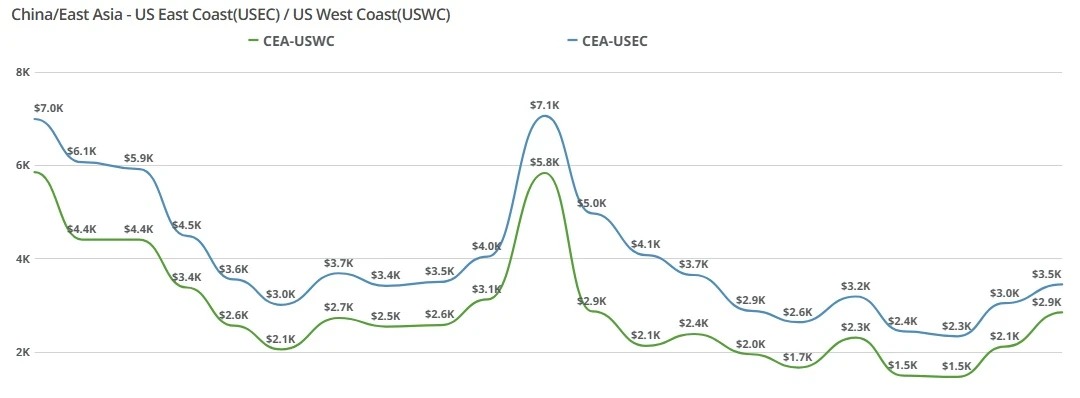
The ocean freight market has seen a period of rate stabilization following adjustments earlier in the month. As of mid-April 2026, current rates are being extended through the end of the month. Current market rates from China/East Asia (CEA) are as follows:
CEA to USWC: Rates are currently holding between $2,600 and $2,700 per container.
CEA to USEC: Rates are trending higher, ranging from $3,600 to $3,700 per container.
While these represent the standard Freight All Kinds (FAK) rates, special or blended rates have emerged from specific origins, particularly Southern China and Southeast Asia. These blended rates, often originating from fixed agent contracts, can bring costs down to approximately $2,100 - $2,200 for the West Coast, depending on the carrier and volume ratios.
Read more about the state of the ocean freight spot market with Freight Right’s TrueFreight Index.
What Happened This Past Week
Carrier-Driven Scarcity: Carriers are aggressively utilizing blank sailings to artificially tighten space and prevent rates from sliding. This has resulted in some bookings from the beginning of the month being rolled to later vessels.
Blended Rate Ratios: To maintain volumes in a market with weak organic demand, agents are mixing low-cost fixed contract rates with FAK rates. For example, a carrier may require one container at full FAK price for every four containers shipped at a discounted contract rate.
Air Freight Spillover: Due to the volatility and "messed up" state of ocean transit, importers requiring speed are pivoting to air freight, driving those rates up to $7.00 - $8.00+ per kilo.
Looking Ahead:
The market appears to be entering a phase of forced stability through the end of April. While demand remains soft, the aggressive blank sailing strategy employed by carriers suggests they are committed to defending current price floors rather than allowing a slide back to previous lows.
Expect the blended rate phenomenon to be a temporary fixture. As risk profiles increase and margins tighten, forwarders will likely have to move back toward market averages to sustain operations. For shippers, the immediate outlook suggests less price volatility but continued equipment and space challenges as carriers continue to pull ships out of circulation to manage capacity.
In the News:
Bloomberg: Global Trade Customers Ask Container Lines to Keep Digital Transition Moving
https://www.bloomberg.com/news/newsletters/2026-04-14/global-goods-trade-and-digitization?srnd=homepage-europe
New York Post: US Court of International Trade considers challenge to Trump’s 10% global tariffs
https://nypost.com/2026/04/10/us-news/us-court-of-international-trade-considers-challenge-to-trumps-10-global-tariffs/
CNBC: Trump threatens 50% tariffs on China as report suggests plans for arms shipment to Iran
https://www.cnbc.com/2026/04/13/trump-threatens-50percent-tariffs-on-china-as-report-suggests-plans-for-arms-shipment-to-iran.html
WSJ: US trade court challenges Trump's basis for 10% global tariffs
https://www.reuters.com/legal/government/us-trade-court-weighs-legality-trump-10-global-tariff-2026-04-10/
Reuters: Italy's surprise rise in exports to US masks deep fragility to tariffs
https://www.reuters.com/business/italys-surprise-rise-exports-us-masks-deep-fragility-tariffs-2026-04-14/
More News
Last-Minute Sailing Cancellations Push April Cargo into May - TFX Update wk. April 20, 2026
Carriers use aggressive blank sailings to maintain China-US rates at $2,700, while shippers withhold volume in anticipation of a May price drop. Explore the impact of fuel surcharges and booking rolls on your supply chain.
Freight Market Correction Deepens on CEA-US Routes After November GRI - TFX Update wk. November 3, 2025
China–US ocean freight rates fall as carriers discount to fill space. CEA-USWC down $400-$500; CEA-USEC near $2,800. See what’s driving the drop and what’s next.
China Holiday Rush Tightens Ocean Freight Space to the US - TFX Update wk. September 21, 2026
China to US ocean freight rates remain steady, but vessel rolls, booking cancellations, and tight pre-holiday space are creating major shipping risks ahead of China’s October shutdown.
Ocean Rates Up as Volumes Continue to Sink - TFX Update wk. March 23, 2026
Understand why ocean freight rates are climbing despite record low volumes. Our March 2026 update covers the $600 rate hikes, new emergency fuel surcharges, and how blank sailings are impacting China-to-US shipping costs.
Carriers Pivot to Weekly Rate Updates Amid Global Fuel Volatility - TFX Update wk. April 6, 2026
Ocean rates hit $2,700 as carriers implement $300 emergency fuel surcharges. Explore how geopolitical instability and weekly rate shifts are impacting China-to-US shipping lanes.

CEA-US Rates Hold Steady at Breakeven Levels - TFX Update wk. February 9, 2026
Ocean rates hold steady at $1,400-$1,600 for USWC as China’s pre-holiday shipping window closes. Explore the impact of high trucking costs and the upcoming total market shutdown.

Top 2 Reasons for eCommerce Cart Abandonment and How to Fix Them
Learn the top 2 reasons for eCommerce cart abandonment—high shipping costs and slow delivery—and discover actionable strategies to reduce lost sales and boost conversions.
Looming Tariffs and Softening Volumes Push Ocean Rates Down - TFX Update wk. July 20, 2026
Track weekly ocean freight rate trends for China to USWC and USEC. Read key insights on carrier rate adjustments, tariff updates, and shipping forecasts.
Tariff Refunds Cushion US Importers Amid Sustained Transpacific Spot Rates - TFX Update wk. August 10, 2026
China-US ocean freight rates remain stable through late August 2026, with USWC rates holding above $7,000/FEU. Discover how aggressive carrier blank sailings and importer tariff refund cushions are sustaining transpacific rate levels ahead of the Q4 holid
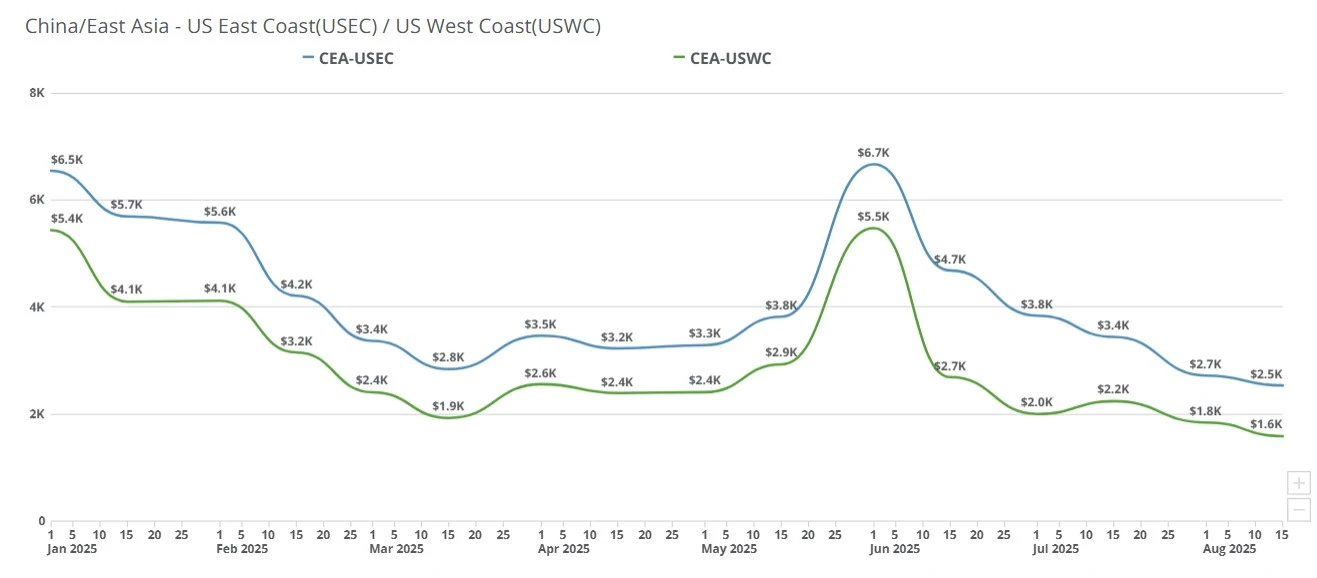
Spot Rates Dip Below 2024 Levels as Blank Sailings Ramp Up - TFX Update wk. August 18, 2025
China-US freight rates dip to $1,520/FEU as carriers cut prices and blank sailings set up a $1,000 September GRI amid weak demand and tariff risks.