- Home
- >
- News
- >
- Shippers Face a Total Standstill in Transpacific Trade - TFX Update wk. February 23, 2026
Shippers Face a Total Standstill in Transpacific Trade - TFX Update wk. February 23, 2026
The Lead:
The week was dominated by a constitutional collision in the United States that fundamentally reshaped the global trade landscape. The Supreme Court's ruling against the use of emergency powers for tariffs effectively dismantled the legal foundation of the administration's IEEPA tariff program, leading to the imminent cessation of billions of dollars in duties. However, the resulting pivot to a 15% global surcharge under Section 122, a bridge measure valid for 150 days, plunged international relations into fresh turmoil. The European Union’s decision to pause its summer trade deal with Washington underscores a growing "trust deficit," as allies and adversaries alike struggle to navigate a U.S. trade policy that has transitioned from high-stakes negotiation to a state of near-total legal and procedural volatility.
This Week’s Ocean, Air & Freight Markets
China-US Ocean Freight Market:
The Transpacific ocean freight market has remained in a state of stasis as the industry navigates the tail end of the Lunar New Year holiday. Rates have held firm at the low levels established earlier in the month, with almost no price movement recorded week-over-week due to the total shutdown of manufacturing and logistics activity in Asia.
CEA to USWC: Pricing remains stable at the current floor of $1,450 to $1,600 per container. This represents a continuation of the breakeven levels seen since early February.
CEA to USEC: Rates to the East Coast also showed no change, holding steady between $2,400 and $2,500.
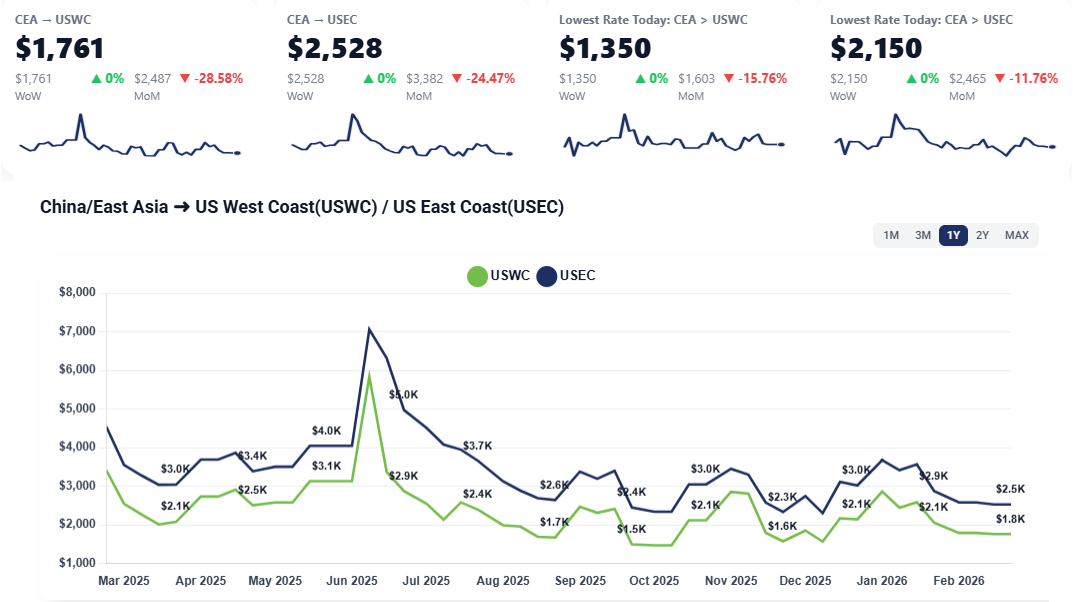
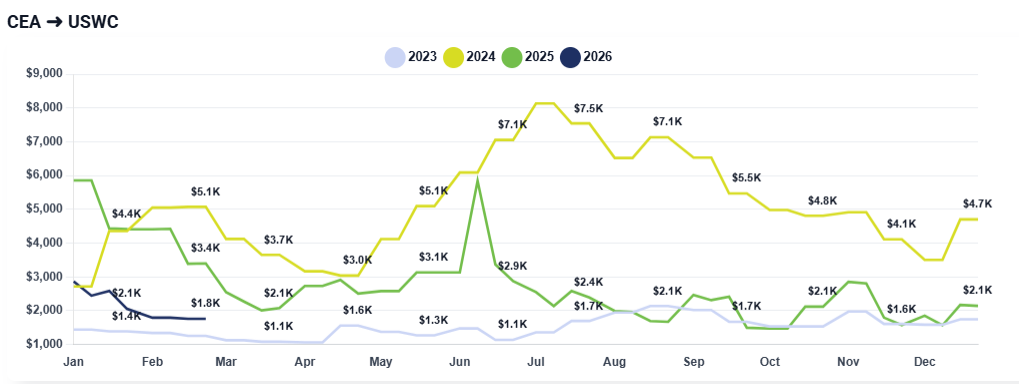
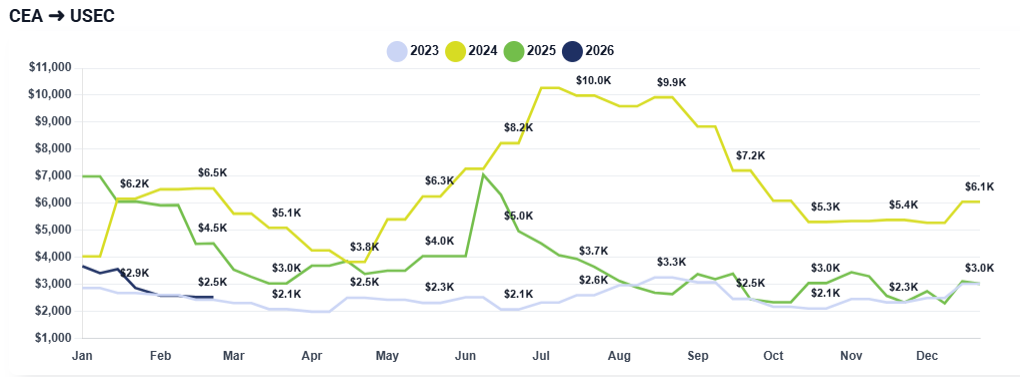
Read more about the state of the ocean freight spot market with Freight Right’s TrueFreight Index.
What Happened This Past Week:
Lunar New Year "Main Event": The market is currently experiencing the peak of the Chinese New Year holiday, which has effectively halted all new bookings and shipping operations in China and Southeast Asia.
Operational Dormancy: Most market participants in Asia are currently away for the holiday, leading to a complete lack of interest in new business or shipping schedules.
Pre-Holiday Volume Exhaustion: The rush to ship cargo before the shutdown concluded last week, leaving behind very little in terms of current cargo movement.
Air Freight Stability: Similar to the ocean sector, air freight has seen no major spikes this week, with rates settling in the high $3.00 to mid-$4.00 range per kilogram as airlines handle the final bits of pre-holiday cargo.
Trucking Rate Normalization: Following the high trucking rates at origin last week across China, internal logistics costs in China have leveled off as the workforce has largely transitioned into the holiday period.
Looking Ahead:
The immediate outlook remains exceptionally quiet, with next week expected to be even shorter in terms of market updates as the holiday concludes. The market is effectively on autopilot until the end of the month.
The industry is now focused on the post-holiday recovery in March. Shippers should anticipate a period of catch up as factories reopen, though the strength of this recovery will depend on whether carriers can find ways to push rates above current breakeven levels. A key milestone to watch will be the release of new contract rates toward the end of March, which will signal whether carriers intend to maintain these low levels or implement aggressive capacity management to force a market correction.
In the News:
Reuters: New US tariffs come in at lower 10% rate
https://www.reuters.com/business/new-us-tariffs-come-lower-10-rate-2026-02-24/
BBC: Trump tariffs ripped up global trade order. What now
https://www.bbc.com/news/articles/cvgvn810njpo
CNBC: Supreme Court ruling throws Trump administration’s tariff strategy into flux. What it means for global trade, U.S. economy
https://www.cnbc.com/2026/02/23/what-supreme-court-tariff-ruling-means-for-global-trade-us-economy.html
Reuters: China says it will decide on US tariff countermeasures in due course
https://www.reuters.com/world/asia-pacific/china-urges-us-drop-new-tariffs-willing-have-new-round-trade-talks-2026-02-24/
NBC: E.U. hits the brakes on U.S. trade deal after Trump threatens 15% global tariffs
https://www.nbcnews.com/business/economy/europe-halts-trade-deal-trump-tariffs-rcna260231
More News

Silence Before the Storm: Transpacific Market Braces for Chinese New Year Shutdown - TFX Update wk. January 26, 2026
Ocean freight rates from China to the US hit new lows as Chinese New Year approaches. With USWC rates falling to $1,600 and carriers selling space at cost, discover what's driving the market downturn and the outlook for February 2026

CEA-US Rates Hold Steady at Breakeven Levels - TFX Update wk. February 9, 2026
Ocean rates hold steady at $1,400-$1,600 for USWC as China’s pre-holiday shipping window closes. Explore the impact of high trucking costs and the upcoming total market shutdown.

Transpacific Carriers Face Losses as Feb Bookings Close - TFX Update wk. February 2, 2026
Ocean freight rates from China to USWC have hit a breakeven low of $1,450 per container. As the Chinese New Year halts Asian manufacturing, explore why rates are falling, the impact of late-week bookings, and the outlook for March contract negotiation.
Ocean Rates Up as Volumes Continue to Sink - TFX Update wk. March 23, 2026
Understand why ocean freight rates are climbing despite record low volumes. Our March 2026 update covers the $600 rate hikes, new emergency fuel surcharges, and how blank sailings are impacting China-to-US shipping costs.
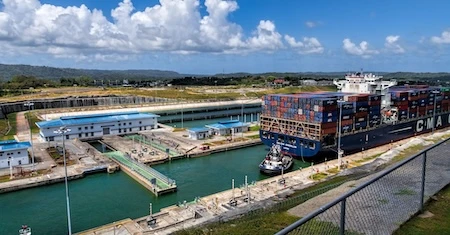
2023 Panama Canal Drought: What Small & Medium-Sized Shippers Need To Know
The Panama canal is experiencing lower water levels as a result of a drought exacerbated by El Nino. The results of this drought have implications for all sizes of shippers around the world but particularly for small to medium sized shippers that are in a
Ocean Rates Hold Firm as China Factories Reopen - TFX Update wk. March 2, 2026
Ocean rates hold at $1,450-$1,500 for USWC as Chinese factories reopen. Explore why the post-holiday rate crash didn't happen and what to expect for the March recovery.
How Chinese Tariffs Affect Your Freight and Logistics
We examine how US-China trade tariffs have affected freight and logistics around the world.

Tariff Fears and Tepid Demand: Why the Transpacific "Mini-Peak" Never Arrived - TFX Update wk. January 19, 2026
Ocean freight rates fall as carriers abandon GRIs due to weak demand and tariff uncertainty. USWC rates hit $1,700–$1,800 as the expected pre-Chinese New Year volume surge fails to arrive.

Shippers Continue to Confront Higher Costs While Freight Forwarders Face Fierce Competition - TFX Update wk. September 8, 2025
Last week's transpacific GRI slowly comes down as carriers test market resilience ahead of Golden Week.
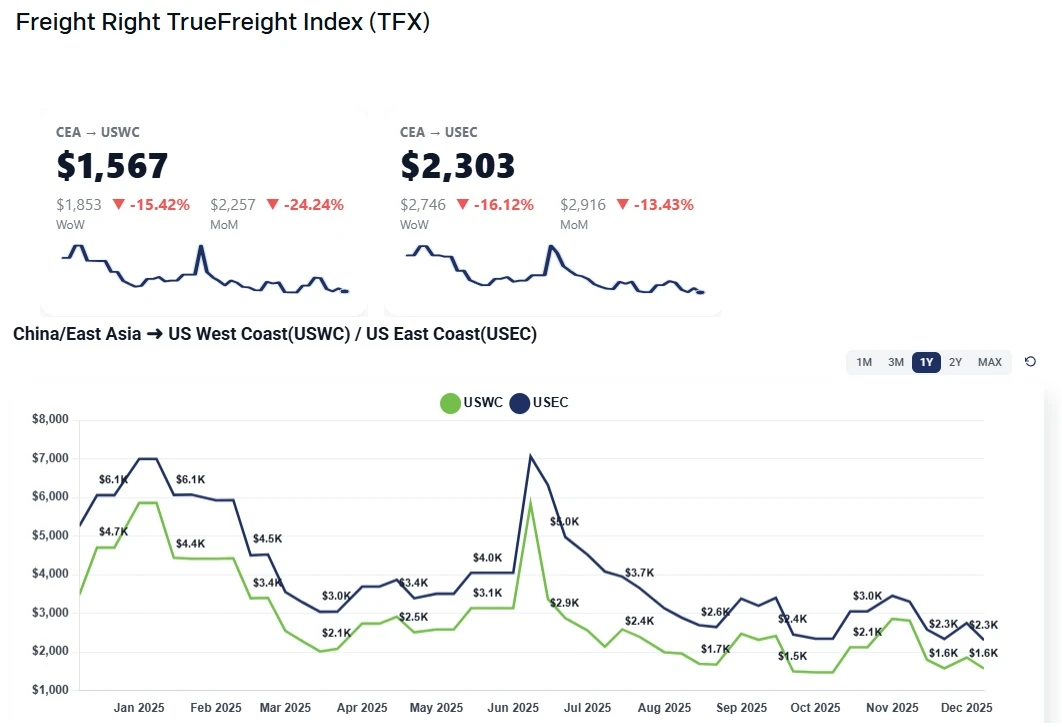
China–US Spot Market Stabilizes After November Plunge, But Gains Remain Fragile - TFX Update wk. December 8, 2025
Small December GRIs lift China–USWC and China–USEC rates slightly, but overcapacity, soft demand, and tariff uncertainty continue to cap meaningful recovery. Outlook steady through Chinese New Year with brief January strength.