- Home
- >
- News
- >
- Carriers Hold Firm on Fuel Surcharges Despite Emerging US-Iran Peace Plans - TFX Update wk. June 15, 2026
Carriers Hold Firm on Fuel Surcharges Despite Emerging US-Iran Peace Plans - TFX Update wk. June 15, 2026
The Lead:
The mid-point of June 2026 demonstrated that the world is moving away from broad, sweeping border surcharges toward highly targeted, regulatory trade walls. The United States actively advanced its strategy to replace expiring emergency surcharges with permanent Section 301 labor tariffs, while successfully utilizing massive Section 232 pharmaceutical duties to force international drug manufacturers into onshoring commitments. Simultaneously, the European Union acted to protect its internal market on two fronts: by closing the de minimis loophole with a new €3 flat fee on low-value online imports, and by advancing the Turnberry trade deal to secure lasting tariff peace with Washington. Ultimately, the week proved that the global economy is functioning within a highly legalistic centralized trade architecture in the West, where access to prime consumer markets requires meeting strict labor, safety, and supply-chain origin mandates.
This Week’s Ocean, Air & Freight Markets
China-US Ocean Freight Market:
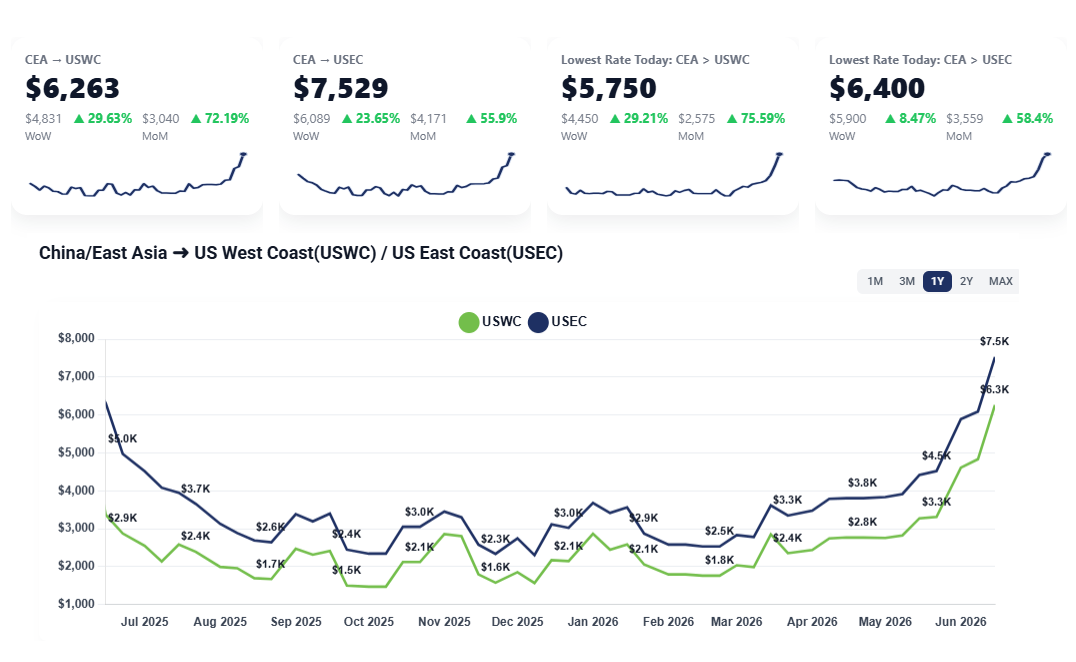
The transpacific ocean freight market has officially entered a higher pricing bracket, confirming the expiration of $6,000 spot rates. Over the past week, ocean freight rates from China to both North American coasts experienced a steep climb, driven by heavy volume increases in the first half of June.
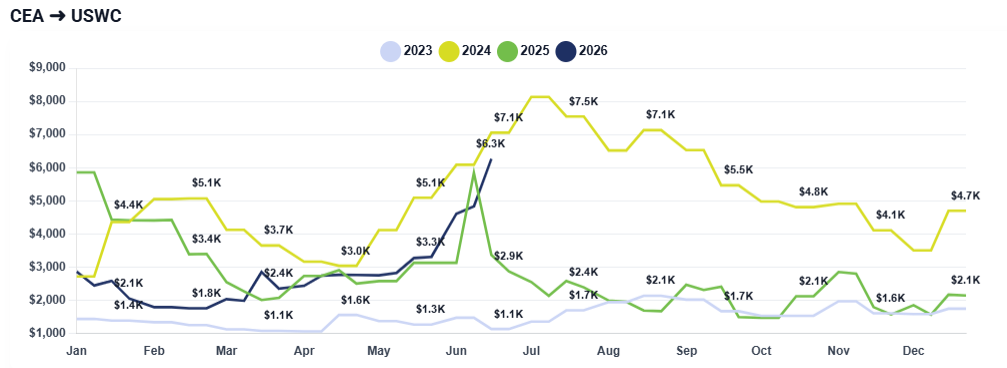
CEA to USWC: Spot rates have broken past previous thresholds and are now officially confirmed in the low $6,000s per FEU.
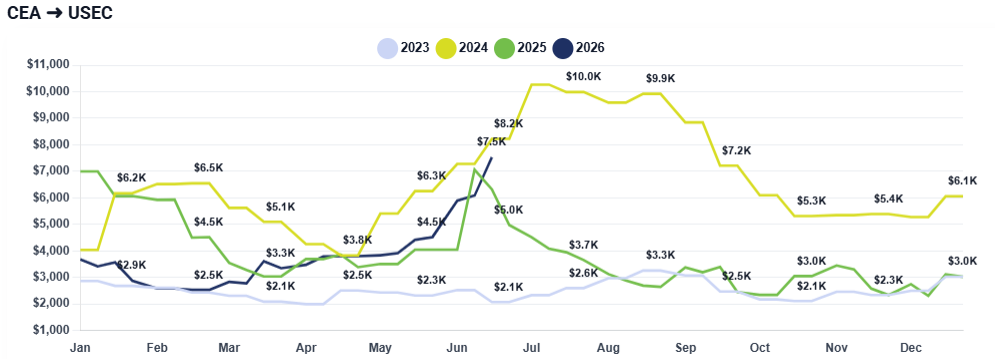
CEA to USEC: Rates to the East Coast have pushed even higher, settling firmly into the mid-$7000s per FEU.
For comparison, Gulf Coast rates are mirroring the East Coast in the mid-$7,000s, while inland moves to the Midwest (e.g., Chicago) have reached $8,000 to $8,400.
Freight Right’s Lowest Rate indicators are finding that importers can find spot rates as low as $5,750 from China to US West Coast and $6,400 from China to US East Coast. Talk to your freight forwarder about options available to you.
Read more about the state of the ocean freight spot market with Freight Right’s TrueFreight Index.
What Happened This Past Week
Peak Season Front-Loading: Carriers reported a significant spike in cargo volumes during the first half of June. This surge is largely attributed to shippers front-loading their inventory early to avoid peak-season bottlenecks, which directly triggered carrier GRI implementations for the second half of the month.
Port Congestion & Rolled Cargo: Ongoing backlog from previous weeks continues to choke the network. This legacy congestion has triggered heavy rolling of bookings, severely degrading schedule reliability.
Strict Dynamic Quoting: Due to the daily volatility in space availability, standard quotes are no longer guaranteed. Logistics providers are forcing a subject to roll and availability clause, as space secured one day is often entirely gone by the next.
Looking Ahead:
The immediate outlook points to sustained upward pressure and prolonged volatility. Shippers should abandon expectations for a quick rate correction; carriers have just successfully pushed rates into the $6,000–$7,000+ range and will be highly resistant to lowering them, likely citing ongoing market uncertainty to justify keeping current fuel surcharges and base rates intact.
Furthermore, because booking backlogs are already stretching lead times out significantly, with some agents quoting the beginning of July as the earliest available space, shippers must plan and book several weeks in advance to secure equipment and vessel space. Even if the geopolitical situation in the Middle East stabilizes and a formal peace deal is signed by the end of the week, the lag in carrier operational adjustments means the earliest the market would see any tangible impact or relief on fuel surcharges would be late next week or early July.
In the News:
WSJ: The Global Economy Is Threatened Again by Trade Imbalances
https://www.wsj.com/economy/global/the-global-economy-is-threatened-again-by-trade-imbalances-b996bc00
NY Post: Trump warns France in exclusive interview with The Post: Kill tech tax or face 100% wine tariffs: ‘I have no choice’
https://nypost.com/2026/06/15/business/trump-warns-france-in-exclusive-interview-with-the-post-kill-tech-tax-or-face-100-wine-tariffs/
The Guardian: Me, worry? For US small businesses, Trump’s tariffs are now a non-issue
https://www.theguardian.com/business/2026/jun/14/small-business-trump-tariffs
Reuters: Macron maintains France will not bend to Trump over digital tax
https://www.reuters.com/business/trump-warns-france-kill-tech-tax-or-face-100-wine-tariffs-ny-post-reports-2026-06-15/
The Economist: A trade war between the EU and China seems inevitable
https://www.economist.com/europe/2026/06/11/a-trade-war-between-the-eu-and-china-seems-inevitable
More News
Late-June Front-Loading Exacerbates Severe Transpacific Space Crunch
Late-June front-loading has triggered a severe transpacific space crunch. Discover how carrier rate hikes are driving ocean freight costs to new heights as shippers scramble for limited vessel capacity.

Importers Race Against July Tariff Deadlines, Throwing Supply Chains Into Chaos - TFX Update wk. June 8, 2026
Ocean freight rates skyrocket past $6,000 to USWC and $7,000 to USEC. Discover how carrier blank sailings, space deficits, and tariff front-loading are driving this early peak season crunch.

China-US Ocean Rates Hold Steady at $3K/$4K Baseline Ahead of Threatened June Spikes - TFX Update wk. May 25, 2026
Ocean freight rates hold steady, but massive June GRIs loom. Discover how carrier blank sailings and terminal capacity constraints are driving up transpacific shipping costs.
Space Tightens on China-US Routes Despite Weak Underlying Volume - TFX Update wk. April 13, 2026
Explore how aggressive blank sailings and new blended rate strategies are stabilizing CEA to USWC/USEC shipping costs despite weak demand. Stay informed on current ocean freight market updates and rate changes.
Carriers Pivot to Weekly Rate Updates Amid Global Fuel Volatility - TFX Update wk. April 6, 2026
Ocean rates hit $2,700 as carriers implement $300 emergency fuel surcharges. Explore how geopolitical instability and weekly rate shifts are impacting China-to-US shipping lanes.
Ocean Freight Rates Double Since March as Carriers Aggressively Squeeze Capacity - TFX Update wk. May 18, 2026
Ocean freight rates double for USWC and USEC as carrier capacity cuts trigger severe space shortages and rolled cargo. Read the latest weekly freight market update on rising spot rates, premium expedited shipping surges, and the June GRI outlook.
Ocean Rates Up as Volumes Continue to Sink - TFX Update wk. March 23, 2026
Understand why ocean freight rates are climbing despite record low volumes. Our March 2026 update covers the $600 rate hikes, new emergency fuel surcharges, and how blank sailings are impacting China-to-US shipping costs.

Transpacific Ocean Freight Rates Hold High as Peak Season Nears Early Close - TFX Update wk. September 7, 2026
China to US ocean freight rates remain elevated in September, with USWC rates near $7,000 and USEC rates at $8,000–$9,000 amid strong demand, tight space and vessel delays.

Silence Before the Storm: Transpacific Market Braces for Chinese New Year Shutdown - TFX Update wk. January 26, 2026
Ocean freight rates from China to the US hit new lows as Chinese New Year approaches. With USWC rates falling to $1,600 and carriers selling space at cost, discover what's driving the market downturn and the outlook for February 2026
Ocean Freight Market Enters Holding Pattern Ahead of September - TFX Update wk. August 17, 2026
China-US ocean freight rates remain elevated in mid-August, with West Coast discounts emerging while East Coast pricing stays firm. See what carrier capacity cuts, blank sailings and demand trends could mean for September.