- Home
- >
- News
- >
- Transpacific Ocean Freight Rates Hold High as Peak Season Nears Early Close - TFX Update wk. September 7, 2026
Transpacific Ocean Freight Rates Hold High as Peak Season Nears Early Close - TFX Update wk. September 7, 2026
The Lead:
The first week of September 2026 marked the final countdown to a full-scale trade war between the US and Canada. As Canadian importers prepared for the 12:01 a.m. activation of matching 15% to 50% counter-tariffs on $27.6 billion of American goods by September 8, global trade trackers confirmed that new US policies now cover 54% of all American goods imports.
This broad expansion of the centralized trade architecture has pushed the US applied tariff rate to a historical high of 11.7%. As physical supply chains across the continent brace for severe cost shocks, international organizations report that global commerce is rapidly shifting toward digitally deliverable services and regional safe harbors to bypass border friction.
This Week’s Ocean, Air & Freight Markets
China-US Ocean Freight Market:
CEA to USWC: Rates are averaging around $7,000 per container, remaining broadly stable week over week. While some carriers are advertising rates closer to $6,000, these offers come with extremely limited space and are not representative of the broader market.
CEA to USEC: Rates remain substantially higher at approximately $8,000–$9,000 per container. East Coast capacity is particularly tight, making space difficult to secure even when lower promotional rates appear in the market.
Overall, demand remains strong and carriers have been able to maintain September pricing without significant movement. The current market increasingly looks like an extended peak season that began earlier than usual this year and could leave ocean rates elevated through the end of September.
Freight Right’s Lowest Rate indicators are finding that importers can find spot rates as low as $4,930 from China to US West Coast and $7,800 from China to US East Coast. Talk to your freight forwarder about options available to you.
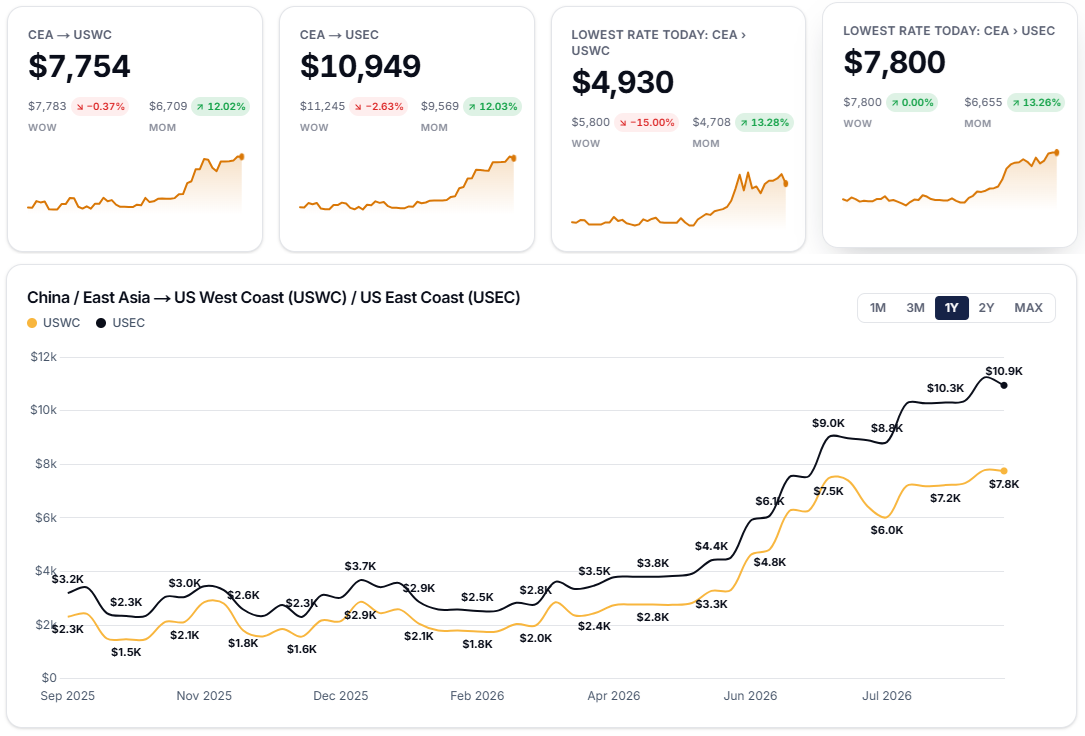
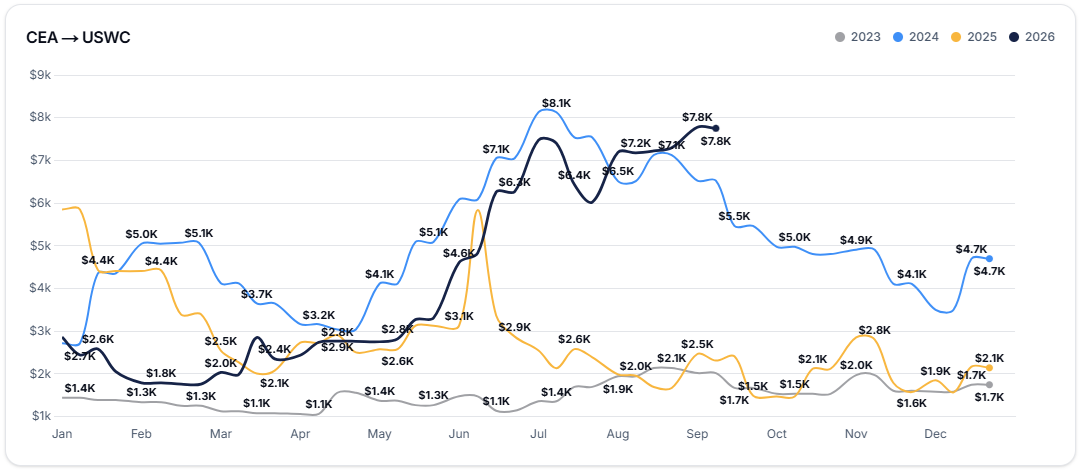
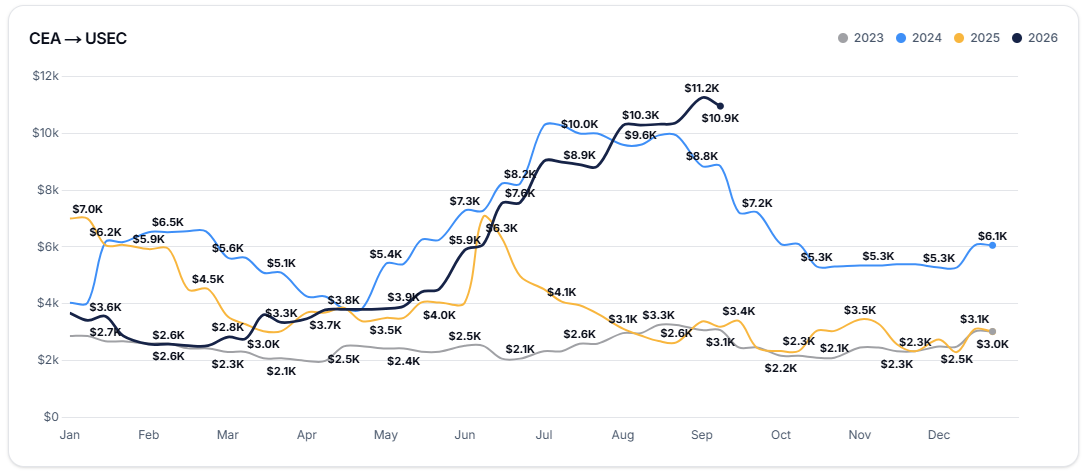
Read more about the state of the ocean freight spot market with Freight Right’s TrueFreight Index.
What Happened This Past Week
Demand remains strong. Cargo volumes have been sufficient to support current pricing, limiting the downward pressure that would normally emerge as peak-season shipments begin to clear.
Peak season arrived early. This year's elevated shipping cycle started around late May and June, roughly a month earlier than a more traditional peak-season pattern, but strength has persisted into September.
East Coast space remains tight. Capacity to the USEC is particularly difficult to secure, helping keep rates in the $8,000–$9,000 range..
Typhoons continue to disrupt vessel schedules. Recent storms affecting China have not been as severe as earlier weather events, but schedule volatility remains high. Delays at one port can carry forward across subsequent calls, while weather-related port omissions add further uncertainty.
Holiday inventory deadlines are approaching. Importers selling through Amazon, Walmart, Target and other retail channels are reaching the point where ocean shipments must depart to arrive in time for Black Friday and the holiday season.
Looking Ahead:
Ocean freight rates appear likely to remain elevated through the rest of September, rather than seeing a meaningful near-term correction. Current demand, tight East Coast space and continuing vessel schedule disruptions all support a relatively firm market.
The more important turning point could arrive around late September to early October. By then, most inventory intended for Black Friday and the holiday season will need to have already moved by ocean. Cargo that misses that window increasingly shifts toward air freight as importers look for faster transportation to meet retail deadlines.
That suggests ocean demand could begin easing in October, with the traditional peak season effectively winding down. However, this year's market may close the peak period at unusually high levels, around $7,000 to the West Coast and $8,000–$9,000 to the East Coast based on the current outlook. After that, the next significant ocean freight demand increase may not emerge until the pre-Chinese New Year shipping cycle in January.
Some carriers are offering rates well below the broader market, but those prices often come with very limited space. An importer may find an attractive rate for a lane but only be able to secure a fraction of the capacity they actually need. For example, space for one container when ten need to move.
Importers should treat unusually low rates cautiously and confirm available capacity before planning shipments around them. In a tight market, the lowest quoted rate may not be a realistic option for moving freight at scale.
China-US Air Freight Market:
CEA to USWC: rates remained steady, with LAX showing little week-over-week movement. Current LAX options generally range from roughly $4.46/kg to $6.62/kg, depending on carrier, routing, density, shipment size, and handling requirements.
CEA to USEC: rates softened slightly, led by a modest decline into the JFK area. Current JFK options generally sit around $6.26/kg to $7.69/kg for the primary services shown in this week's rate sheet. ORD rates, meanwhile, remained stable week over week.
What Happened This Past Week
JFK rates eased slightly: Capacity and demand remain sufficiently balanced on China-to-JFK services, allowing rates to move modestly lower this week.
LAX remains stable: China-to-LAX pricing showed little week-over-week movement, indicating that available capacity is still keeping pace with current West Coast demand.
ORD is holding steady: Rates into the Chicago market were largely unchanged, with no significant capacity or demand shock pushing pricing materially higher or lower.
Golden Week is getting closer: China's October holiday is beginning to influence shipping plans. Importers and exporters typically accelerate cargo movements before factories and logistics operations slow for the holiday.
Pre-holiday demand is expected to build: As more shippers compete to move freight before the shutdown period, available air capacity could tighten and give carriers greater pricing power.
Looking Ahead:
The current stability in China-to-US air freight rates is unlikely to last through the remainder of September. With Golden Week approaching, shippers are expected to increasingly pull shipments forward to avoid holiday-related production and logistics delays.
That should create progressively stronger air freight demand over the next several weeks, particularly as the market moves deeper into September. Rates to LAX, JFK, ORD and other major US gateways could therefore begin climbing week by week as available capacity tightens.
Importers with time-sensitive cargo should consider securing space earlier rather than relying on today's relatively stable pricing to remain available closer to the holiday.
In the News:
NY Times: Canada’s Retaliatory Tariffs Set to Take Effect as Trump Threatens to Escalate
https://www.nytimes.com/2026/09/07/world/canada/tariffs-trade-war-carney-trump.html
Reuters: Canada ready for US trade deal that benefits both countries, Carney says
https://www.reuters.com/world/canada-ready-us-trade-deal-that-benefits-both-countries-carney-says-2026-09-03/
ABC News: US tariff on Canadian imports could send hockey gear prices even higher
https://abcnews.com/Business/wireStory/us-tariff-canadian-imports-send-soaring-hockey-gear-136249934
Financial Times: How Canadian companies are navigating Trump’s tariffs
https://www.ft.com/content/99df992e-0c74-41da-a65a-edd895ebc2c3?syn-25a6b1a6=1
Bloomberg: Canada Hits Back With New US Tariffs
https://www.bloomberg.com/news/videos/2026-09-06/canada-hits-back-with-new-us-tariffs-video
More News
Ocean Freight Rates Hold Firm as Carriers Defend Pricing Into 2026 Contract Season - TFX Update wk. December 29, 2025
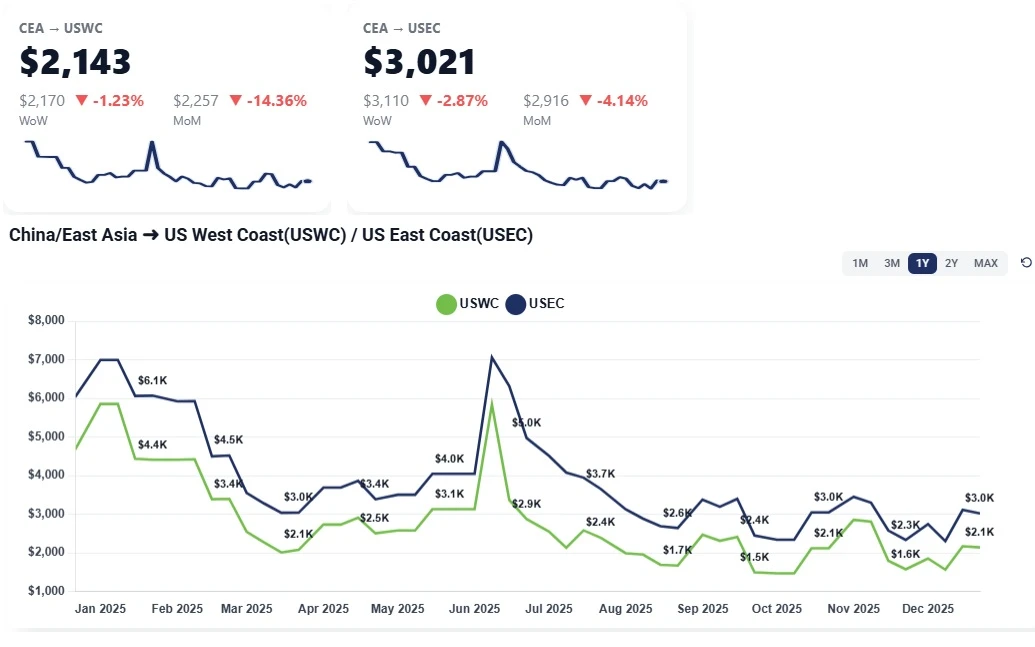
Transpacific ocean freight rates from China to the US West and East Coasts remained elevated week over week as carriers held firm through the holiday slowdown, positioning pricing ahead of Chinese New Year and upcoming contract season negotiations.

Importers Race Against July Tariff Deadlines, Throwing Supply Chains Into Chaos - TFX Update wk. June 8, 2026
Ocean freight rates skyrocket past $6,000 to USWC and $7,000 to USEC. Discover how carrier blank sailings, space deficits, and tariff front-loading are driving this early peak season crunch.
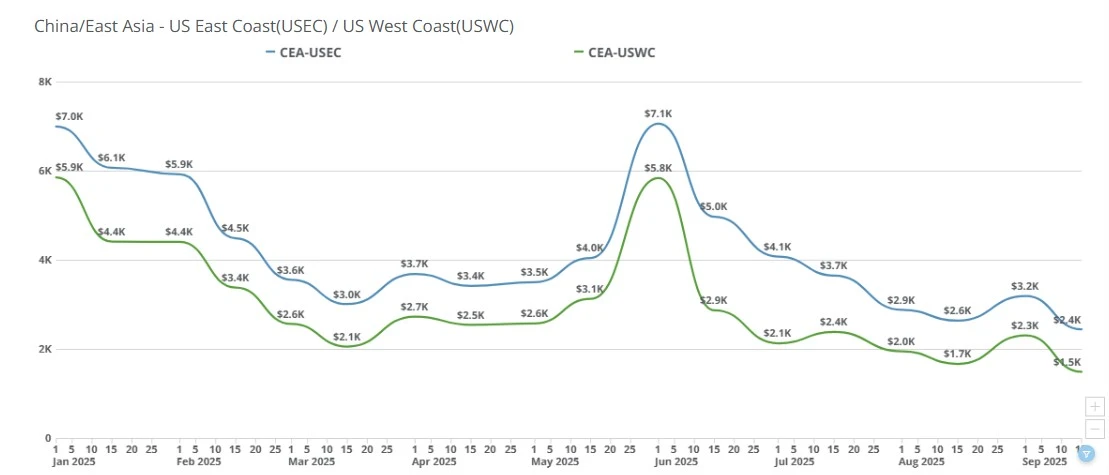
Spot Prices Ease on CEA to USWC, CEA to USEC; Forwarders Cut Margins to Win Cargo - TFX Update wk. September 22, 2025
China–US ocean spot rates eased WoW as early-September GRIs faded. USWC nears trough, USEC softens, and fierce forwarder pricing persists ahead of Golden Week.
China-US Ocean Rates Hold Steady as Post-Holiday Space Tightens - TFX Update wk. October 12, 2026
China to US ocean freight rates remain steady, but vessel rolls, booking cancellations, and tight pre-holiday space are creating major shipping risks ahead of China’s October shutdown.
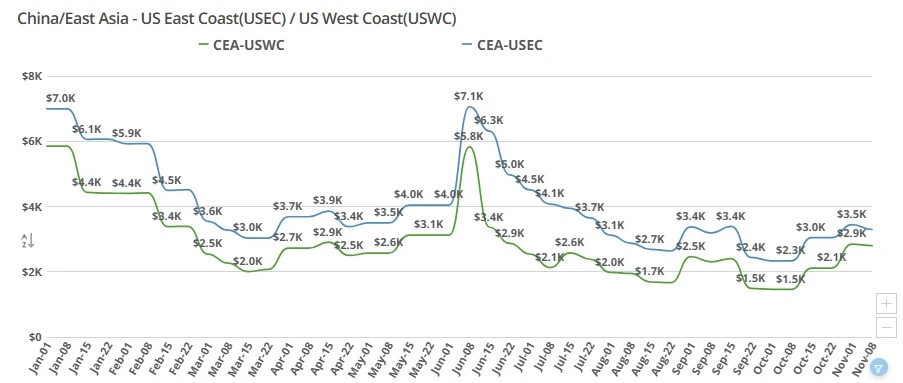
China-US Ocean Rates Ease Again as Post-Peak Lull Deepens - TFX Update wk. November 10, 2025
Transpacific ocean freight rates continue to decline as post-peak demand cools. China–US West Coast rates near $1,700, East Coast around $2,600 per FEU.

China Holiday Rush Tightens Ocean Freight Space to the US - TFX Update wk. September 21, 2026
China to US ocean freight rates remain steady, but vessel rolls, booking cancellations, and tight pre-holiday space are creating major shipping risks ahead of China’s October shutdown.
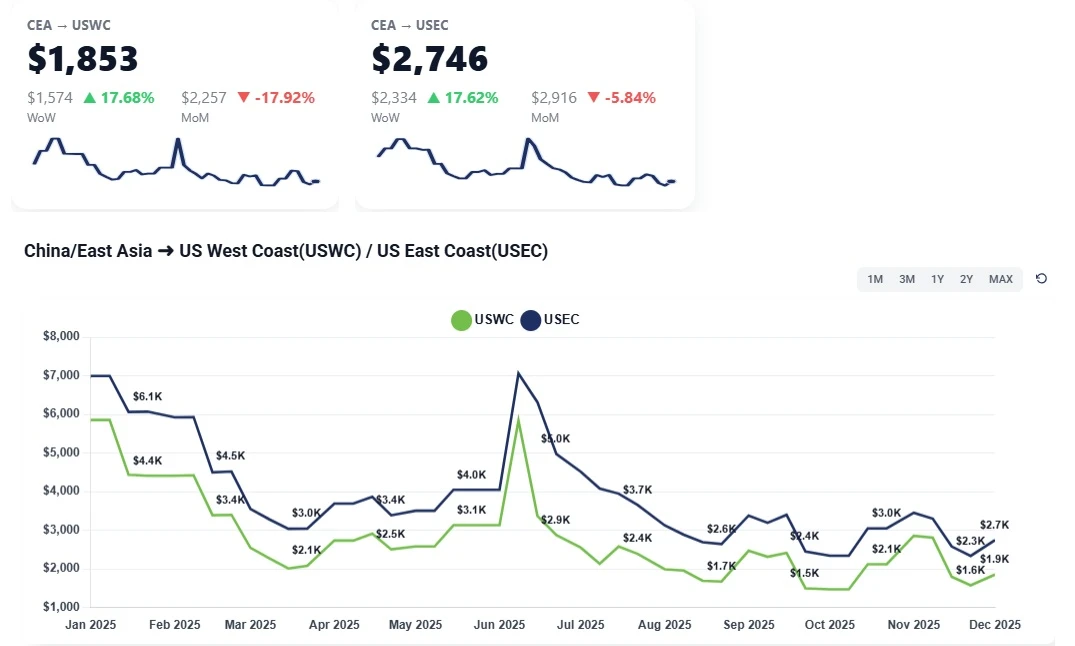
China–US West and East Coast Rates Hold Flat After Short-Lived December Rate Spike - TFX Update wk. December 1, 2025
Weekly ocean freight update on China–US West and East Coast lanes as an early December GRI fades, leaving spot rates near November levels amid weak demand.
Transpacific Rates Pop Again: Carriers Push Mid-December Increases Into January - TFX Update wk. December 15, 2025
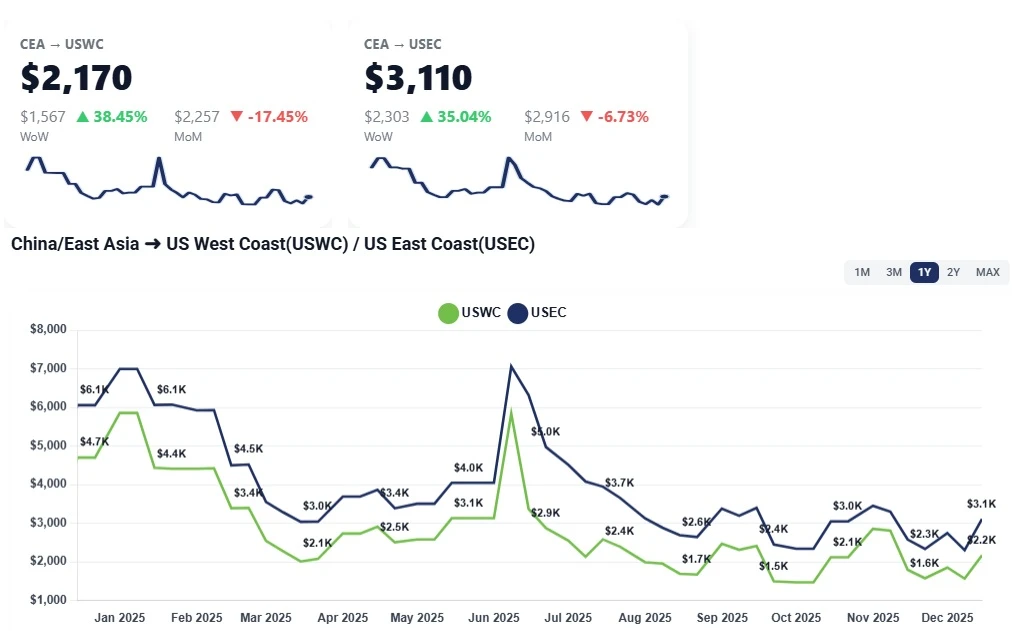
China–US ocean freight rates rose WoW: USWC near $2.1K/FEU and USEC near $2.9–$3.0K as carriers end fixed extensions and hold firm into January.
Ocean Freight Contract Season: Winners, Losers, and the Illusion of Stability
A look into the volatile freight contract season, exploring broken promises, rate surges, and solutions for sustainable agreements through strategic contracting and innovative market practices.

Ocean Freight Rates Hold Firm as Carriers Keep Capacity Tight - TFX Update wk. August 24, 2026
China to US ocean freight rates remain firm as West Coast rates rebound 9% and East Coast rates rise 3%. See what’s driving the market and the outlook for September.