- Home
- >
- News
- >
- Ocean Freight Market Enters Holding Pattern Ahead of September - TFX Update wk. August 17, 2026
Ocean Freight Market Enters Holding Pattern Ahead of September - TFX Update wk. August 17, 2026
The Lead:
So far, mid August has demonstrated that Washington is continuing to solidify a centralized trade architecture by extending national security protections to high-tech sectors, issuing a Presidential Proclamation under Section 232 imposing 15% to 100% tariffs on foreign drones and components.
Simultaneously, a landmark federal decision by the US Court of International Trade upheld the administration's suspension of the $800 de minimis exemption, permanently altering crossborder ecommerce by subjecting low-value parcels to formal customs entries.
As macro-economic data revealed that the US weighted-average statutory tariff rate settled at 11.0%, North American trade faced heightened friction, prompting Canadian and US officials to hold emergency weekend negotiations in Washington to head off a pending 50% Section 338 tariff deadline on Canadian goods.
This Week’s Ocean, Air & Freight Markets
China-US Ocean Freight Market:
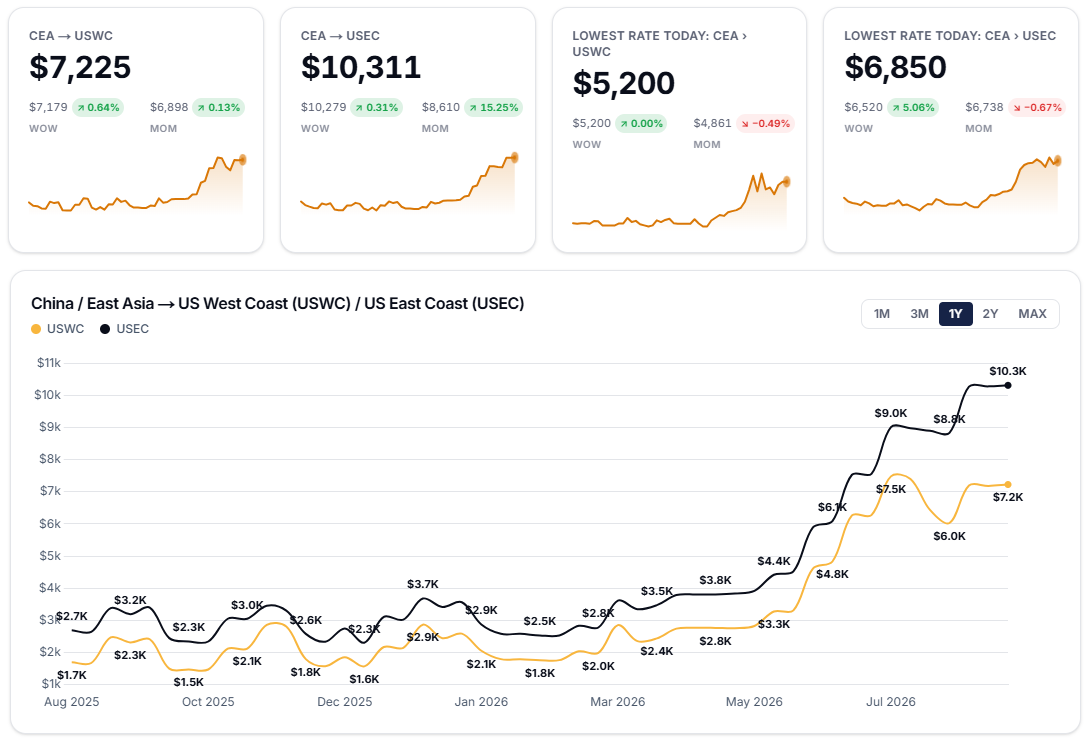
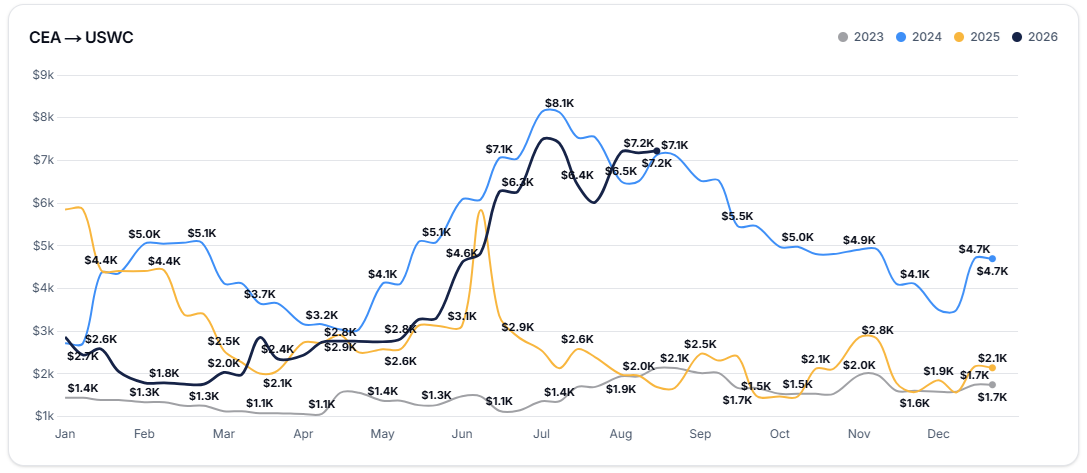
CEA to USWC: Market rates are hovering around $7,000 to $7,500 per FEU. However, promotional rates are available, bringing actual usable market levels down to roughly $5,700–$6,300 per container. Overall, rates for the West Coast remain stable to slightly softer due to these discounted options.
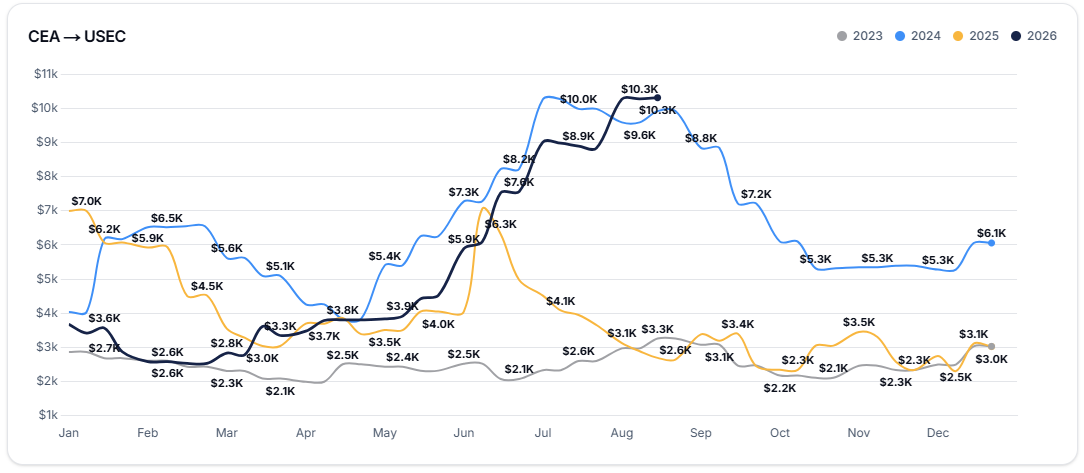
CEA to USEC: Market rates sit firmly between $9,800 and $11,000 per FEU. Unlike the West Coast, virtually no promotional or discounted rates are accessible for East Coast, Gulf Coast, or inland destinations, forcing shippers to book near full market price.
Freight Right’s Lowest Rate indicators are finding that importers can find spot rates as low as $5,200 from China to US West Coast and $6,850 from China to US East Coast. Talk to your freight forwarder about options available to you.
Read more about the state of the ocean freight spot market with Freight Right’s TrueFreight Index.
What Happened This Past Week
Carrier Capacity Management: Ocean carriers are aggressively managing capacity by pulling approximately 20% of capacity out of the market through blank sailings. This strict supply control prevents spot rates from dropping significantly.
Bundled Volume Promotional Rates: Discounted West Coast rates ($5,700–$6,000) come with carrier contingencies. Shippers must commit to volume bundles (e.g., 1:1 or 2:1 ratios), where booking multiple containers at full market rates unlocks a single discounted slot, driving down the average per-unit cost.
Tariff Absorption & Market Fatigue: The recent 2.5% tariff increase introduced three weeks ago has caused minimal demand disruption. Shippers have largely absorbed the minor cost differential, leading to a stabilization period rather than panic-booking or severe pullbacks.
Early Peak Season Elongation: Ocean carriers are intentionally maintaining high rate floors to stretch out profitability during an early peak season that began in June and is expected to run through October.
Looking Ahead:
The market is currently in a brief late-August lull, but rate floors are expected to remain solid. Carrier capacity cuts should successfully prevent a major rate collapse, ensuring spot rates stay near elevated levels through the end of the month.
Heading into September, minor downward adjustments of a few hundred dollars may occur if overall volumes drop slightly, but no drastic rate cuts are anticipated. Carriers will continue using blank sailings as a lever to preserve high rate baselines.
China-US Air Freight Market:
CEA to USWC: rates eased toward the end of last week after a short-lived increase early in the week. Typhoon Dolphin disrupted flight schedules and temporarily tightened available capacity, pushing rates higher as cargo backlogs accumulated. Once schedules normalized and the backlog cleared, softer underlying demand allowed pricing to retreat.
Current week quotes into LAX and SFO generally sit around $5.00–$6.30/kg for standard-density cargo, depending on origin, carrier, routing, and shipment configuration..
CEA to USEC: Rates followed a similar pattern. Temporary capacity disruption from Typhoon Dolphin created upward pressure early last week, but rates softened later as delayed cargo moved through the network and demand moderated.
Pricing in JFK is generally around $6.25–$7.65/kg for standard-density cargo, with carrier and routing choices accounting for much of the spread. Overall, the market has moved back toward more stable conditions following last week's weather-driven volatility.
What Happened This Past Week
Typhoon created temporary capacity pressure: Flight schedule disruptions at the beginning of last week reduced available uplift and caused cargo to accumulate, briefly pushing air freight rates higher.
The increase was operational rather than demand-driven: Last week's rate spike appears to have been primarily caused by temporary flight disruptions rather than a fundamental increase in cargo volumes. That distinction is important because rates normalized quickly once capacity returned.
Carrier capacity is currently better aligned with demand: With flight schedules stabilizing and no significant backlog remaining, available capacity appears sufficient for current shipment volumes, limiting the likelihood of another immediate rate increase.
Looking Ahead:
Air freight rates from China to the US are expected to remain relatively stable this week as the market has absorbed the disruption caused by Typhoon Dolphin and backlogs have been cleared. Softer demand should limit carriers’ ability to push through meaningful rate increases, keeping both West and East Coast pricing within a narrow range. Barring new weather events or capacity disruptions, any upward pressure would need to come from sustained demand growth rather than short-term operational issues.
In the News:
ABC News: Government fights trade judge’s order for tariff refunds to all importers
https://abcnews.com/Business/wireStory/government-fights-trade-judges-order-tariff-refunds-importers-135550378
CBS: Most global trade flows through these 27 chokepoints. The economic risks are rising.
https://www.cbsnews.com/news/strait-of-hormuz-shipping-chokepoints-global-trade/
Bloomberg: US, Canada Barrel Toward 50% Tariff as Trump Deadline Approaches
https://www.bloomberg.com/news/articles/2026-08-18/us-canada-barrel-toward-50-tariff-as-trump-deadline-approaches
Financial Times: War and climate change drive surge in global shipping costs
https://www.ft.com/content/2fb7f9b7-58dc-4909-94fa-8e753b7be47d?syn-25a6b1a6=1
BBC: US says dozens of countries helped China dodge Trump's tariffs
https://www.bbc.com/news/articles/c78gy6ep3n5o
More News
Ocean Freight Rates Hold Firm as Carriers Defend Pricing Into 2026 Contract Season - TFX Update wk. December 29, 2025
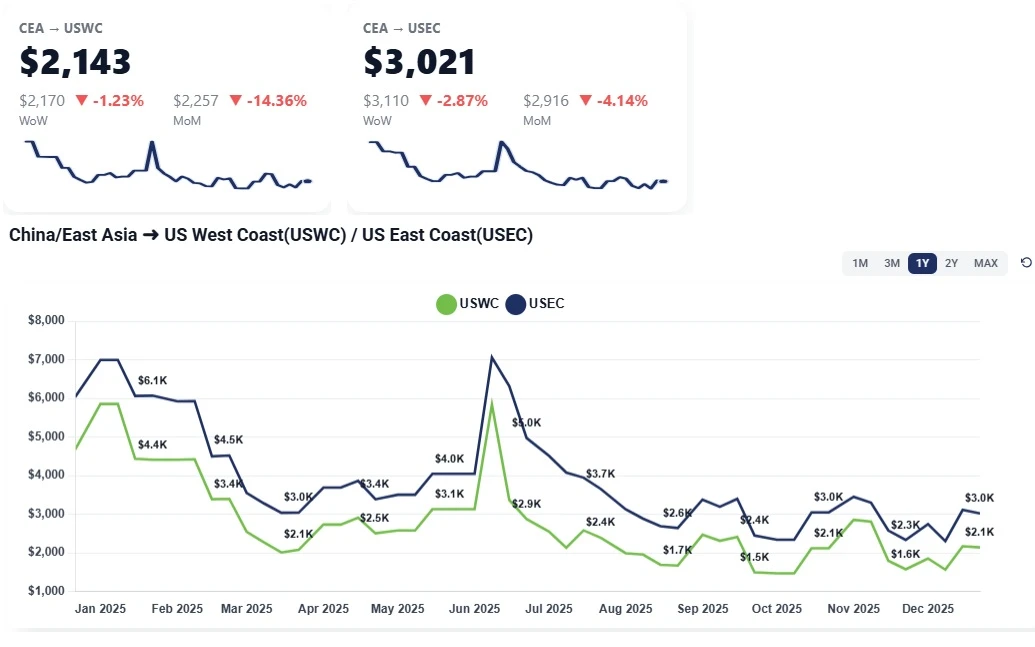
Transpacific ocean freight rates from China to the US West and East Coasts remained elevated week over week as carriers held firm through the holiday slowdown, positioning pricing ahead of Chinese New Year and upcoming contract season negotiations.

Ocean Freight Rates Hold Firm as Carriers Keep Capacity Tight - TFX Update wk. August 24, 2026
China to US ocean freight rates remain firm as West Coast rates rebound 9% and East Coast rates rise 3%. See what’s driving the market and the outlook for September.
China–US Ocean Freight Market Holds Firm, but Promotional Rates Gain Traction - TFX Update wk. June 22, 2026
China–US ocean freight rates remain elevated, with CEA to USWC pricing above $6,000 while promotional carrier deals help some shipments move lower. Learn what is driving rates and what to expect heading into July.
Tariff Refunds Cushion US Importers Amid Sustained Transpacific Spot Rates - TFX Update wk. August 10, 2026
China-US ocean freight rates remain stable through late August 2026, with USWC rates holding above $7,000/FEU. Discover how aggressive carrier blank sailings and importer tariff refund cushions are sustaining transpacific rate levels ahead of the Q4 holid
Carriers Prepare August GRIs Following Sharp West Coast Rate Decline - TFX Update wk. July 27, 2026
China to US ocean freight rates declined again this week, led by sharp drops on West Coast routes while East Coast pricing remained relatively resilient. Learn what's driving the market correction, August rate increases, and what to expect as peak shippin

Golden Week Ocean Rates Hold Steady as Carriers Extend Pricing Into Mid-October - TFX Update wk. September 28, 2026
Ocean freight rates hold steady ahead of Golden Week as carriers extend rates through October 14th. Discover key transpacific market trends and forecast post-holiday congestion risks.

Carriers Hold Firm on Fuel Surcharges Despite Emerging US-Iran Peace Plans - TFX Update wk. June 15, 2026
Transpacific ocean freight rates soared past $6,000 to the USWC and hit the mid-$7,000s to the USEC. Discover how front-loading and severe space constraints are driving this week's market update.
Ocean Freight Rates Double Since March as Carriers Aggressively Squeeze Capacity - TFX Update wk. May 18, 2026
Ocean freight rates double for USWC and USEC as carrier capacity cuts trigger severe space shortages and rolled cargo. Read the latest weekly freight market update on rising spot rates, premium expedited shipping surges, and the June GRI outlook.
Carriers Begin Small Rate Cuts as Transpacific Market Loses Momentum - TFX Update wk. July 6, 2026
China–US ocean freight rates from CEA to the US West Coast and East Coast softened slightly week over week as demand remained low, carriers tested modest reductions, and the market appeared to reach a near-term rate ceiling.
Ocean Rates Rise Again as China Holiday Squeezes Capacity - TFX Update wk. September 14, 2026
China to US ocean freight rates rise $500–$600 as blank sailings, tight capacity and unstable vessel schedules intensify ahead of China’s October holiday.