- Home
- >
- News
- >
- Importers Race Against July Tariff Deadlines, Throwing Supply Chains Into Chaos - TFX Update wk. June 8, 2026
Importers Race Against July Tariff Deadlines, Throwing Supply Chains Into Chaos - TFX Update wk. June 8, 2026
The Lead:
The first week of June 2026 saw a transition from chaotic, emergency trade restrictions to deeply structured, long-term industrial protectionism. By unveiling a two-tiered, 60-nation Section 301 tariff framework based on forced labor criteria, the US successfully engineered a more durable, court-proof legal vehicle to replace its temporary balance-of-payments surcharges before they expire in July. This aggressive US move toward a highly regulated, centralized trade architecture forced major partners into structural pivots: the European Union finalized a critical concession pact with Washington to secure its baseline 10% preference while simultaneously enacting a fierce new domestic steel quota regime to lock out Chinese market dumping. Ultimately, the week proved that while a multipolar landscape continues to operate elsewhere through localized compromises like the new US-China Board of Trade, global supply chains are facing a permanently higher cost baseline dictated by strict national labor, environment, and metal-origin compliance walls.
This Week’s Ocean, Air & Freight Markets
China-US Ocean Freight Market:
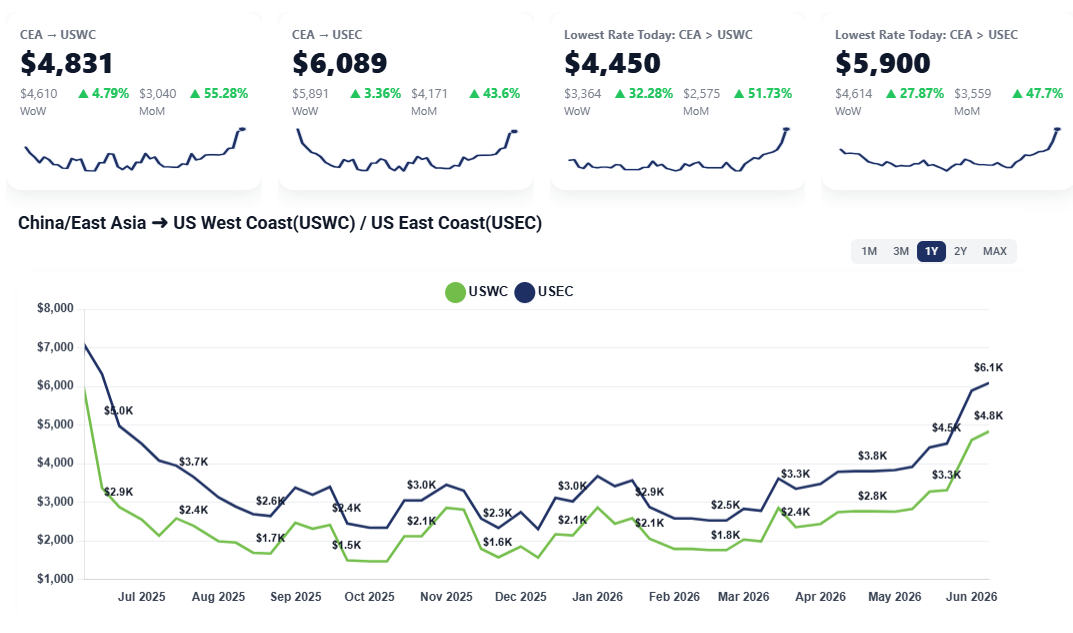
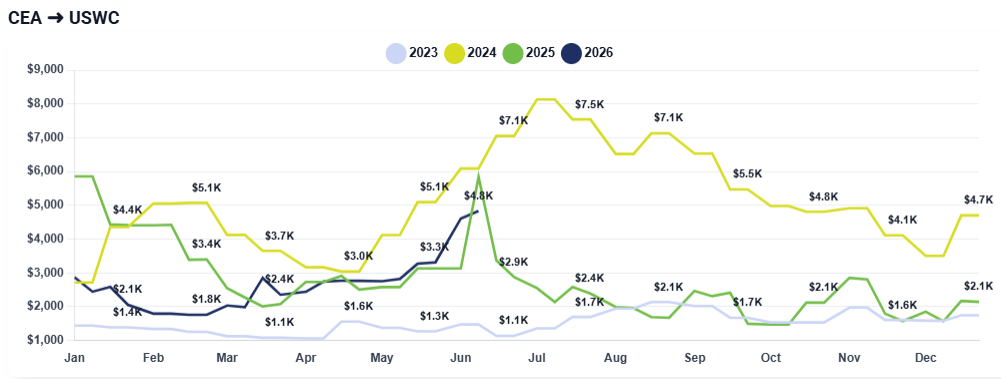
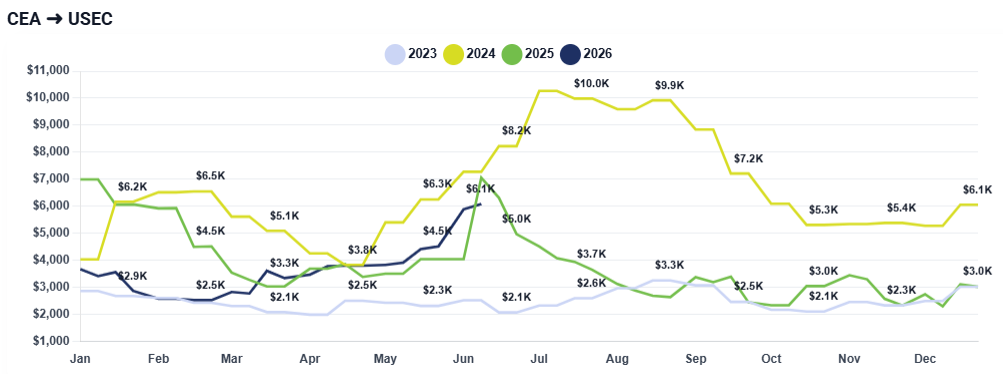
The container shipping market is experiencing substantial week-over-week rate increases, catching many importers by surprise as prices climb significantly. Current ocean freight rates are rapidly escalating past previous baselines .
CEA to USWC: Rates have surged from the high $4,000+, nearly $5,000, and are explicitly projected to climb over $6,000+ per container.
CEA to USEC: Rates are following a similar upward trajectory and are expected to surpass $7,000+ per container.
Freight Right’s Lowest Rate indicators are finding that importers can find spot rates as low as $4,450 from China to US West Coast and $5,900 from China to US East Coast. Talk to your freight forwarder about options available to you.
Read more about the state of the ocean freight spot market with Freight Right’s TrueFreight Index.
What Happened This Past Week
The Traffic Jam Backlog in China: Persistent blank sailings have triggered severe cargo backlogs at Chinese export hubs. When a carrier cancels a voyage, hundreds of containers are rolled to the following week, compounding volumes, generating a traffic jam effect, and triggering multi-day communication delays just to confirm bookings.
Pre-July Tariff Anxiety and Front-Loading: Importers are grappling with immense confusion and marketing anxiety regarding impending July tariff changes. To avoid recalculation headaches and potential margin erosion from unexpected 20% to 30% adjustments, businesses are aggressively front-loading their fall and holiday season inventories ahead of schedule.
Overlapping Demand Cycles: The unseasonal surge of front-loaded holiday goods is directly colliding with the traditional, non-negotiable peak importing window for summer and outdoor seasonal products, overwhelming available vessel space.
Looking Ahead:
The current market strain represents an early, highly compressed peak season rather than the traditional timeline typically seen later in the year. This elevated rate environment is expected to persist through the remainder of June and throughout July, as ocean carriers are highly unlikely to voluntarily relinquish their pricing leverage.
A traditional, prolonged peak season spanning August through October appears unlikely under current macroeconomic conditions. Instead, relief will likely hinge on two primary triggers later this summer: Front-loaders completely depleting their advanced supply chain volumes by late July, causing export demand to drop; and carriers systematically restoring blanked vessels back into active service rotations.
Once vessel space opens up, carriers will be forced to downwardly adjust their pricing levels to attract volume, potentially pointing toward market normalization by August or September.
In the News:
Bloomberg: Trump’s Tariff Wall Takes a Curious Woke Turn
https://www.bloomberg.com/news/newsletters/2026-06-08/trump-and-tariffs
NYTimes: Trump Administration Turns to a New Rationale to Justify Old Tariffs
https://www.nytimes.com/2026/06/03/business/economy/trump-tariffs-forced-labor.html
CNBC: Trump’s trade war has a new target: forced labor. The case behind it is far from simple
https://www.cnbc.com/2026/06/09/trump-tariffs-trade-china-forced-labor.html
Reuters: Signs global trade in goods is starting to slow, WTO says
https://www.reuters.com/business/signs-global-trade-goods-starting-slow-wto-says-2026-06-05/
Financial Times: Donald Trump’s replacement tariff wall continues to rise
https://www.ft.com/content/ed7c8cb6-821e-47f3-80c0-463f4bca6e3e?syn-25a6b1a6=1
More News
Late-June Front-Loading Exacerbates Severe Transpacific Space Crunch
Late-June front-loading has triggered a severe transpacific space crunch. Discover how carrier rate hikes are driving ocean freight costs to new heights as shippers scramble for limited vessel capacity.

Carriers Hold Firm on Fuel Surcharges Despite Emerging US-Iran Peace Plans - TFX Update wk. June 15, 2026
Transpacific ocean freight rates soared past $6,000 to the USWC and hit the mid-$7,000s to the USEC. Discover how front-loading and severe space constraints are driving this week's market update.

Transpacific Ocean Freight Rates Hold High as Peak Season Nears Early Close - TFX Update wk. September 7, 2026
China to US ocean freight rates remain elevated in September, with USWC rates near $7,000 and USEC rates at $8,000–$9,000 amid strong demand, tight space and vessel delays.

China-US Ocean Rates Hold Steady at $3K/$4K Baseline Ahead of Threatened June Spikes - TFX Update wk. May 25, 2026
Ocean freight rates hold steady, but massive June GRIs loom. Discover how carrier blank sailings and terminal capacity constraints are driving up transpacific shipping costs.

China–US Ocean Freight Market Holds Firm, but Promotional Rates Gain Traction - TFX Update wk. June 22, 2026
China–US ocean freight rates remain elevated, with CEA to USWC pricing above $6,000 while promotional carrier deals help some shipments move lower. Learn what is driving rates and what to expect heading into July.
Ocean Freight Contract Season: Winners, Losers, and the Illusion of Stability
A look into the volatile freight contract season, exploring broken promises, rate surges, and solutions for sustainable agreements through strategic contracting and innovative market practices.
Ocean Freight Rates Hold Firm as Carriers Defend Pricing Into 2026 Contract Season - TFX Update wk. December 29, 2025
Transpacific ocean freight rates from China to the US West and East Coasts remained elevated week over week as carriers held firm through the holiday slowdown, positioning pricing ahead of Chinese New Year and upcoming contract season negotiations.

US Slaps 10% Lumber and 25% Furniture Tariffs: Impact on Housing, Trade, and Consumers
The U.S. will impose 10% tariffs on lumber and 25% on furniture starting October 14, 2025, a move set to impact housing costs, supply chains, and trade relations.
Ocean Freight Rates Double Since March as Carriers Aggressively Squeeze Capacity - TFX Update wk. May 18, 2026
Ocean freight rates double for USWC and USEC as carrier capacity cuts trigger severe space shortages and rolled cargo. Read the latest weekly freight market update on rising spot rates, premium expedited shipping surges, and the June GRI outlook.
Tariff Refunds Cushion US Importers Amid Sustained Transpacific Spot Rates - TFX Update wk. August 10, 2026
China-US ocean freight rates remain stable through late August 2026, with USWC rates holding above $7,000/FEU. Discover how aggressive carrier blank sailings and importer tariff refund cushions are sustaining transpacific rate levels ahead of the Q4 holid