New US Tariffs on Polysilicon and Solar Products: What Importers Need to Know
The Trump administration has announced a new set of trade measures covering polysilicon and products made from it, adding another layer of tariffs and import controls to supply chains serving the US solar and semiconductor industries.
President Donald Trump signed the new measures on August 6, 2026, following a Department of Commerce investigation under Section 232 of the Trade Expansion Act of 1962. The administration determined that the volume and circumstances of polysilicon and derivative imports threaten to impair US national security. The measures take effect December 4, 2026.
For importers, manufacturers and logistics providers, the change is more complicated than a straightforward 15% tariff. According to the White House's fact sheet on the action, the administration is establishing both a minimum import price system for polysilicon and its derivatives and a 15% ad valorem tariff on downstream derivative products.
What is being tariffed?
The measures target the polysilicon supply chain.
Polysilicon is an ultra-pure form of silicon and an upstream material used in two strategically important industries: semiconductors and solar energy. Semiconductor-grade polysilicon ultimately feeds chip manufacturing, while solar-grade polysilicon is processed into ingots, wafers and cells used in photovoltaic modules.
The administration has established the following minimum import prices:
Polysilicon: $21 per kilogram
Polysilicon ingots and wafers: $100 per kilogram
Solar cells: $0.22 per watt
Solar modules/panels: $0.38 per watt
In addition, the White House says downstream derivative products will be subject to a 15% ad valorem tariff.
This distinction is important. Raw polysilicon is covered by the minimum import price system, while the additional 15% tariff applies to covered products downstream of polysilicon. Industry publication Solar Power World similarly reports that polysilicon-only imports do not receive the additional 15% tariff, while imported wafers, cells and finished panels are covered.
The administration says the measures are intended to protect a strategically important domestic industry and reduce US dependence on foreign production.
How do the minimum import prices work?
Rather than relying exclusively on conventional percentage-based tariffs, the new policy establishes minimum prices for covered imports.
This means an importer bringing covered merchandise into the United States below the applicable minimum price could face an additional charge designed to bring the effective import value up to the established floor.
The minimum prices are particularly significant for the solar industry because they apply at several stages of the supply chain, from polysilicon itself through wafers, cells and completed solar modules.
For importers, this means customs compliance will involve more than simply applying a percentage to the declared value of a shipment. Companies will need to determine whether their goods fall within the covered classifications, establish their appropriate customs value and retain documentation supporting the transaction.
The combination of minimum prices and tariffs is intended to prevent low-priced foreign goods from undermining domestic production while still permitting covered products to enter the United States.
By what authority can these tariffs be implemented?
The principal legal authority is Section 232 of the Trade Expansion Act of 1962.
Section 232 authorizes the federal government to investigate whether imports of a particular product threaten to impair US national security. If the Commerce Department reaches such a finding, the statute gives the President authority to take action to adjust those imports.
The Department of Commerce opened the polysilicon Section 232 investigation on July 1, 2025, examining polysilicon and its derivatives and their effect on national security.
That national-security authority distinguishes these measures from another set of tariffs that already applies to certain Chinese polysilicon products.
Under a separate legal mechanism, Section 301 of the Trade Act of 1974, the Office of the US Trade Representative previously increased tariffs on Chinese solar wafers and polysilicon to 50%, effective January 1, 2025.
The two regimes therefore should not be confused. Section 301 measures address specific Chinese trade practices, while the new polysilicon measures arise from a Section 232 national-security investigation and have broader application.
How much are the tariffs?
The headline rate is an additional 15% ad valorem tariff on covered downstream polysilicon derivative products.
At the same time, the minimum import price system establishes floors of $21/kg for polysilicon, $100/kg for ingots and wafers, $0.22/watt for solar cells and $0.38/watt for solar modules.
Importers should not assume, however, that 15% represents the total duty exposure for every covered shipment.
Other tariffs may already apply depending on the product's classification and country of origin. Most notably, Chinese polysilicon and solar wafers have already been subject to a 50% Section 301 tariff since January 1, 2025.
Actual landed-cost exposure therefore needs to be evaluated by HTS classification, country of origin and any other applicable trade remedies rather than by looking at the new 15% rate in isolation.
Are there exceptions?
Yes. The measures include mechanisms designed to prevent the tariff system from applying identically in every circumstance.
One important component is an incentive for companies that invest in domestic production. The administration has authorized the Commerce Department to create an incentive program for companies investing in US facilities producing polysilicon or derivative products.
This is consistent with the administration's broader objective of using the tariff regime to encourage companies to move more of the polysilicon, wafer, cell and related manufacturing supply chain into the United States.
Importers should therefore examine the detailed product coverage and applicable country treatment rather than assuming that every product containing polysilicon automatically receives the same tariff treatment.
Who is expected to be affected?
US importers
The most immediate impact will fall on companies importing polysilicon derivatives, solar wafers, cells, modules and other covered products.
Importers will need to identify applicable HTS classifications, country of origin, customs value and any existing trade remedies before determining the actual duty owed.
Solar manufacturers and developers
US solar manufacturers that rely on imported wafers, cells or other components could experience higher input costs.
Solar developers and installers purchasing imported finished modules could also face higher equipment prices. Solar Power World expects the measures to increase the price floor for imported solar panels.
That could benefit US manufacturers competing against low-priced imports while increasing procurement costs elsewhere in the solar supply chain.
Domestic polysilicon producers
Domestic manufacturers are among the intended beneficiaries.
The United States currently has two major polysilicon production facilities, including Hemlock Semiconductor in Michigan and Wacker Chemie's facility in Tennessee.
Both companies welcomed the administration's action. Hemlock parent Corning said it would encourage continued investment in US capacity, while Wacker pointed to the importance of polysilicon production for semiconductor supply-chain resilience.
Semiconductor and technology companies
The semiconductor industry is affected more indirectly.
Polysilicon is an essential upstream material for semiconductor manufacturing, including chips supporting artificial intelligence, data centers and other advanced computing applications. The administration is treating domestic polysilicon capacity as a national-security issue partly because of the importance of maintaining a secure US semiconductor supply chain.
The new measures also sit alongside the administration's separate Section 232 action covering semiconductors, semiconductor manufacturing equipment and derivative products.
Freight forwarders, customs brokers and logistics teams
For the logistics industry, the impact will primarily be a compliance and landed-cost issue.
Freight forwarders and customs brokers handling solar and polysilicon products will need to pay particular attention to HTS classification, country of origin, customs valuation, product composition and entry date.
The distinction between raw polysilicon and downstream derivatives is especially important because the applicable treatment can differ substantially.
What importers should do before December 4
Companies moving polysilicon, wafers, solar cells, modules or potentially covered derivative products should begin reviewing their classifications and supply chains before the measures take effect on December 4, 2026.
Importers should identify:
the product's HTSUS classification;
country of origin;
entered customs value;
whether the product is subject to the minimum import price;
whether the additional 15% Section 232 tariff applies; and
whether an existing Section 301 or other trade remedy also applies.
Companies can use USTR's Section 301 tariff search tool to check whether an HTS subheading is covered by existing Section 301 actions.
The new polysilicon measures are ultimately more than a simple tariff increase. By combining a 15% tariff on downstream derivatives, minimum import prices and incentives for domestic manufacturing, the administration is attempting to reshape where critical solar and semiconductor inputs are produced.
For importers, knowing the headline tariff rate is therefore only the starting point. Product classification, origin, valuation and the interaction between different US trade remedies will determine the actual impact on landed cost.
More News

New Trump Tariffs Take Effect: What Importers Need to Know About the Latest US Trade Measures
The Trump administration's new Section 301 tariffs are now in effect. Learn what products are affected, tariff rates, exemptions, legal authority, and who will be impacted.
New US Tariffs on Canada: What Importers Need to Know About the White House's Latest Trade Actions
New U.S. tariffs on Canadian goods could reshape cross-border trade. See which products are affected, available exceptions, and what importers should do next.
China–US West and East Coast Rates Hold Flat After Short-Lived December Rate Spike - TFX Update wk. December 1, 2025
Weekly ocean freight update on China–US West and East Coast lanes as an early December GRI fades, leaving spot rates near November levels amid weak demand.
Wait-and-See Grips Importers As Rates Remain Unchanged - TFX Update: wk. July 28st, 2025
As the deadline before reciprocal tariffs take place, the Trump administration continues to make deals with nations around the world. Importers are back to taking a wait-and-see approach while rates USWC and USEC remain unchanged.
The Big Swing: Pharma tariffs, plus new probes that could widen the net
The White House has announced new tariffs on branded pharmaceuticals and launched national security probes into medical equipment and robotics. Learn what’s changing, how hospitals and manufacturers could be affected, and where to track historical HS/HTS.

New Executive Order Limits Tariff Stacking on Imports to Prevent Excessive Duties
President Trump issues Executive Order to stop overlapping tariffs on imports under national security and trade actions, ensuring duty rates remain targeted and non-cumulative. Effective retroactively from March 4, 2025.
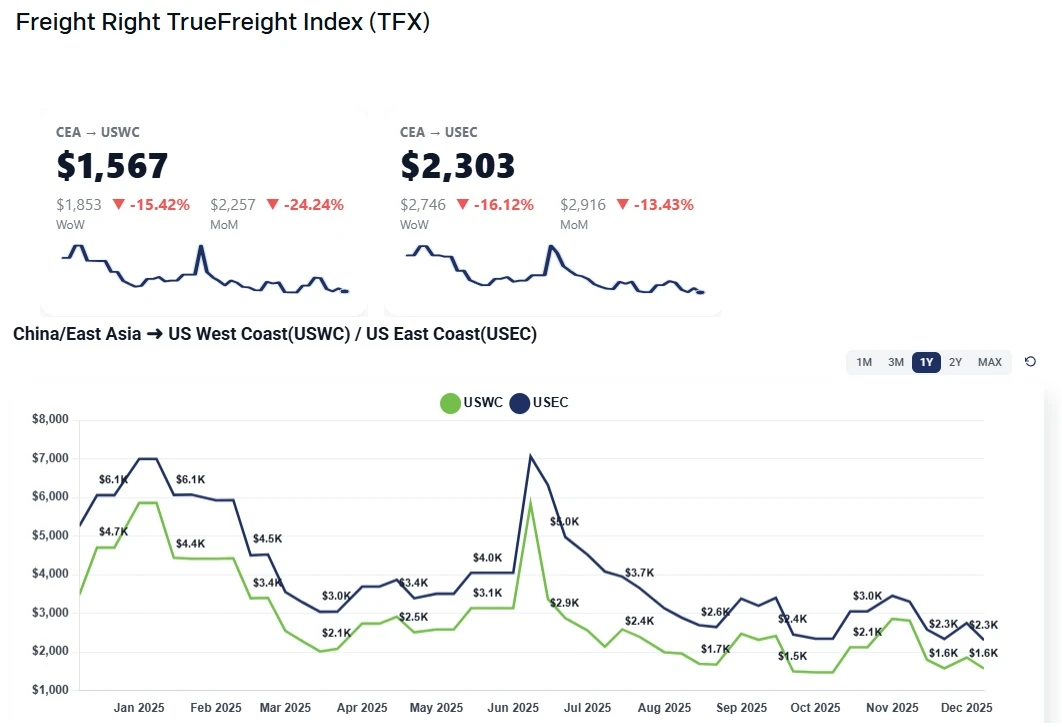
China–US Spot Market Stabilizes After November Plunge, But Gains Remain Fragile - TFX Update wk. December 8, 2025
Small December GRIs lift China–USWC and China–USEC rates slightly, but overcapacity, soft demand, and tariff uncertainty continue to cap meaningful recovery. Outlook steady through Chinese New Year with brief January strength.
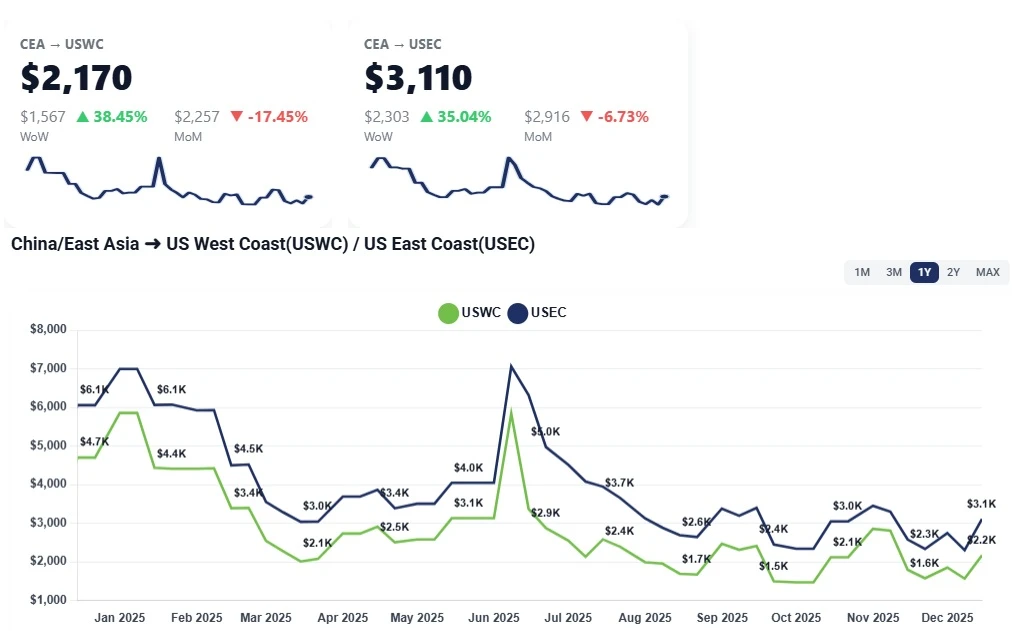
Transpacific Rates Pop Again: Carriers Push Mid-December Increases Into January - TFX Update wk. December 15, 2025
China–US ocean freight rates rose WoW: USWC near $2.1K/FEU and USEC near $2.9–$3.0K as carriers end fixed extensions and hold firm into January.

ILA 2024 Strike: What Ports Are Affected & More
The International Longshoremen's Association began their strike October 1, 2024, affecting ports running along the east coast and Gulf regions of the United States. See what ports are affected and what this strike can mean for shippers.
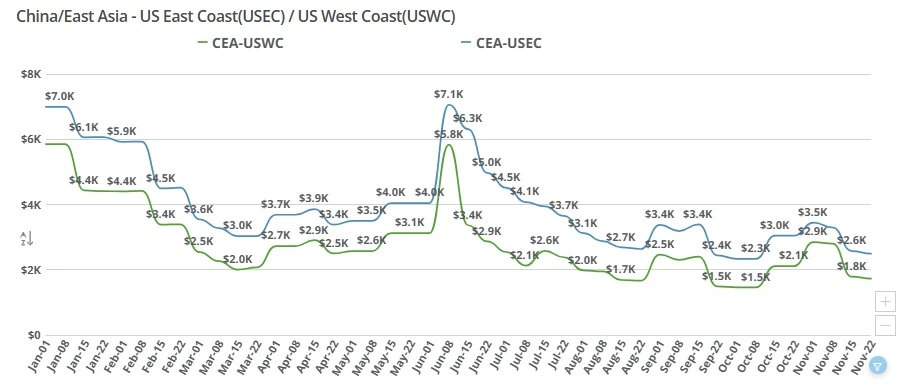
Spot Rates Plunge on Both Coasts With Short Holiday Week and Weak Imports - TFX Update wk. November 24, 2025
Transpacific ocean freight rates dropped sharply this week as weak import demand and the Thanksgiving holiday slowdown pushed China–US West and East Coast spot prices to new lows. Get the latest market drivers and outlook.