- Home
- >
- News
- >
- Tariff Refunds Cushion US Importers Amid Sustained Transpacific Spot Rates - TFX Update wk. August 10, 2026
Tariff Refunds Cushion US Importers Amid Sustained Transpacific Spot Rates - TFX Update wk. August 10, 2026
The Lead:
Last demonstrated that Washington is actively using Section 232 national security authority to shield high-tech manufacturing, placing 15% tariffs and Minimum Import Prices on foreign polysilicon and solar components. This aggressive expansion of the centralized trade architecture triggered immediate countermeasures, as Beijing restricted dual-use drone exports to the US while levying duties on American agricultural goods. Meanwhile, updated fiscal reports confirmed that while CBP has already certified $100 billion in IEEPA duty refunds, North American supply chains have rapidly reconfigured with a record 83.6% of Canadian and Mexican goods taking shelter under USMCA rules to insulate themselves from escalating baseline tariffs
This Week’s Ocean, Air & Freight Markets
China-US Ocean Freight Market:
CEA to USWC: Rates remain firm week-over-week, with general pricing still above $7,000 per FEU to the US West Coast.
While some highly specific promotional or special rates are available, the broader market has not experienced the decline that had been anticipated earlier in August. Expectations that pricing could retreat toward June or July levels have faded, with carriers successfully defending current rate levels.
CEA to USEC: East Coast pricing is similarly stable week-over-week, with even less rate adjustment reported than on the West Coast. Despite some reduction in overall volumes, carriers are actively removing capacity to keep supply aligned with demand and support existing pricing.
Freight Right’s Lowest Rate indicators are finding that importers can find spot rates as low as $5,200 from China to US West Coast and $6,520 from China to US East Coast. Talk to your freight forwarder about options available to you.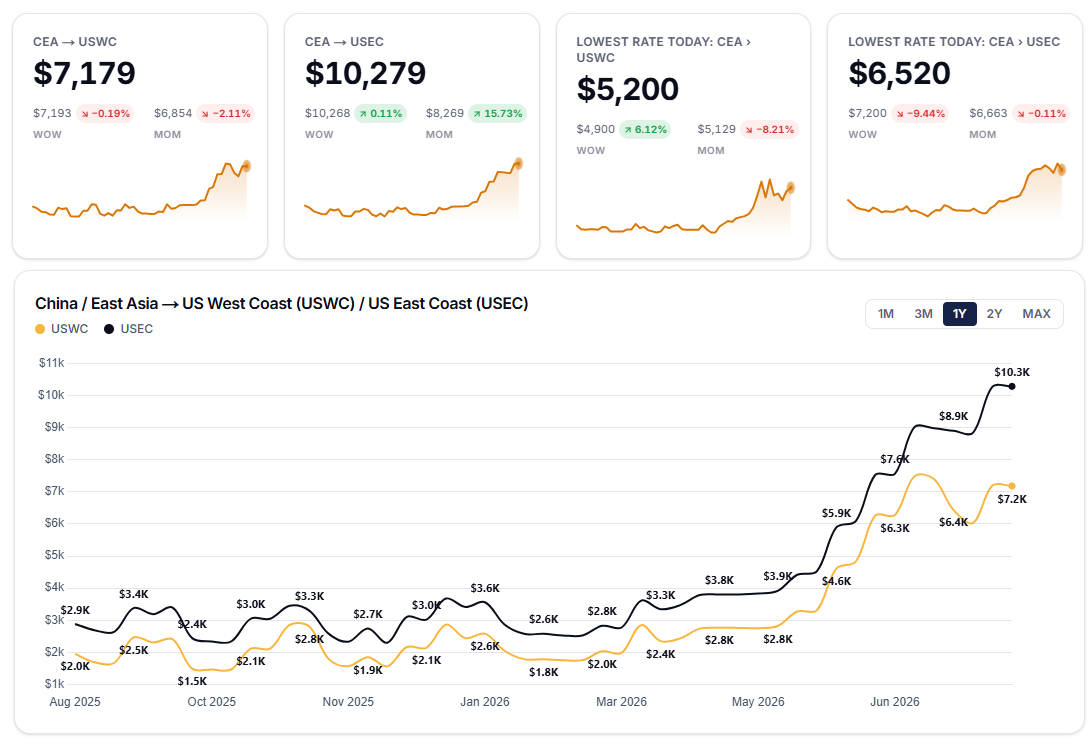
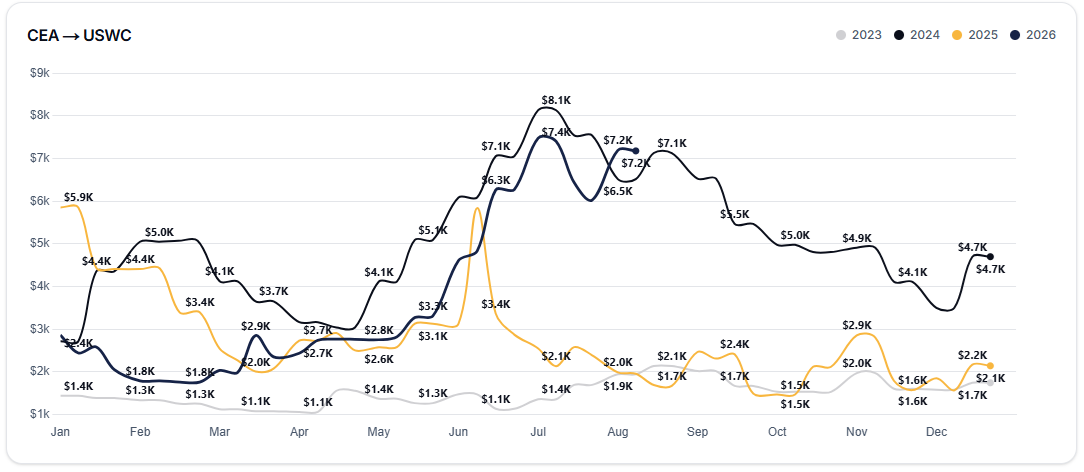
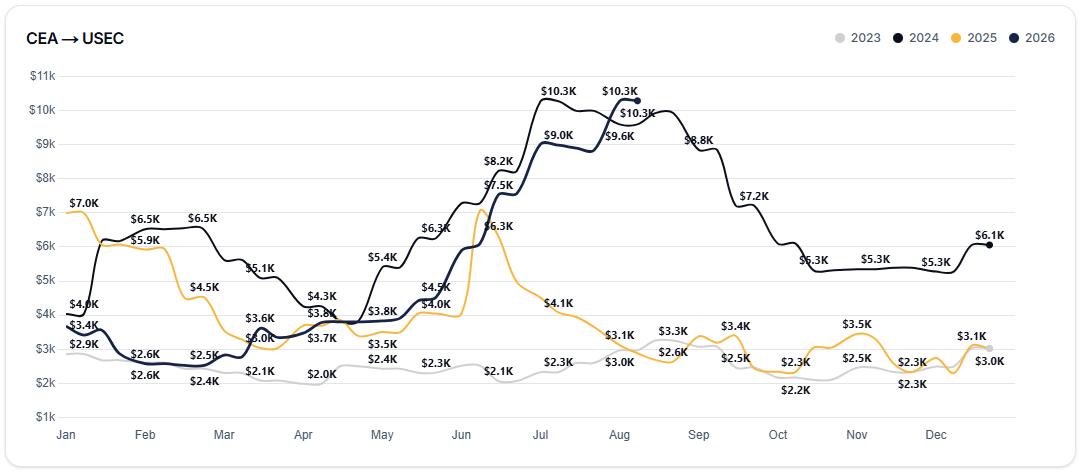
Read more about the state of the ocean freight spot market with Freight Right’s TrueFreight Index.
What Happened This Past Week
Too Soon to Tell How the Market Will React to the latest Tariffs Tariff: The recent 2.5% tariff increase (stepping up from 10% to 12.5%) has generated little to no downward pressure on import volumes. Importers have largely absorbed the minor adjustment as a standard cost of doing business rather than pausing procurement schedules.
Liquidity Influx from Prior Tariff Refunds: Many US importers are actively receiving cash payouts from historical tariff refund filings. This newly acquired capital buffer is enabling buyers to absorb or subsidize the extra 2.5% duty without reducing order sizes or hiking shelf prices.
Aggressive Capacity Reductions by Ocean Carriers: Ocean liners are taking stringent measures to defend rate floors by executing blank (cancelled) sailings on roughly 25% to 30% of total rotational capacity, withdrawing roughly 40 out of 150 planned sailings.
Pre-Holiday Peak Season Stocking: With major Q4 promotional periods (Halloween, Thanksgiving, and Christmas) approaching in under two months, importers are prioritizing volume preservation and inventory readiness over waiting for speculative rate drops.
Looking Ahead:
Rates are projected to remain firm and range-bound through the remainder of August and into September 2026. With carriers demonstrating strong discipline through capacity management and importers utilizing cash reserves to maintain holiday order flows, a steep downward rate correction appears unlikely in the short term. Unless consumer demand drops sharply enough to force importers to pause purchase orders, or external macro shifts significantly drive down bunker fuel costs, the transpacific market is expected to remain tight with elevated freight pricing through the early autumn peak.
In the News:
The Guardian: Trump orders new 15% tariff on key material for solar panels and microchips
https://www.theguardian.com/us-news/2026/aug/07/trump-orders-tariff-solar-panels-microchips-manufacturing-ingredient
CBS: Warren presses US companies to share billions in tariff refunds with customers
https://www.cbsnews.com/news/elizabeth-warren-tariff-refunds-ieepa/
Bloomberg: US Moves Past Tariffs to Focus on Supply Chain Revamps in China Trade Policy
https://www.bloomberg.com/news/newsletters/2026-08-11/us-moves-past-tariffs-to-focus-on-supply-chain-revamps-in-china-trade-policy
NY Times: Canada Offers US Concessions in Trade Talks but Demands a Comprehensive Deal
https://www.nytimes.com/2026/08/07/world/canada/us-trade-tariffs-carney-trump.html
BBC: Trump imposes 15% tariff on key chip material to counter China
https://www.bbc.com/news/articles/cdrvn686dljo
Subscribe for weekly updates from Freight Right.
More News
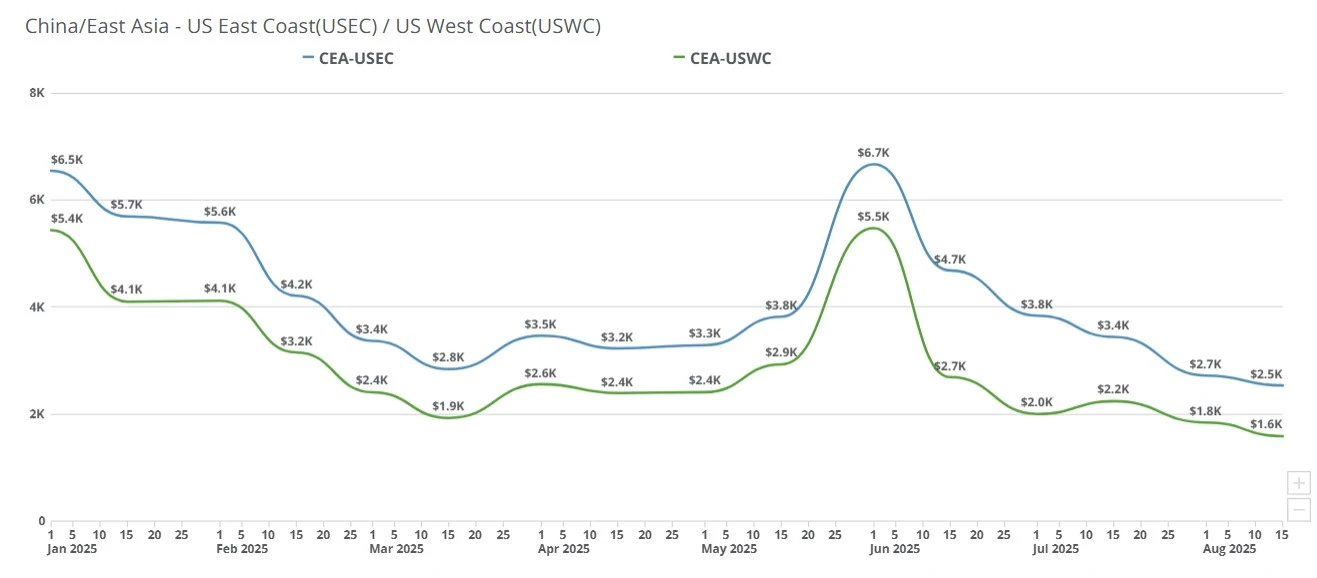
Spot Rates Dip Below 2024 Levels as Blank Sailings Ramp Up - TFX Update wk. August 18, 2025
China-US freight rates dip to $1,520/FEU as carriers cut prices and blank sailings set up a $1,000 September GRI amid weak demand and tariff risks.
Blank Sailings and Rollovers Dominate May Freight Market - TFX Update wk. May 4, 2026
China-US rates remain stable at $2,700-$3,800, but blank sailings and vessel overloading are causing record shipment rollovers and strategic rerouting through Busan.
August Ocean Rate Increase Begins to Unravel as Importers Hold Back - TFX Update wk. August 3, 2026
China to US ocean freight rates rose above $7,000 in early August, but weak demand, excess West Coast capacity, and aggressive discounting are pushing rates back toward the mid-$5,000 range
Late-June Front-Loading Exacerbates Severe Transpacific Space Crunch
Late-June front-loading has triggered a severe transpacific space crunch. Discover how carrier rate hikes are driving ocean freight costs to new heights as shippers scramble for limited vessel capacity.
Ocean Freight Market Enters Holding Pattern Ahead of September - TFX Update wk. August 17, 2026
China-US ocean freight rates remain elevated in mid-August, with West Coast discounts emerging while East Coast pricing stays firm. See what carrier capacity cuts, blank sailings and demand trends could mean for September.
Transpac Spot Rates Slip as Golden Week Quiet Hits; USWC Near $1.3k/FEU - TFX Update wk. September 29, 2025
China-US spot rates dipped again, with USWC near $1,300/FEU. Golden Week slowdowns and tariff drag curb demand as carriers weigh blank sailings.

IEEPA Tariff Refund Update: CBP Reports $35.46B in Refunds
CBP’s latest IEEPA tariff refund update shows $35.46B in anticipated refunds and interest. Learn what importers should do now to claim eligible refunds.
Why Customs Brokers Are Better Positioned Than Lawyers to Handle IEEPA Tariff Refunds
IEEPA tariff refunds are managed through CBP systems, ACE data, CAPE declarations, and ACH refund setup. Learn why licensed customs brokers are often better positioned than lawyers to help importers recover eligible tariff refunds efficiently.

Importers Race Against July Tariff Deadlines, Throwing Supply Chains Into Chaos - TFX Update wk. June 8, 2026
Ocean freight rates skyrocket past $6,000 to USWC and $7,000 to USEC. Discover how carrier blank sailings, space deficits, and tariff front-loading are driving this early peak season crunch.

Transpacific Ocean Freight Rates Hold High as Peak Season Nears Early Close - TFX Update wk. September 7, 2026
China to US ocean freight rates remain elevated in September, with USWC rates near $7,000 and USEC rates at $8,000–$9,000 amid strong demand, tight space and vessel delays.