- Home
- >
- News
- >
- August Ocean Rate Increase Begins to Unravel as Importers Hold Back - TFX Update wk. August 3, 2026
August Ocean Rate Increase Begins to Unravel as Importers Hold Back - TFX Update wk. August 3, 2026
The Lead:
The end of July and beginning of August 2026 demonstrated the operational reality of Washington's new centralized trade architecture. With the expiration of the in-transit grace period, global supply chains transitioned fully to entry-by-entry compliance under the 60-nation Section 301 forced-labor tariffs. To offset severe manufacturing friction, the U.S. executive branch introduced targeted relief mechanisms, such as the Commerce Department's 3.75% engine tariff offset, while simultaneously erecting specialized import barriers like quartz surface TRQs. However, as state governments launch formal legal battles against the USTR's blanket duty coverage, the week closed with clear signs that this regulatory trade regime will face intense courtroom scrutiny even as businesses rebuild their global sourcing networks.
This Week’s Ocean, Air & Freight Markets
China-US Ocean Freight Market:
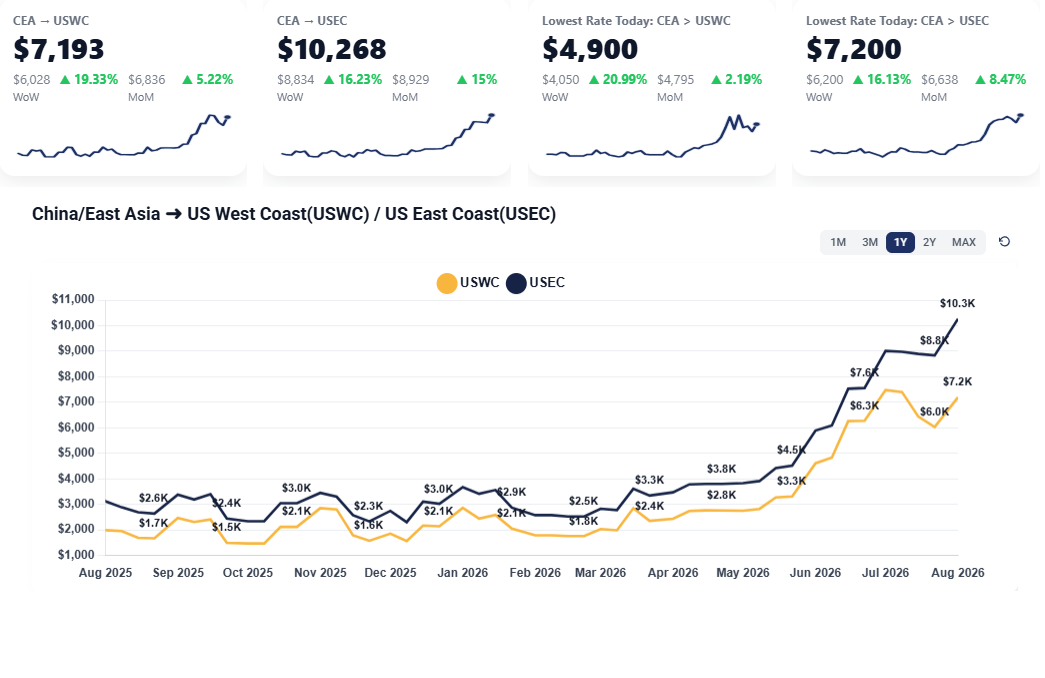
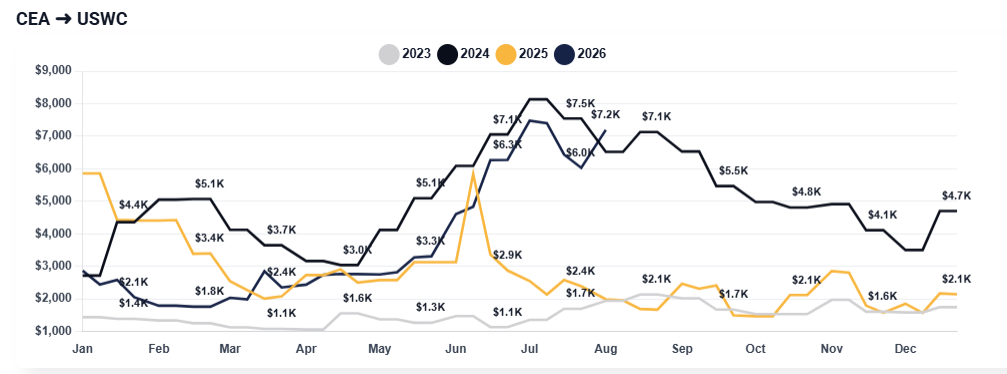
CEA to USWC: Published August rates increased sharply to approximately $7,200–$7,300 per container, bringing West Coast pricing back above the $7,000 threshold. However, these higher rates are not being widely accepted in the market.
Forwarders are already using contract allocations, blended rate structures, and special pricing to offer practical rates in the mid-$5,000 range, with some quotes reportedly falling closer to $5,300–$5,400. Based on current booking activity, the August increase is expected to be largely erased within days, returning West Coast rates to approximately where they stood before the increase.
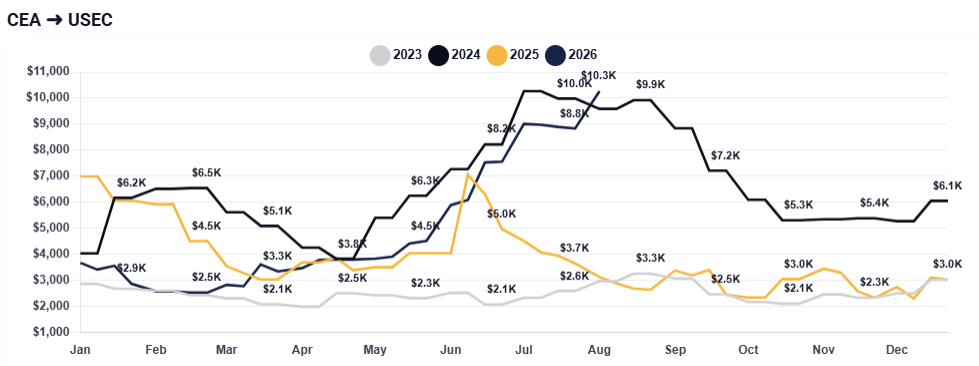
CEA to USEC: East Coast rates also moved higher following the August rate increase, but the market is seeing similar discounting through special and blended-rate programs. Unlike the West Coast, however, East Coast pricing is expected to decline more gradually.
The slower adjustment reflects the smaller amount of available capacity compared with the heavily supplied West Coast market. Although the notes do not provide a precise East Coast spot-rate range, they indicate that East Coast and Gulf Coast rates are softening alongside the West Coast, but at a slower pace.
Freight Right’s Lowest Rate indicators are finding that importers can find spot rates as low as $4,900 from China to US West Coast and $7,200 from China to US East Coast. Talk to your freight forwarder about options available to you.
Read more about the state of the ocean freight spot market with Freight Right’s TrueFreight Index.
What Happened This Past Week
Importers are delaying shipments. Many shippers are holding cargo for several days or rolling early-August bookings in anticipation of lower rates. China-based agents and forwarders are reporting the same wait-and-see behavior.
The August rate increase lacks demand support. Carriers introduced rates above $7,000, but volumes have already weakened. The market does not appear strong enough to sustain the announced increase.
West Coast capacity is accelerating the shipment volume decline. The West Coast remains the largest transpacific trade lane and has significantly more available capacity, allowing changes in demand to appear in pricing more quickly than on East Coast and Gulf Coast routes.
Higher tariffs are adding pressure to landed costs. The discussion noted an additional 2.5 percentage points of tariff exposure compared with earlier periods. This may further discourage discretionary or accelerated imports during the second half of the year.
Discounted rates may come with operational tradeoffs. Special pricing often depends on combining several bookings under the same sailing or allocation. If one shipment changes, space or schedules for the remaining bookings may also need to be adjusted.
Looking Ahead:
Headline rates are expected to formalize their downward trend toward the mid-$5,000 range over the coming weeks as published rates align with effective market transactions. To counteract this rate erosion and establish a price floor near $5,500–$6,000, ocean carriers are expected to introduce ancillary fees, such as a $150 Panama Canal surcharge slated for the second half of the month, rather than relying solely on base rate increases.
Shippers leveraging discounted or special mid-$5,000 rates should anticipate potential operational friction. Because these rates rely on forwarders consolidating multi-container bundles onto specific vessel sailings, any schedule changes or dropped bookings by co-loaders can invalidate the pricing group. Consequently, shippers taking advantage of lower spot rates face an increased risk of rolled cargo, vessel delays, or last-minute schedule adjustments without prior notice.
In the News:
CNBC: Twenty five states sue Trump administration over latest global tariffs
https://www.cnbc.com/2026/08/03/trump-tariffs-25-states-lawsuit-supreme-court.html
Reuters: China draws 'red lines' around its economic model ahead of EU, US trade talks
https://www.reuters.com/world/china/china-draws-red-lines-around-its-economic-model-ahead-eu-us-trade-talks-2026-08-02/
Bloomberg: Copper Tops $14,000 as US Stockpiles Swell Before Tariff Call
https://www.bloomberg.com/news/articles/2026-08-04/copper-marches-closer-to-14-000-as-flows-to-us-tighten-market
NY Times: US Trade Deficit Dips in June as Imports Fall Back
https://www.nytimes.com/2026/08/04/business/economy/us-trade-deficit-june.html
BBC: US states sue to block Trump tariffs impacting dozens of countries
https://www.bbc.com/news/articles/cy4kp8jd0ppo
More News
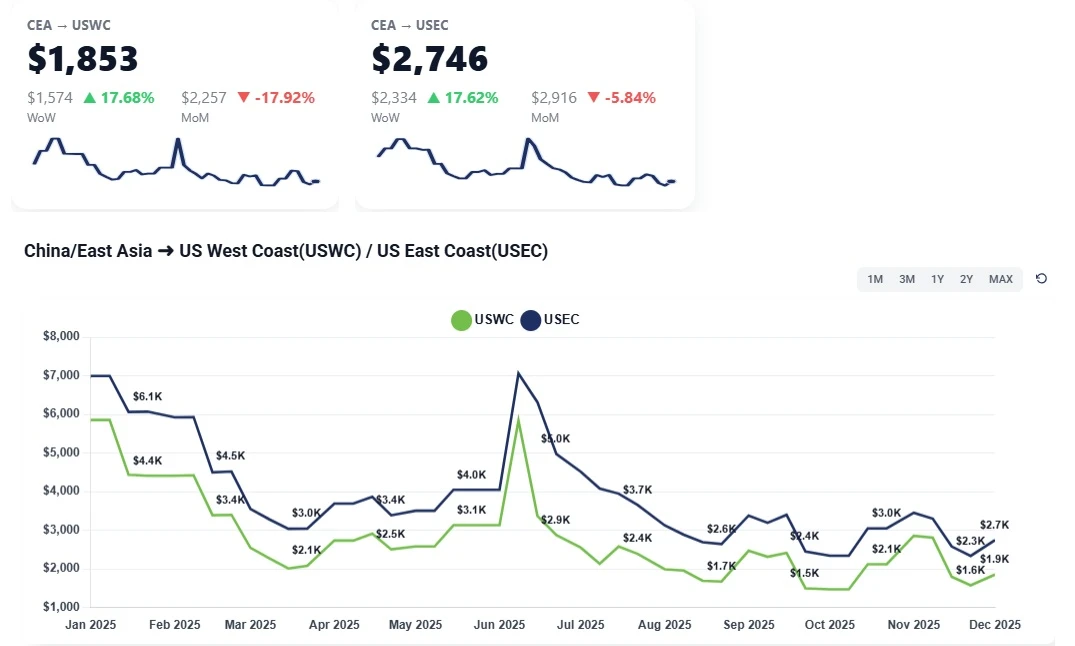
China–US West and East Coast Rates Hold Flat After Short-Lived December Rate Spike - TFX Update wk. December 1, 2025
Weekly ocean freight update on China–US West and East Coast lanes as an early December GRI fades, leaving spot rates near November levels amid weak demand.
Space Tightens on China-US Routes Despite Weak Underlying Volume - TFX Update wk. April 13, 2026
Explore how aggressive blank sailings and new blended rate strategies are stabilizing CEA to USWC/USEC shipping costs despite weak demand. Stay informed on current ocean freight market updates and rate changes.
US East Coast Freight Targets $4,500 Threshold - TFX Update wk. May 11, 2026
China to US rates surge toward $4,500 as carriers implement mid-month hikes. Learn how post-holiday demand, IEEPA refunds, and shifting air freight trends are redefining Trans-Pacific logistics strategies.
Tariff Refunds Cushion US Importers Amid Sustained Transpacific Spot Rates - TFX Update wk. August 10, 2026
China-US ocean freight rates remain stable through late August 2026, with USWC rates holding above $7,000/FEU. Discover how aggressive carrier blank sailings and importer tariff refund cushions are sustaining transpacific rate levels ahead of the Q4 holid
Transpacific Rates Pop Again: Carriers Push Mid-December Increases Into January - TFX Update wk. December 15, 2025
China–US ocean freight rates rose WoW: USWC near $2.1K/FEU and USEC near $2.9–$3.0K as carriers end fixed extensions and hold firm into January.
Carriers Push Back with GRIs, but Market Fundamentals Push Harder - TFX Update wk. January 12, 2026
China–US ocean freight rates fell week-over-week as weak January demand erased early GRIs. See what’s driving transpacific pricing and where rates may head next.
Carriers Prepare August GRIs Following Sharp West Coast Rate Decline - TFX Update wk. July 27, 2026
China to US ocean freight rates declined again this week, led by sharp drops on West Coast routes while East Coast pricing remained relatively resilient. Learn what's driving the market correction, August rate increases, and what to expect as peak shippin
Ocean Freight Market Enters Holding Pattern Ahead of September - TFX Update wk. August 17, 2026
China-US ocean freight rates remain elevated in mid-August, with West Coast discounts emerging while East Coast pricing stays firm. See what carrier capacity cuts, blank sailings and demand trends could mean for September.
Spot Rates Plunge on Both Coasts With Short Holiday Week and Weak Imports - TFX Update wk. November 24, 2025
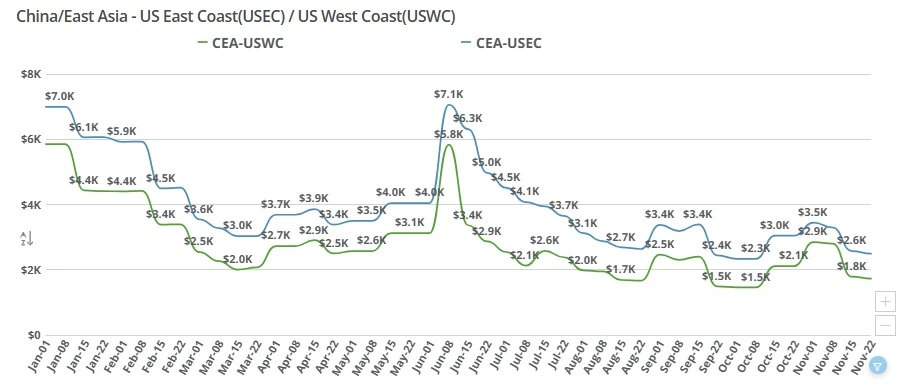
Transpacific ocean freight rates dropped sharply this week as weak import demand and the Thanksgiving holiday slowdown pushed China–US West and East Coast spot prices to new lows. Get the latest market drivers and outlook.

Transpacific Ocean Freight Rates Hold High as Peak Season Nears Early Close - TFX Update wk. September 7, 2026
China to US ocean freight rates remain elevated in September, with USWC rates near $7,000 and USEC rates at $8,000–$9,000 amid strong demand, tight space and vessel delays.