- Home
- >
- News
- >
- Capacity Management & Holiday Rush Drive Transpacific Freight Rates Higher - TFX Update wk. August 31, 2026
Capacity Management & Holiday Rush Drive Transpacific Freight Rates Higher - TFX Update wk. August 31, 2026
The Lead:
The end of August saw trade tensions between the US and Canada reach a breaking point after Washington activated 50% Section 338 tariffs on $20 billion of Canadian goods. Canada struck back by authorizing matching counter-tariffs on $27.6 billion (CAD) in American imports scheduled for September 8, backed by a $7.5 billion domestic support package for affected workers and businesses.
With Washington threatening additional 50% tariffs on the Canadian auto sector for 2027 and Ottawa refusing to negotiate on cultural and agricultural protections, the week closed with the once-integrated North American supply chain facing its most severe structural strain in decades.
This Week’s Ocean, Air & Freight Markets
China-US Ocean Freight Market:
Transpacific spot ocean rates saw continued upward momentum entering September, with carriers successfully pushing General Rate Increases (GRIs). Rates on all major trade corridors rose by approximately $300 to $500 per container week-over-week.
CEA to USWC: Freight rates moved upward into the $7,000–$8,000 per FEU range, bolstered by a 9% week-over-week growth in volume/demand.
CEA to USEC: Rates held strong between $10,000 and $11,000 per FEU, supported by a 3% week-over-week uptick in volume.
Freight Right’s Lowest Rate indicators are finding that importers can find spot rates as low as $5,800 from China to US West Coast and $7,800 from China to US East Coast. Talk to your freight forwarder about options available to you.
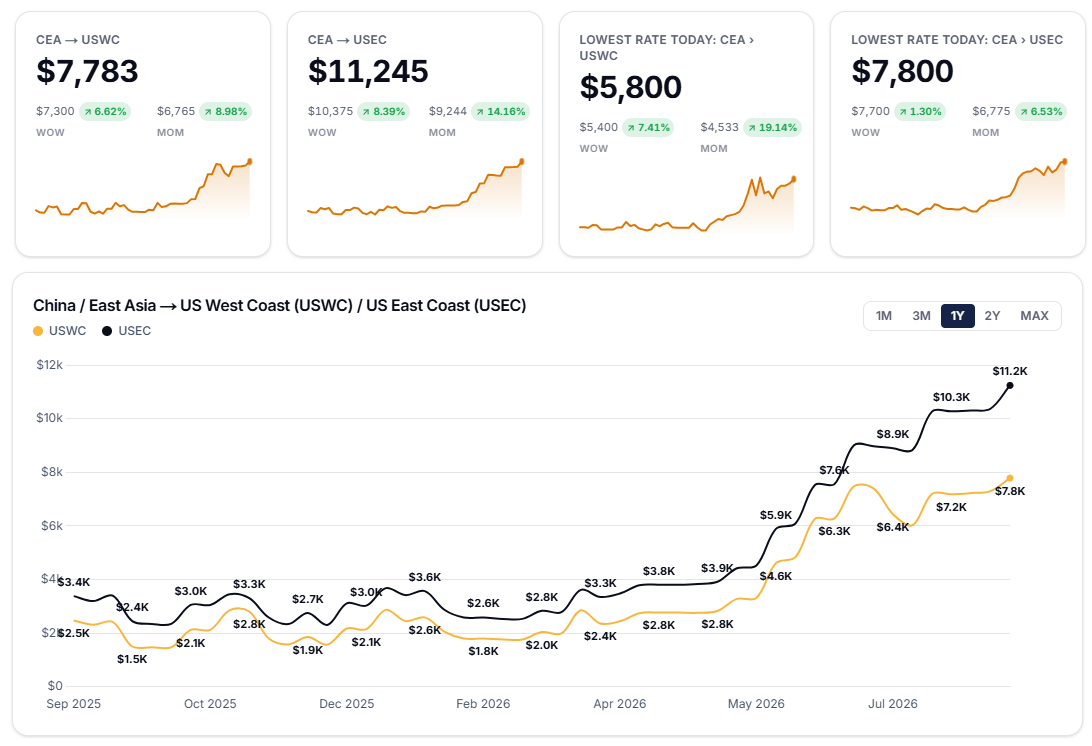
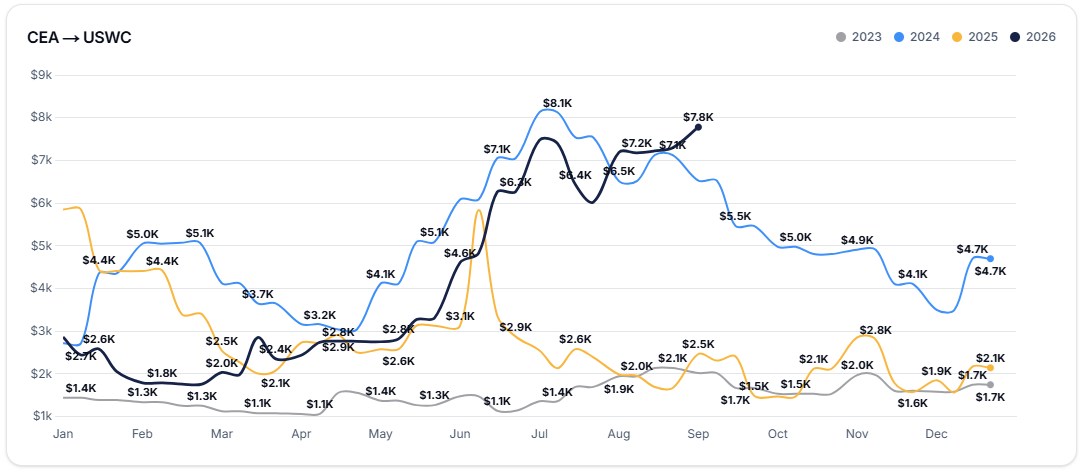
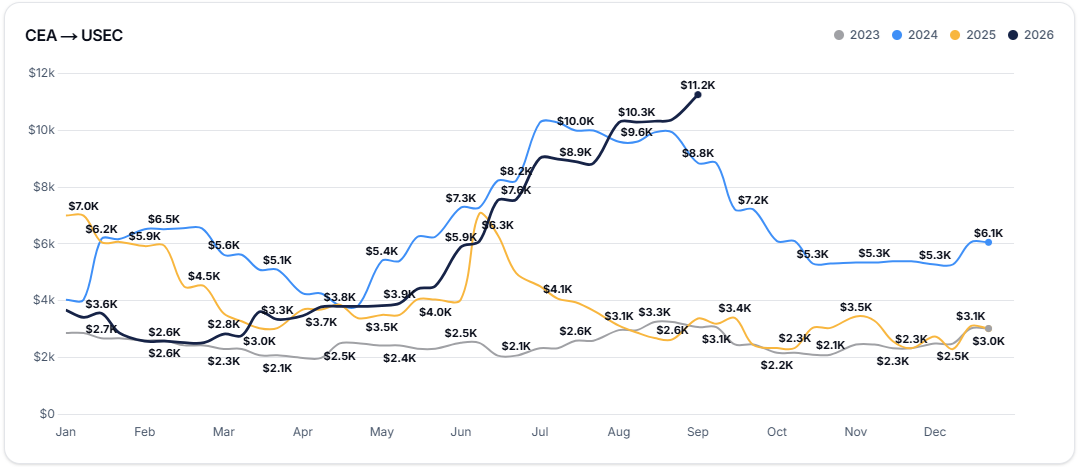
Read more about the state of the ocean freight spot market with Freight Right’s TrueFreight Index.
What Happened This Past Week
Active Capacity Control: Ocean carriers have successfully managed vessel supply by implementing strategically targeted blank sailings, modifying vessel rotations, and pulling capacity from select lanes to maintain pricing power.
Sustained Import Demand: Consumer and commercial demand remains strong, with volume rising 9% week-over-week to the US West Coast and 3% to the US East Coast.
Strict Peak Season Deadlines: Retailers and e-commerce sellers (such as Amazon merchants) are accelerating shipments to meet mandatory early-to-mid-October fulfillment center delivery deadlines for Black Friday and holiday inventory.
Broader Geopolitical & Fuel Cost Pressures: Underlying fuel and bunker costs remain high, preventing rates from returning to pre-peak baseline levels.
Looking Ahead:
The transpacific ocean freight market is reaching the final stretch of an unusually long peak season, which has run continuously since late May. Market elevated rate conditions are projected to persist throughout September.
As the shipping window for holiday inventory closes around late September to early October, demand for ocean space is anticipated to taper off. As off-peak season approaches, carriers will likely lose leverage to maintain rates at the current $7,000–$10,000 levels. Shippers can expect spot rates to begin softening late in the month as market pressure gradually subsides into Q4.
China-US Air Freight Market:
CEA to USWC: China-to-U.S. air freight rates showed a split market this week. Rates into the USECt, particularly the LAX area, remained largely stable week-over-week, with no significant pricing movement reported.
CEA to USEC: Rates from China into JFK and ORD increasing week-over-week. The gains indicate tightening conditions on these routes as the market enters September and shippers begin preparing for the seasonal cargo rush ahead of China’s October Golden Week holiday.
What Happened This Past Week
JFK and ORD rates are moving higher: Pricing into New York and Chicago increased this week, pointing to stronger demand and/or tighter available capacity on these routes compared with the West Coast.
Peak-season preparations are beginning: September typically brings increased shipping activity as importers move cargo ahead of China’s October Golden Week holiday and associated factory closures.
Late-September demand is the key factor: The more meaningful peak-season push is expected during the second half of September, when shippers are likely to accelerate bookings ahead of the holiday.
Market strength is becoming route-specific: The divergence between stable LAX pricing and higher JFK/ORD rates shows that capacity pressure is not developing evenly across U.S. gateways.
Looking Ahead:
Air freight rates are expected to remain firm through September, with the potential for additional upward pressure as the market approaches the second half of the month.
The strongest conditions are likely to emerge as shippers compete for capacity ahead of China’s October holiday period. JFK and ORD could remain particularly exposed to rate increases if demand continues to build against limited capacity. LAX may also begin to strengthen if the late-September cargo surge absorbs currently available space.
For shippers with time-sensitive cargo moving before Golden Week, securing capacity earlier in September could reduce exposure to tighter space and higher spot rates later in the month.
In the News:
CNBC: Tariffs and global trade relations: Experts weigh in on U.S. trade policy, battle against inflation
https://www.cnbc.com/video/2026/09/01/tariffs-and-global-trade-relations-experts-weigh-in-on-u-s-trade-policy-battle-against-inflation.html
The Washington Post: The US and Canada are in a trade war. China aims to win it.
https://www.washingtonpost.com/world/2026/08/25/us-canada-are-trade-war-china-aims-win-it/
CBS: New tariffs on Canadian goods could mean higher prices, new pressure on Georgia businesses
https://www.cbsnews.com/atlanta/news/new-tariffs-on-canadian-goods-could-mean-higher-prices-new-pressure-on-georgia-businesses/
Financial Times: Trump’s tariff fix leaves US trade policy in permanent flux
https://www.ft.com/content/46bf442d-175b-4347-8ef6-e3d80ae6ea63
WSJ: Canadian Small Businesses to Bear Brunt of New U.S. Tariffs
https://www.wsj.com/economy/trade/canadian-small-businesses-to-bear-brunt-of-new-u-s-tariffs-7a434c08
More News

Transpacific Carriers Face Losses as Feb Bookings Close - TFX Update wk. February 2, 2026
Ocean freight rates from China to USWC have hit a breakeven low of $1,450 per container. As the Chinese New Year halts Asian manufacturing, explore why rates are falling, the impact of late-week bookings, and the outlook for March contract negotiation.
Ocean Spot Rates Rise $700–$900; Air Freight Climbs on Apple Charters and Tariff Rush - TFX Update wk. October 13, 2025
Transpacific ocean and air rates jump as carriers pull capacity, Apple charters tighten space, and shippers rush to beat U.S. tariff deadlines
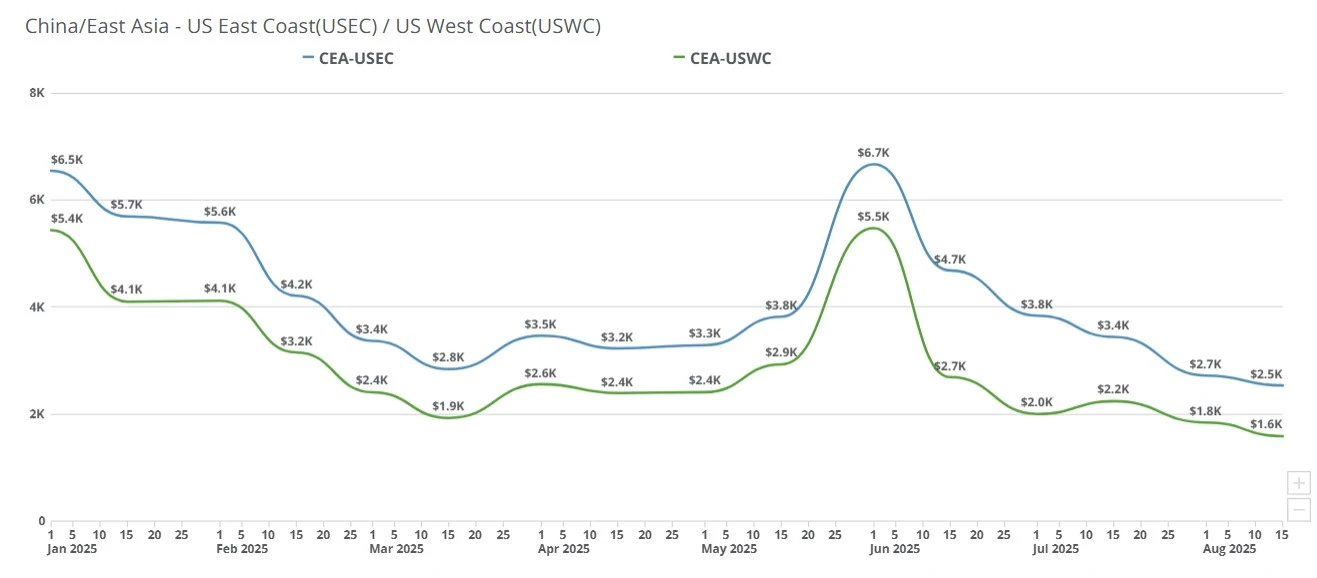
Spot Rates Dip Below 2024 Levels as Blank Sailings Ramp Up - TFX Update wk. August 18, 2025
China-US freight rates dip to $1,520/FEU as carriers cut prices and blank sailings set up a $1,000 September GRI amid weak demand and tariff risks.

Blank Sailings and Rollovers Dominate May Freight Market - TFX Update wk. May 4, 2026
China-US rates remain stable at $2,700-$3,800, but blank sailings and vessel overloading are causing record shipment rollovers and strategic rerouting through Busan.
Tariff Refunds Cushion US Importers Amid Sustained Transpacific Spot Rates - TFX Update wk. August 10, 2026
China-US ocean freight rates remain stable through late August 2026, with USWC rates holding above $7,000/FEU. Discover how aggressive carrier blank sailings and importer tariff refund cushions are sustaining transpacific rate levels ahead of the Q4 holid
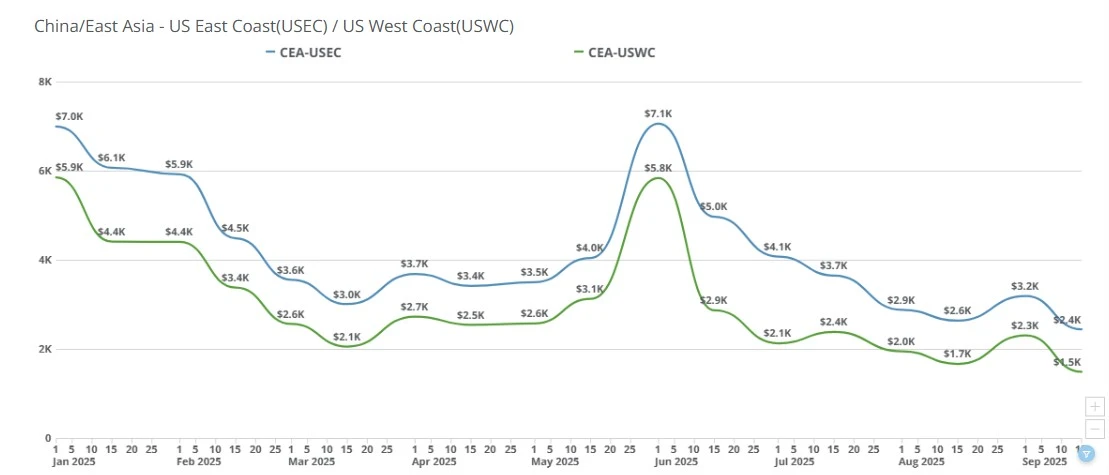
Transpac Spot Rates Slip as Golden Week Quiet Hits; USWC Near $1.3k/FEU - TFX Update wk. September 29, 2025
China-US spot rates dipped again, with USWC near $1,300/FEU. Golden Week slowdowns and tariff drag curb demand as carriers weigh blank sailings.

Ocean Freight Market Enters Holding Pattern Ahead of September - TFX Update wk. August 17, 2026
China-US ocean freight rates remain elevated in mid-August, with West Coast discounts emerging while East Coast pricing stays firm. See what carrier capacity cuts, blank sailings and demand trends could mean for September.

Is Amazon’s Inventory Placement Service worth it?
What are the pros and cons of Amazon's Inventory Placement System and when it is a good idea?
Ocean Rates Rise Again as China Holiday Squeezes Capacity - TFX Update wk. September 14, 2026
China to US ocean freight rates rise $500–$600 as blank sailings, tight capacity and unstable vessel schedules intensify ahead of China’s October holiday.

Importers Race Against July Tariff Deadlines, Throwing Supply Chains Into Chaos - TFX Update wk. June 8, 2026
Ocean freight rates skyrocket past $6,000 to USWC and $7,000 to USEC. Discover how carrier blank sailings, space deficits, and tariff front-loading are driving this early peak season crunch.