- Home
- >
- News
- >
- Ocean Rates Rise Again as China Holiday Squeezes Capacity - TFX Update wk. September 14, 2026
Ocean Rates Rise Again as China Holiday Squeezes Capacity - TFX Update wk. September 14, 2026
The Lead:
The second week of September saw trade hostilities peak after Canada activated matching 15% to 50% counter-tariffs on $27.6 billion (CAD) in US exports on September 8. Washington immediately retaliated with executive threats against major exporters, including a proposed ban on US sales of Canadian-made Bombardier aircraft.
However, as the logistical costs of operating under a centralized trade architecture mounted for crossborder manufacturers, the week concluded with the USITC opening a formal public docket on Section 338 administrative processes and diplomatic leaders signaling a potential return to the negotiating table.
This Week’s Ocean, Air & Freight Markets
China-US Ocean Freight Market:
Ocean freight rates from China to the US continued to move higher this week, with carriers maintaining firm control over available capacity. Rates increased by roughly $500–$600 per container week over week, extending the upward trend seen through the first half of September.
CEA to USWC: West Coast rates are now approximately $7,000–$8,000 per container. Space has tightened further compared with the beginning of September, with blank sailings and booking rollovers making confirmed capacity increasingly difficult to secure.
CEA to USEC: East Coast pricing remains significantly higher, with rates now above $10,000 and reaching approximately $11,000 per container in some cases. Like the West Coast, the lane is experiencing constrained capacity and increasingly unstable vessel schedules.
The bigger operational concern, however, is no longer just price. Vessel schedules have become increasingly unreliable. A shipment can secure space and still see its scheduled departure pushed back several days. When a booking rollover is combined with a delayed vessel departure, total delays can approach two weeks.
Freight Right’s Lowest Rate indicators are finding that importers can find spot rates as low as $6,400 from China to US West Coast and $8,500 from China to US East Coast. Talk to your freight forwarder about options available to you.
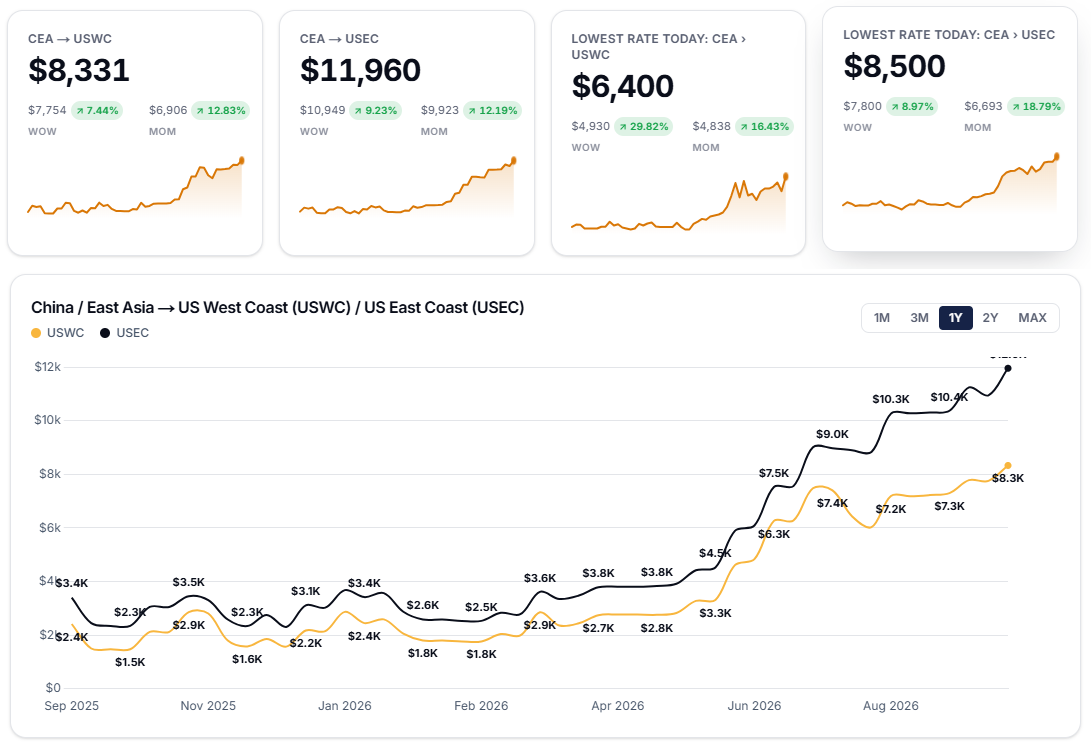
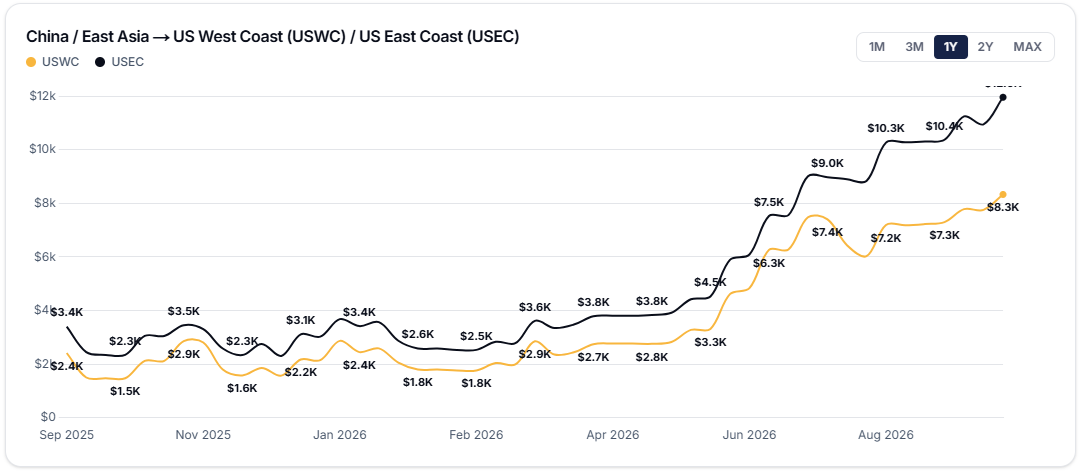
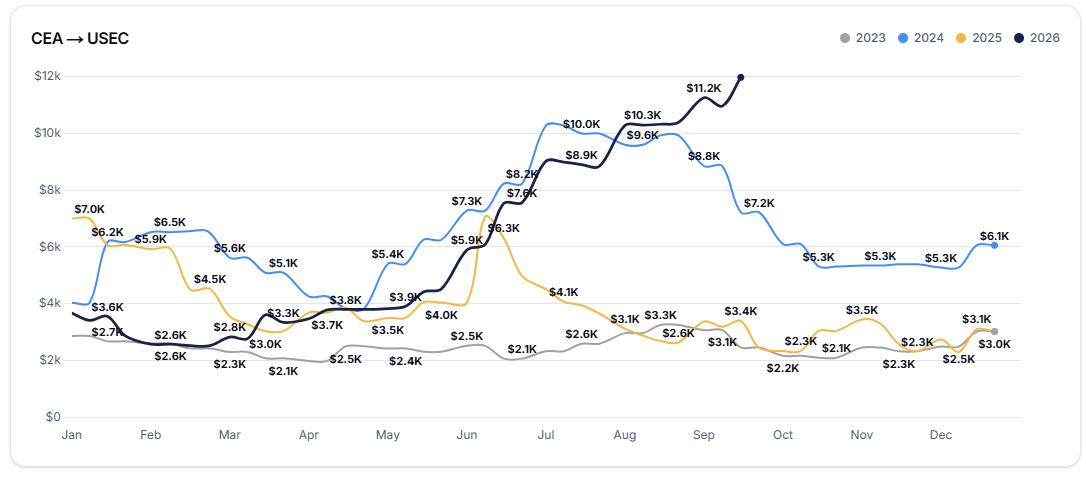
Read more about the state of the ocean freight spot market with Freight Right’s TrueFreight Index.
What Happened This Past Week
Carriers continue to restrict capacity. Blank sailings and vessel removals are keeping supply tight enough to support additional rate increases even as underlying demand remains relatively contained.
China’s upcoming holidays are creating a final shipping push. With a long weekend approaching followed by the week-long early-October holiday, importers have a narrowing window to move cargo before widespread factory and logistics closures.
Space is becoming more difficult to secure. Carriers have already announced blank sailings around the October holiday, while existing capacity is filling as shippers try to move freight before the shutdown.
Typhoon disruptions continue to affect vessel rotations. Earlier weather disruptions have created knock-on effects across sailing schedules. Vessels arriving late at one port can remain behind schedule throughout subsequent rotations.
Higher fuel costs are providing additional support for rates. While geopolitical disruptions in the Middle East do not directly affect transpacific routings in the same way they affect Europe-bound services, higher fuel costs are still influencing carrier pricing.
Looking Ahead:
The next two weeks are likely to represent the final major ocean freight push before China's early-October holiday, keeping space tight and rates elevated through the remainder of September. Additional increases are possible, but operational reliability may be the more important issue for importers than another few hundred dollars of rate movement.
Shippers should expect continued blank sailings, booking rollovers and shifting ETDs. The recommendation from this week's discussion is to increase booking lead time from roughly one week to two to three weeks, even when cargo is not yet ready. Securing space early is increasingly important when schedule reliability is low.
Conditions may remain difficult immediately after China returns from the October holiday as carriers work through accumulated cargo and reduced sailing capacity. Some urgent shipments that miss the ocean window could also shift to air freight, adding pressure to that market.
By the second half to end of October, however, ocean demand is expected to cool. Much of the inventory intended for the year-end holiday selling season will already have moved, reducing the urgency that is currently supporting rates. That creates the potential for rates to begin moving lower heading into November and December before another seasonal push develops ahead of Chinese New Year.
China-US Air Freight Market:
Air freight rates edged higher last week, but the increase remains mild as the market has yet to see the stronger demand typically expected heading into the second half of September.
CEA to USWC: Rates into Los Angeles and San Francisco are showing modest upward pressure. LAX pricing generally sits around $5.20–$6.80/kg for larger standard-density shipments, depending on carrier, origin, and routing. SFO is generally around $5.20–$6.00/kg. The movement remains limited rather than signaling a full peak-season surge.
CEA to USEC: East Coast rates remain higher, with JFK generally around $6.00–$6.80/kg for standard-density cartonized cargo, with some services above $7/kg for pallets. Rates have firmed mildly week over week, but demand has not accelerated enough to produce a significant increase.
What Happened This Past Week
Demand remains relatively subdued: The anticipated September pickup has not developed significantly yet, limiting carriers' ability to push through larger increases.
Peak-season pressure is starting slowly: Rates are beginning to firm as the market approaches the second half of September, but the increase remains gradual.
Capacity remains available: Current flight schedules and available space are generally keeping the market balanced despite early signs of stronger pre-holiday activity.
East Coast remains more expensive: Longer routings and tighter economics continue to keep JFK pricing above major West Coast gateways.
China's Golden Week is getting closer: Shippers have a narrowing window to move cargo before China's early-October holiday, creating the potential for a concentrated demand increase later in September.
Looking Ahead:
The next two weeks will be the key test for the September air freight market. Rates are likely to continue trending upward, but the magnitude will depend on whether the expected pre-Golden Week shipping push actually materializes.
If shippers begin moving significantly more cargo ahead of the October holiday, available capacity could tighten quickly and produce more pronounced increases on both US coasts. The risk of a sharper move is greatest during the second half of September as the pre-holiday shipping window closes.
For now, the market is firming rather than surging. That could change quickly if demand becomes concentrated during the final two weeks before Golden Week.
In the News:
WSJ: Shipping Nations Warn of Structural Shift in Global Trade
https://www.wsj.com/logistics-report/shipping-nations-warn-of-structural-shift-in-global-trade-cdb207d0
Bloomberg: Shipping Nations Warn Global Trade Is Fracturing, And Everyone Pays
https://www.bloomberg.com/news/articles/2026-09-09/shipping-nations-warn-global-trade-is-fracturing-and-everyone-pays
Reuters: Carney, locked in US trade war, pitches Canada to global investment titans
https://www.reuters.com/business/carney-locked-us-trade-war-pitches-canada-global-investment-titans-2026-09-14/
NY Times: Trump’s Tariffs Tear at the Bond Between Twin Border Towns
https://www.nytimes.com/2026/09/13/world/canada/trump-tariffs-ontario-michigan-algoma-steel.html
ABC News: China says it hopes to agree with US on tariff reductions 'at an early date'
https://abcnews.com/International/wireStory/china-hopes-agree-us-tariff-reductions-early-date-136328623
More News

Transpacific Ocean Freight Rates Hold High as Peak Season Nears Early Close - TFX Update wk. September 7, 2026
China to US ocean freight rates remain elevated in September, with USWC rates near $7,000 and USEC rates at $8,000–$9,000 amid strong demand, tight space and vessel delays.

Blank Sailings and Rollovers Dominate May Freight Market - TFX Update wk. May 4, 2026
China-US rates remain stable at $2,700-$3,800, but blank sailings and vessel overloading are causing record shipment rollovers and strategic rerouting through Busan.

Ocean Freight Rates Hold Firm as Carriers Keep Capacity Tight - TFX Update wk. August 24, 2026
China to US ocean freight rates remain firm as West Coast rates rebound 9% and East Coast rates rise 3%. See what’s driving the market and the outlook for September.

Ocean Freight Market Enters Holding Pattern Ahead of September - TFX Update wk. August 17, 2026
China-US ocean freight rates remain elevated in mid-August, with West Coast discounts emerging while East Coast pricing stays firm. See what carrier capacity cuts, blank sailings and demand trends could mean for September.
US East Coast Freight Targets $4,500 Threshold - TFX Update wk. May 11, 2026
China to US rates surge toward $4,500 as carriers implement mid-month hikes. Learn how post-holiday demand, IEEPA refunds, and shifting air freight trends are redefining Trans-Pacific logistics strategies.
Carriers Hold the Line at $1,500 Floor - TFX Update wk. March 9, 2026
Ocean rates hold steady at $1,500 for USWC as Chinese factories reopen. Explore why the post-holiday rate war never arrived and what this means for April contract negotiations.
Spot Rates Dip Below 2024 Levels as Blank Sailings Ramp Up - TFX Update wk. August 18, 2025
China-US freight rates dip to $1,520/FEU as carriers cut prices and blank sailings set up a $1,000 September GRI amid weak demand and tariff risks.
Transpac Spot Rates Slip as Golden Week Quiet Hits; USWC Near $1.3k/FEU - TFX Update wk. September 29, 2025
China-US spot rates dipped again, with USWC near $1,300/FEU. Golden Week slowdowns and tariff drag curb demand as carriers weigh blank sailings.

Capacity Management & Holiday Rush Drive Transpacific Freight Rates Higher - TFX Update wk. August 31, 2026
Discover why strategic blank sailings and early holiday inventory shipments are driving Transpacific container rates up to $10k per FEU this September
Ocean Rates Up as Volumes Continue to Sink - TFX Update wk. March 23, 2026
Understand why ocean freight rates are climbing despite record low volumes. Our March 2026 update covers the $600 rate hikes, new emergency fuel surcharges, and how blank sailings are impacting China-to-US shipping costs.