- Home
- >
- News
- >
- China-U.S. Ocean Freight Outlook: Stable October Rates, November Easing - TFX Update wk. October 19, 2026
China-U.S. Ocean Freight Outlook: Stable October Rates, November Easing - TFX Update wk. October 19, 2026
Key Takeaways
Ocean rates hold steady. China–U.S. spot rates remain near $7,000 per 40-foot container to the West Coast and $8,000 to the East Coast.
Space is opening up. Easing peak-season demand is improving booking availability, with select rates as low as $6,400 West Coast and $7,800 East Coast.
Gradual declines ahead. Rates are expected to soften into November and December, though carrier blank sailings could limit reductions.
Air freight remains tight. E-commerce and technology shipments are driving frequent price increases, with elevated rates expected through year-end.
January could bring a rebound. The article forecasts renewed ocean rate pressure as importers ship ahead of Chinese New Year factory closures.
The Lead:
The third week of October highlighted ongoing corporate adaptation under Washington's centralized trade architecture alongside strategic diplomatic moves in Europe. While the EU and China secured a 16-point commercial trade deal in Brussels to stabilize green-tech supply chains, North American automotive leaders held emergency summit talks in Detroit to lobby against a 50% vehicle tariff planned for January 2027.
Concurrently, supply chain managers faced urgent administrative windows as CBP issued a firm November 4 deadline for importers to reclaim back-duties under CAPE Phase 3, even as border updates confirmed that Section 301 forced-labor duties and Section 338 Canadian import bans remain fully enforced.
This Week’s Ocean, Air & Freight Markets
China-US Ocean Freight Market:
China to US ocean freight rates held broadly steady this week as booking space became more available. The market has stabilized, with signs pointing toward softer pricing as peak-season demand fades.
CEA to USWC: Spot rates have stabilized, hovering near $7,000 per FEU. While baseline market rates remain flat through month-end, additional capacity is opening up. Aggressive pricing anomalies exist among niche carriers, such as Ocean Network Express (ONE), offering rates significantly below general market averages, though space on these lower-cost options is fully booked through October.
CEA to USEC: Rates have similarly settled, holding around $8,000 per FEU. Space conditions have eased in tandem with the West Coast, ending the extreme tightness observed earlier in the season.
Freight Right’s Lowest Rate indicators are finding that importers can find spot rates as low as $6,400 from China to US West Coast and $7,800 from China to US East Coast. Talk to your freight forwarder about options available to you.
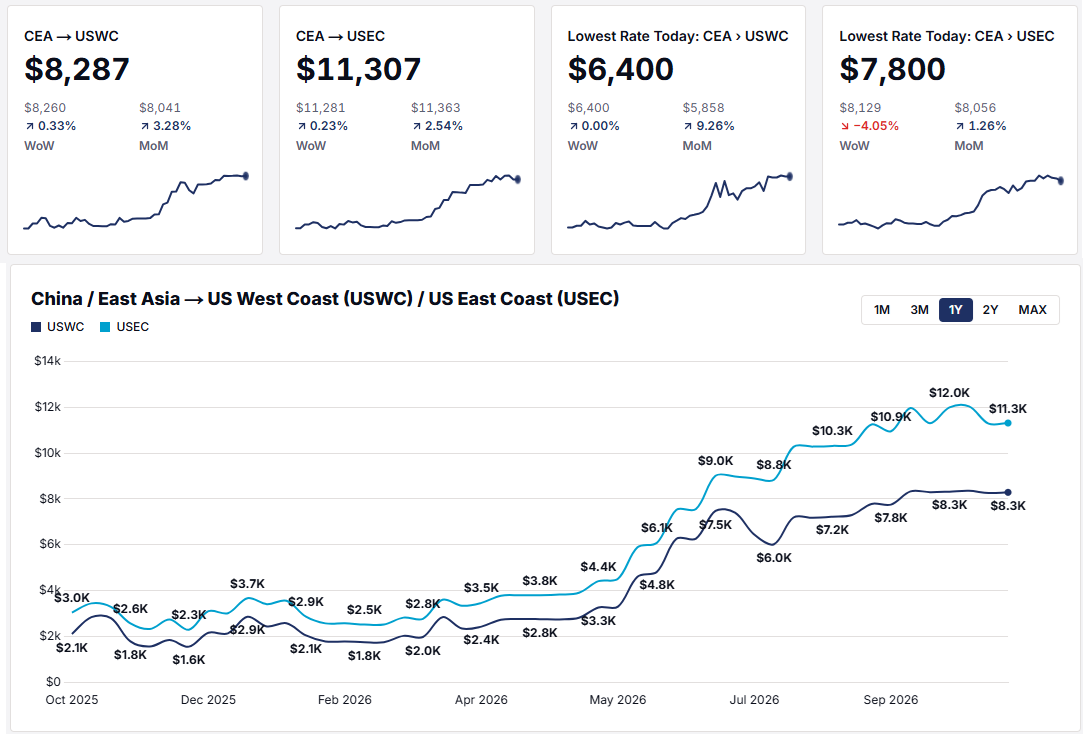
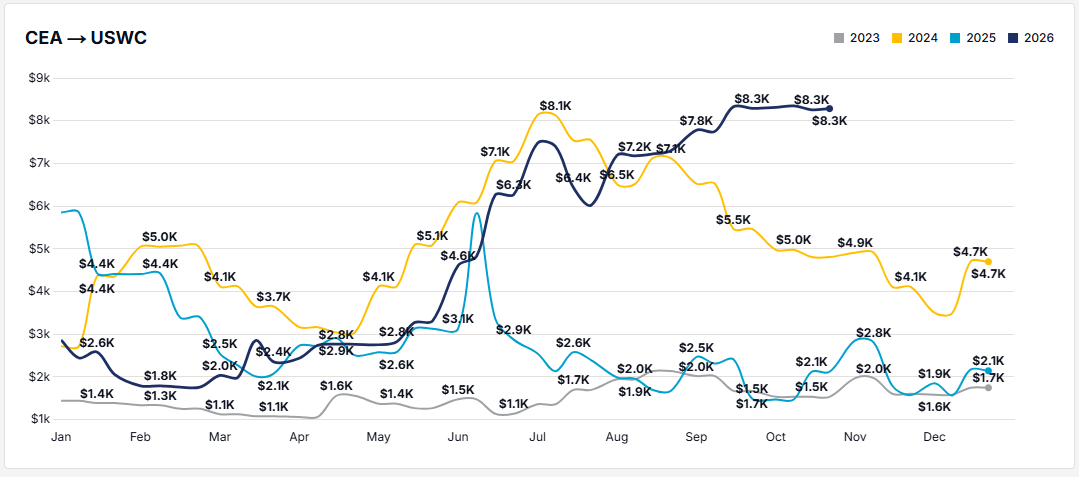
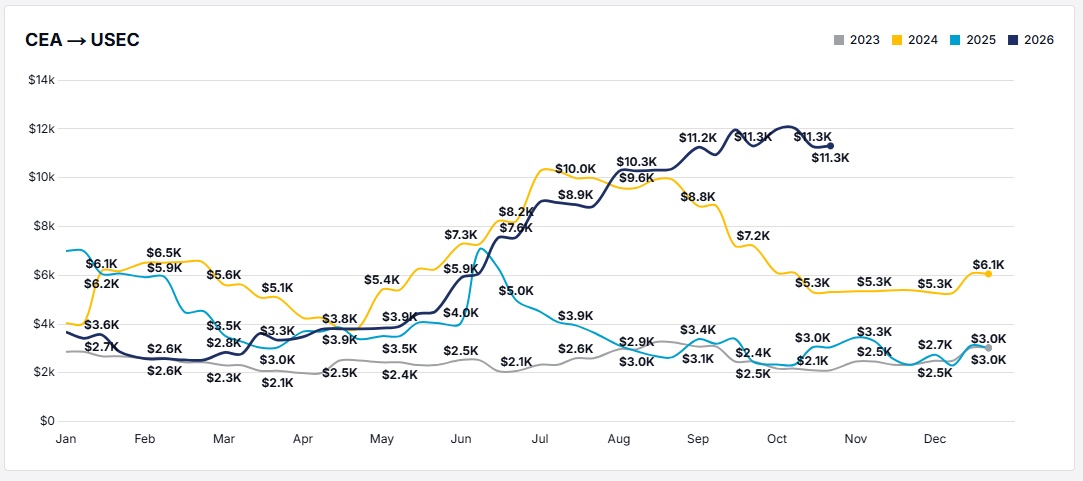
Read more about the state of the ocean freight spot market with Freight Right’s TrueFreight Index.
A Closer Look:
End of Season Demand Drop: The peak shipping season is officially wrapping up. Volume is beginning a natural seasonal decline, relieving pressure on ocean carrier capacity.
Amazon Holiday Inbound Cutoffs: Crucial cutoffs for shipping goods into Amazon FBA fulfillment centers for the holiday selling season took effect on October 21, with final extreme cutoffs set for October 28–29. Ocean shipments departing Asia now will not arrive in time for holiday sales, driving down demand for new ocean bookings.
Increased Freight Forwarder & Agent Capacity: Space availability through overseas agents has improved compared to late August and September. Discounted "special rates" that previously suffered from severe rollings and zero space are now open and accessible for bookings.
Persistent Schedule Instability: Vessel reliability remains inconsistent across major carrier alliances. Booking rollings continue for cargo currently in transit, though new ocean bookings made this week are expected to encounter fewer delays as volume softens.
Looking Ahead:
The ocean freight market is expected to experience a mild rate degradation through late October and into November and December as seasonal volumes drop off. However, shippers should not expect a total rate collapse; ocean carriers are likely to manage capacity tightly via blank sailings to defend rate floors heading into the end of the year.
Looking into early 2027, a sharp rate rebound is expected in January as importers rush to move cargo ahead of the early Chinese New Year (beginning the first week of February). Ocean carriers will leverage this pre-holiday push to maximize spot rates and profitability before the extended factory closures begin.
Meanwhile, air freight is experiencing the exact opposite trend: as ocean cutoffs pass, importers needing last-minute holiday inventory are shifting urgent cargo to air, pushing transpacific air rates up to 8.00–9.00/kg with lead times stretching to a week.
China-US Air Freight Market:
China to US air freight rates remain under upward pressure this week as demand from e-commerce shippers and major technology companies increases. Since last week, some rates have risen multiple times within a single day, making pricing and booking conditions highly volatile.
CEA to USWC: quotes for cartons at a density of 167 kg/CBM show China to LAX rates ranging from approximately $6.46 to $10.00/kg, depending on origin, routing, and shipment weight. Comparable China to SFO services range from approximately $6.46 to $7.54/kg. Connecting services offer lower quoted rates than some direct flights.
CEA to USEC: Comparable China to JFK quotes range from approximately $6.92 to $9.08/kg. Services connecting through Tokyo sit at the lower end, while direct Shanghai-to-JFK service is quoted near the upper end.
A Closer Look:
Higher e-commerce demand: Increased shipping activity is adding pressure to available China-to-U.S. air cargo capacity.
Large technology shipments: Demand from major shippers such as Apple is increasing competition for space.
Frequent repricing: Multiple increases within a single day mean quoted costs can change quickly before a booking is confirmed.
Wide differences between services: Origin airport, routing, cargo density, and shipment weight affect pricing, creating substantial differences between available options.
Looking Ahead:
Air freight rates are expected to remain elevated through the end of 2026. Continued demand from e-commerce and major technology shippers is likely to sustain pressure on capacity, with further short-term price changes possible.
Shippers should confirm pricing and space close to booking and allow room for increases in freight budgets. Where delivery schedules permit, comparing connecting services and alternative departure airports may help control costs.
In the News:
CNN: How the US-Iran war upended two critical global trade routes
https://edition.cnn.com/2026/10/17/economy/us-iran-war-shipping-trade-hormuz-bab-el-mandab-strait-intl-vis
Reuters: Trump's Russia sanctions waiver eases India's energy woes, lifts trade deal chances
https://www.reuters.com/world/india/trumps-russia-sanctions-waiver-eases-indias-energy-woes-lifts-trade-deal-chances-2026-10-19/
WSJ: Tariffs on Metals, Autos Mire Down US-Mexico Trade Talks
https://www.wsj.com/logistics-report/tariffs-on-metals-autos-mire-down-u-s-mexico-trade-talks-c1be20d2
Financial Times: South Africa’s president eyes trade with China and India as US ties sour
https://www.ft.com/content/617fb017-e08e-4e37-abac-a38731b2de3c?syn-25a6b1a6=1
NYTimes: Trump Tariffs on Canada Spark Latest Lawsuit Over Trade Powers
https://www.nytimes.com/2026/10/20/business/trump-tariffs-canada-lawsuit.html
More News
China–US West and East Coast Rates Hold Flat After Short-Lived December Rate Spike - TFX Update wk. December 1, 2025
Weekly ocean freight update on China–US West and East Coast lanes as an early December GRI fades, leaving spot rates near November levels amid weak demand.
China-U.S. Ocean Freight Steadies as Carriers Prepare $1,000 November GRI - TFX Update wk. October 27, 2025
U.S-China trade deal specifics; transpacific freight rates hold steady as carriers plan a $1,000 GRI for Nov. 1, easing fears after tariff threats and muted seasonal demand.

Transpacific Ocean Freight Rates Hold High as Peak Season Nears Early Close - TFX Update wk. September 7, 2026
China to US ocean freight rates remain elevated in September, with USWC rates near $7,000 and USEC rates at $8,000–$9,000 amid strong demand, tight space and vessel delays.
Spot Rates Plunge on Both Coasts With Short Holiday Week and Weak Imports - TFX Update wk. November 24, 2025
Transpacific ocean freight rates dropped sharply this week as weak import demand and the Thanksgiving holiday slowdown pushed China–US West and East Coast spot prices to new lows. Get the latest market drivers and outlook.
Freight Market Correction Deepens on CEA-US Routes After November GRI - TFX Update wk. November 3, 2025
China–US ocean freight rates fall as carriers discount to fill space. CEA-USWC down $400-$500; CEA-USEC near $2,800. See what’s driving the drop and what’s next.
China-US Ocean Rates Ease Again as Post-Peak Lull Deepens - TFX Update wk. November 10, 2025
Transpacific ocean freight rates continue to decline as post-peak demand cools. China–US West Coast rates near $1,700, East Coast around $2,600 per FEU.

Ocean Freight Rates Hold Firm as Carriers Keep Capacity Tight - TFX Update wk. August 24, 2026
China to US ocean freight rates remain firm as West Coast rates rebound 9% and East Coast rates rise 3%. See what’s driving the market and the outlook for September.
Carriers Begin Small Rate Cuts as Transpacific Market Loses Momentum - TFX Update wk. July 6, 2026
China–US ocean freight rates from CEA to the US West Coast and East Coast softened slightly week over week as demand remained low, carriers tested modest reductions, and the market appeared to reach a near-term rate ceiling.
Transpacific Rates Pop Again: Carriers Push Mid-December Increases Into January - TFX Update wk. December 15, 2025
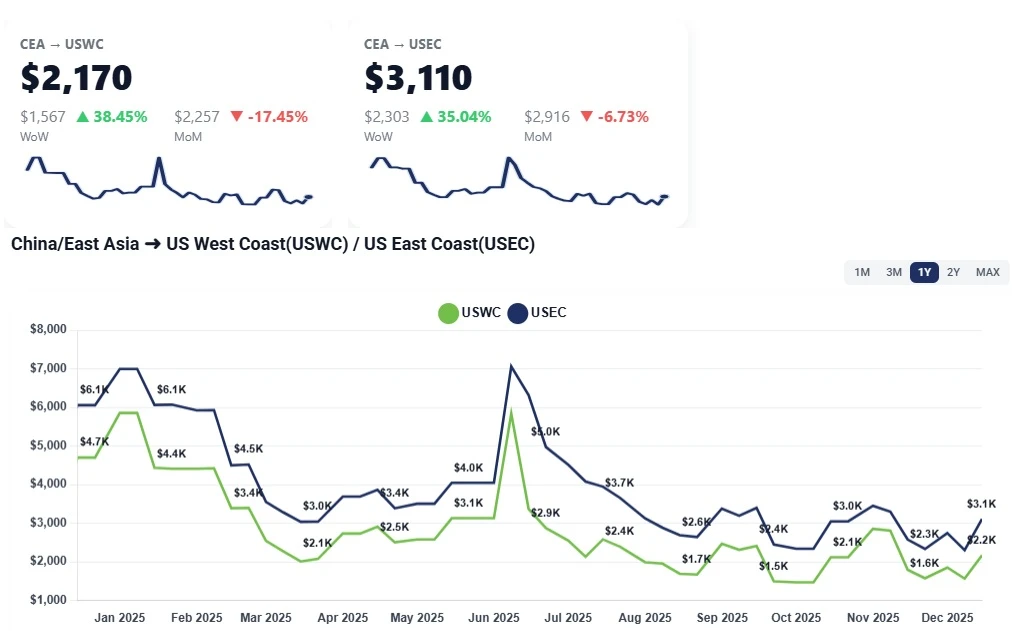
China–US ocean freight rates rose WoW: USWC near $2.1K/FEU and USEC near $2.9–$3.0K as carriers end fixed extensions and hold firm into January.
Tariff Refunds Cushion US Importers Amid Sustained Transpacific Spot Rates - TFX Update wk. August 10, 2026
China-US ocean freight rates remain stable through late August 2026, with USWC rates holding above $7,000/FEU. Discover how aggressive carrier blank sailings and importer tariff refund cushions are sustaining transpacific rate levels ahead of the Q4 holid