- Home
- >
- News
- >
- Ocean Freight Rates Hold Firm as Carriers Keep Capacity Tight - TFX Update wk. August 24, 2026
Ocean Freight Rates Hold Firm as Carriers Keep Capacity Tight - TFX Update wk. August 24, 2026
The Lead:
Last week represented an unprecedented escalation in North American trade friction, as Washington invoked Section 338 of the Tariff Act of 1930, a dormant authority not deployed in decades, to slap 50% tariffs on $20 billion of Canadian imports.
Following a brief three-day pause that failed to break a diplomatic deadlock over agricultural access and motor vehicle rules, the punitive levies officially took effect on August 22.
Because the 50% duty applies even to USMCA-compliant products, the move effectively overrode North American free-trade protections for covered sectors, prompting Canada to prepare matching counter-tariffs for early September and driving transatlantic supply chains deeper into uncertainty.
This Week’s Ocean, Air & Freight Markets
China-US Ocean Freight Market:
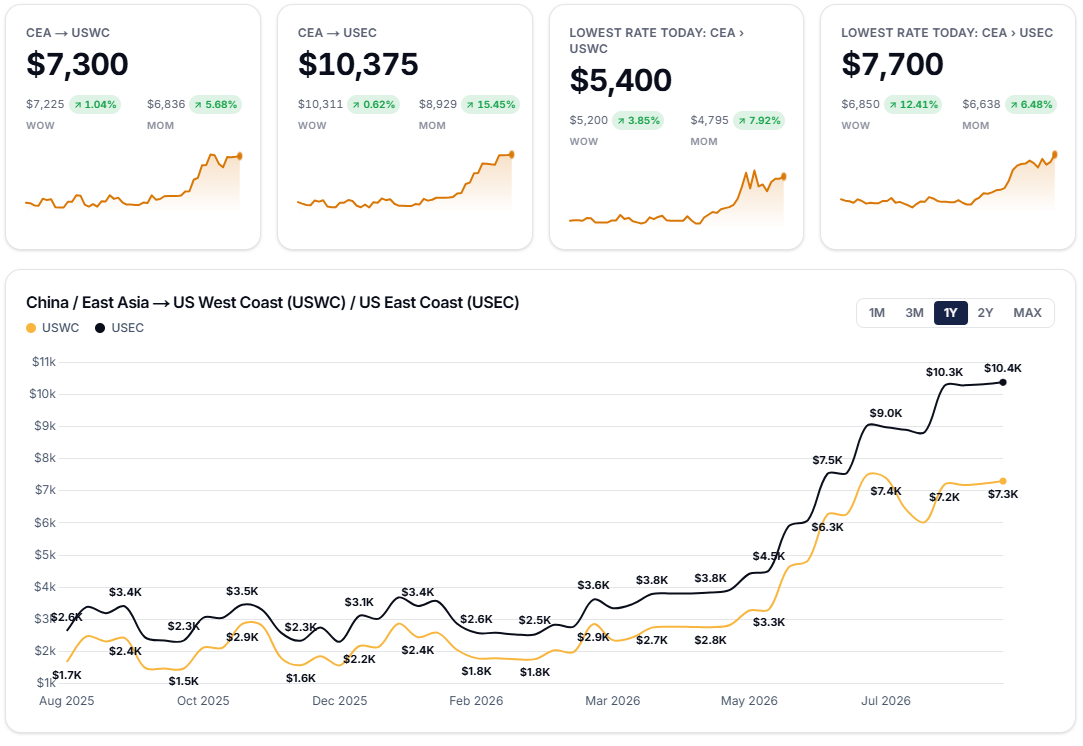
Ocean freight rates remained broadly stable this week, with no significant upward or downward movement in actual market pricing compared with previous week. Demand remains present, but the bigger factor supporting rates is carriers’ continued discipline around vessel deployment and available capacity.
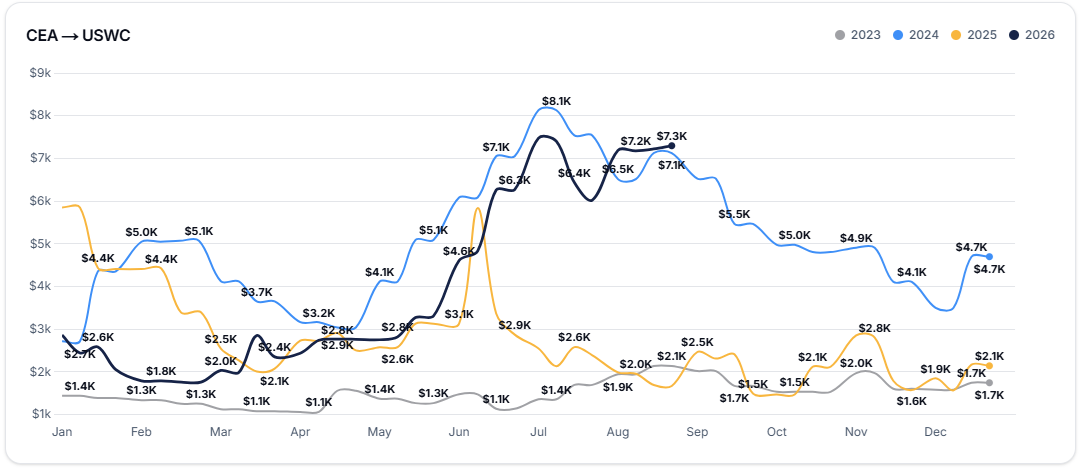
CEA to USWC: Market indicators showed an approximately 9% week-over-week increase. The larger percentage move primarily reflects a rebound from the rate declines seen on the West Coast earlier in the second half of August, rather than a sudden surge in demand. West Coast pricing had previously fallen more sharply than East Coast pricing, creating more room for rates to recover.
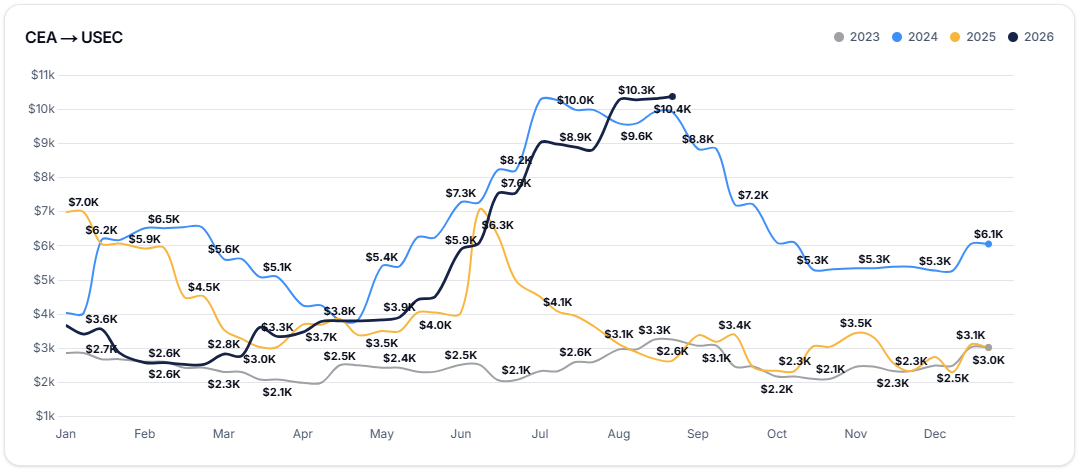
CEA to USEC: Rates increased by approximately 3% week-over-week. East Coast pricing did not experience the same degree of decline earlier in August, so its increase this week was more moderate. Space to the East Coast has also tightened somewhat, but this appears to be driven more by carriers actively managing vessel capacity than by exceptionally strong demand.
Freight Right’s Lowest Rate indicators are finding that importers can find spot rates as low as $5,400 from China to US West Coast and $7,700 from China to US East Coast. Talk to your freight forwarder about options available to you.
Read more about the state of the ocean freight spot market with Freight Right’s TrueFreight Index.
What Happened This Past Week
Carrier capacity management is keeping rates supported. Carriers have been successful at managing vessel rotations and available supply, preventing excess capacity from pushing rates materially lower even without a major demand surge.
Demand remains present but has not accelerated dramatically. The market continues to have enough cargo demand to support current pricing, but there is little evidence of the kind of volume spike that would normally produce a substantial rate increase.
Tariff developments have had little immediate impact on booking behavior. According to this week's discussion, recent tariff-related developments have not materially changed shipping activity. Importers appear to be continuing with existing shipping plans rather than significantly accelerating or delaying cargo.
Looking Ahead:
The transpacific market appears positioned to enter September on relatively firm footing, but a major rate increase is not currently expected. There have been indications that carriers could attempt increases in September, though the current market does not suggest that a significant jump is imminent.
Instead, the more likely scenario is a continuation of the pattern seen through August: stable to moderately firmer rates supported by disciplined capacity management rather than a major demand-driven surge. Carriers' ability to adjust vessel supply will remain important. As long as they keep capacity closely aligned with demand, there is limited room for rates to fall substantially.
The East Coast bears watching in particular. With space already becoming somewhat tighter, further capacity reductions or an increase in bookings could put additional upward pressure on pricing. On the West Coast, the recent rebound may begin to level out once rates have recovered from their earlier August decline.
India-US Ocean Freight Market:
Conditions out of India remain severely constrained, with little meaningful improvement in the backlog that has been affecting export bookings. Available vessel space remains tight, lead times are extended, and carriers are taking a stricter approach to confirmed bookings as they work through accumulated cargo.
Current bookings are generally running approximately three weeks out, making advance planning increasingly important for shippers moving freight from India.
What Happened This Past Week
Export capacity remains heavily constrained. Carriers are continuing to manage available space closely as they work through a substantial backlog of shipments waiting to move.
Lead times remain extended. Export bookings are currently running approximately three weeks out, with limited evidence that conditions are beginning to normalize.
Carriers are tightening booking commitments. Space is being allocated more carefully to shipments that are considered firm, reducing carriers' exposure to speculative bookings that may later be canceled or rolled.
Cancellation and rollover fees are being enforced more aggressively. Once space is confirmed, changing or canceling a booking can result in significant penalties. In some cases, cancellation fees are running around $350 per booking.
Flexibility is limited once space is confirmed. Even cancellations made shortly after confirmation may still be subject to fees, leaving shippers with considerably less room to adjust plans than under normal market conditions.
The issue remains concentrated in India. Similar restrictions are not currently widespread in China, outside of certain special-rate or restricted-capacity arrangements.
Looking Ahead:
India's export market is likely to remain difficult in the near term as carriers continue working through the existing backlog and tightly controlling vessel space.
Shippers should expect longer booking lead times and should be particularly cautious about confirming space before cargo plans are firm. With carriers enforcing cancellation and rollover penalties more strictly, booking speculatively and making changes later can become expensive.
The key signal to watch will be whether booking lead times begin to shorten from the current approximately three-week window. Until that happens, the market should be treated as capacity-constrained, with early planning and firm shipment commitments increasingly important.
China-US Air Freight Market:
CEA to USWC: Air freight rates remained broadly stable week-over-week. Currently, pricing into LAX and SFO generally sits around $5.00–$6.30/kg for standard-density cargo, depending on origin, carrier, routing, and shipment configuration.
There has been little underlying rate movement this week, with available capacity and demand remaining relatively balanced.
CEA to USEC: Rates for this route were also largely unchanged. Standard-density options into JFK are generally around $6.25–$6.70/kg, with pricing varying by carrier and whether cargo is palletized. Like the West Coast, the East Coast market has avoided any significant rate movement this week, pointing to relatively stable demand and capacity conditions.
What Happened This Past Week
Flight schedules remain relatively normal: Unlike the temporary disruption seen from Typhoon Dolphin earlier in August, current schedules have been sufficiently stable to keep capacity flowing and prevent significant backlogs.
Typhoon Saudel is the key near-term risk: The approaching storm is expected to affect parts of Fujian and Guangdong over the weekend, potentially disrupting flights and cargo handling from important South China gateways.
Potential capacity pressure remains event-driven: Any rate increase would likely be tied to flight cancellations, delayed departures, or cargo backlogs rather than a broader increase in underlying air freight demand.
Looking Ahead:
The baseline outlook is for air freight rates to remain relatively stable, but Typhoon Saudel introduces additional uncertainty heading into the weekend and early next week.
If the storm causes significant flight cancellations or airport disruptions, available capacity could temporarily tighten and create cargo backlogs. That could lead to short-term upward pressure on rates, particularly for shipments originating in South China.
However, if flight operations normalize quickly and any backlog is cleared without a significant demand surge, the impact should be temporary. For now, the market appears stable, with weather-related disruption rather than demand growth representing the biggest near-term risk to rates.
In the News:
CNBC: US retreat from global order ‘eroding’ European competitiveness, central bank boss warns
https://www.cnbc.com/2026/08/19/lagarde-ecb-europe-economy-trump.html
NBC: The Iran war is pushing US allies and rivals to a risky new frontier for global trade: The Arctic
https://www.nbcnews.com/world/asia/new-arctic-trade-route-china-south-korea-shippping-europe-russia-rcna593868
Bloomberg: India Lifts Wheat Export Ban in Boost to War-Hit World Trade
https://www.bloomberg.com/news/articles/2026-08-24/india-lifts-wheat-export-ban-in-boost-to-war-hit-global-supply
NY Times: Trump Threatens Even Higher Tariffs on Canadian Exports After Talks Unravel
https://www.nytimes.com/2026/08/24/business/economy/trump-canada-tariffs.html
The Guardian: Canada vows ‘dollar for dollar’ response as US puts 50% tariffs on some goods
https://www.theguardian.com/world/2026/aug/22/canada-tariffs-trump-trade-deal-talks-fail
More News
Ocean Rates Rise Again as China Holiday Squeezes Capacity - TFX Update wk. September 14, 2026
China to US ocean freight rates rise $500–$600 as blank sailings, tight capacity and unstable vessel schedules intensify ahead of China’s October holiday.

Ocean Freight Market Enters Holding Pattern Ahead of September - TFX Update wk. August 17, 2026
China-US ocean freight rates remain elevated in mid-August, with West Coast discounts emerging while East Coast pricing stays firm. See what carrier capacity cuts, blank sailings and demand trends could mean for September.

Transpacific Ocean Freight Rates Hold High as Peak Season Nears Early Close - TFX Update wk. September 7, 2026
China to US ocean freight rates remain elevated in September, with USWC rates near $7,000 and USEC rates at $8,000–$9,000 amid strong demand, tight space and vessel delays.
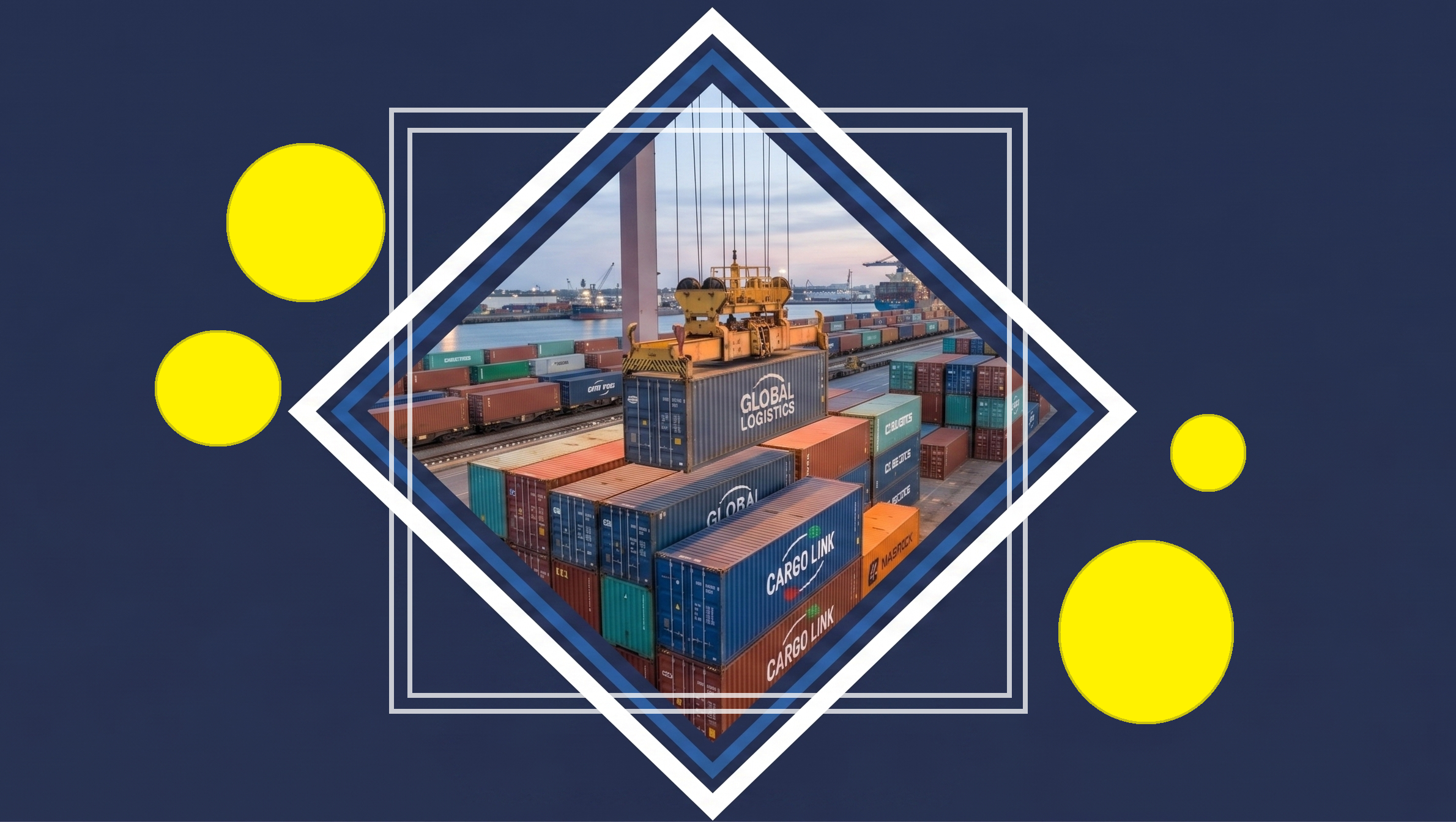
Carriers Prepare August GRIs Following Sharp West Coast Rate Decline - TFX Update wk. July 27, 2026
China to US ocean freight rates declined again this week, led by sharp drops on West Coast routes while East Coast pricing remained relatively resilient. Learn what's driving the market correction, August rate increases, and what to expect as peak shippin

Ocean Freight Rates Double Since March as Carriers Aggressively Squeeze Capacity - TFX Update wk. May 18, 2026
Ocean freight rates double for USWC and USEC as carrier capacity cuts trigger severe space shortages and rolled cargo. Read the latest weekly freight market update on rising spot rates, premium expedited shipping surges, and the June GRI outlook.

August Ocean Rate Increase Begins to Unravel as Importers Hold Back - TFX Update wk. August 3, 2026
China to US ocean freight rates rose above $7,000 in early August, but weak demand, excess West Coast capacity, and aggressive discounting are pushing rates back toward the mid-$5,000 range
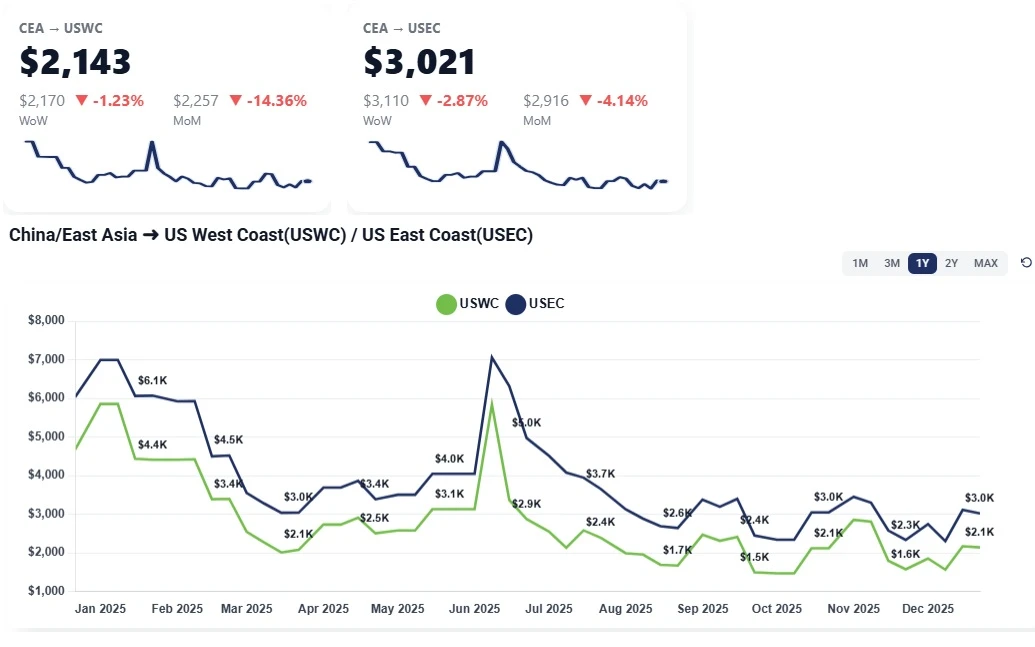
Ocean Freight Rates Hold Firm as Carriers Defend Pricing Into 2026 Contract Season - TFX Update wk. December 29, 2025
Transpacific ocean freight rates from China to the US West and East Coasts remained elevated week over week as carriers held firm through the holiday slowdown, positioning pricing ahead of Chinese New Year and upcoming contract season negotiations.
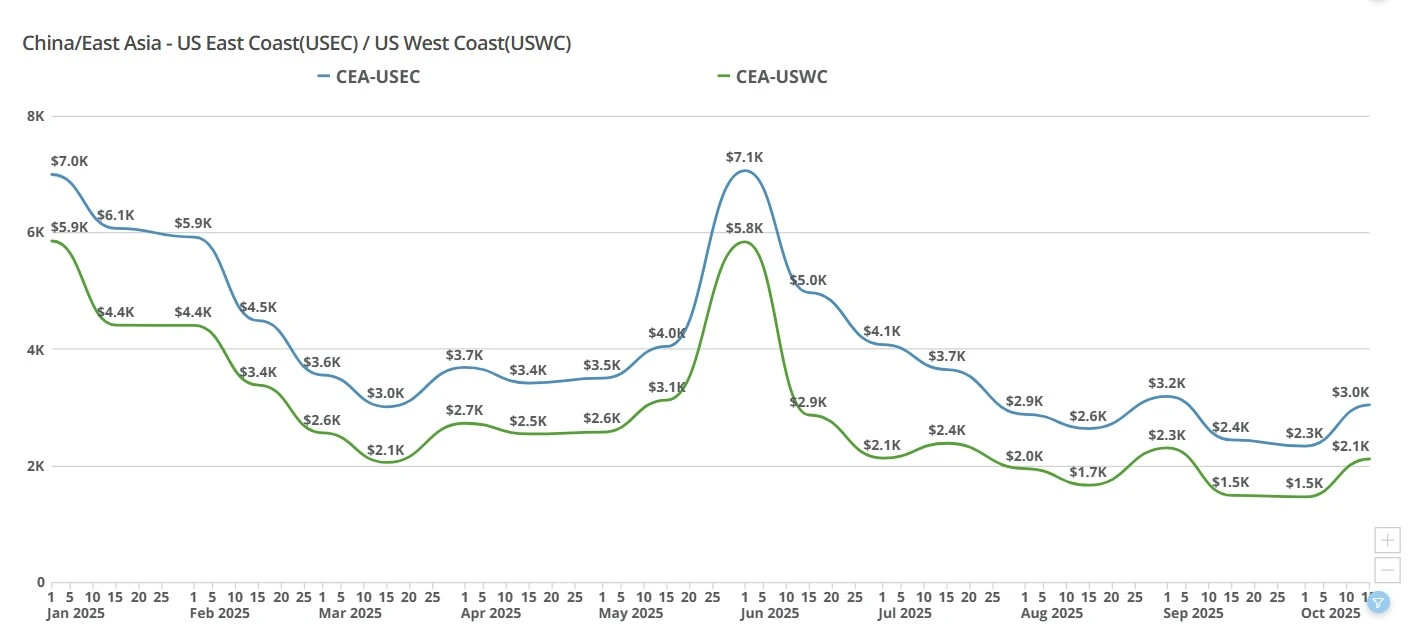
Ocean Spot Rates Rise $700–$900; Air Freight Climbs on Apple Charters and Tariff Rush - TFX Update wk. October 13, 2025
Transpacific ocean and air rates jump as carriers pull capacity, Apple charters tighten space, and shippers rush to beat U.S. tariff deadlines
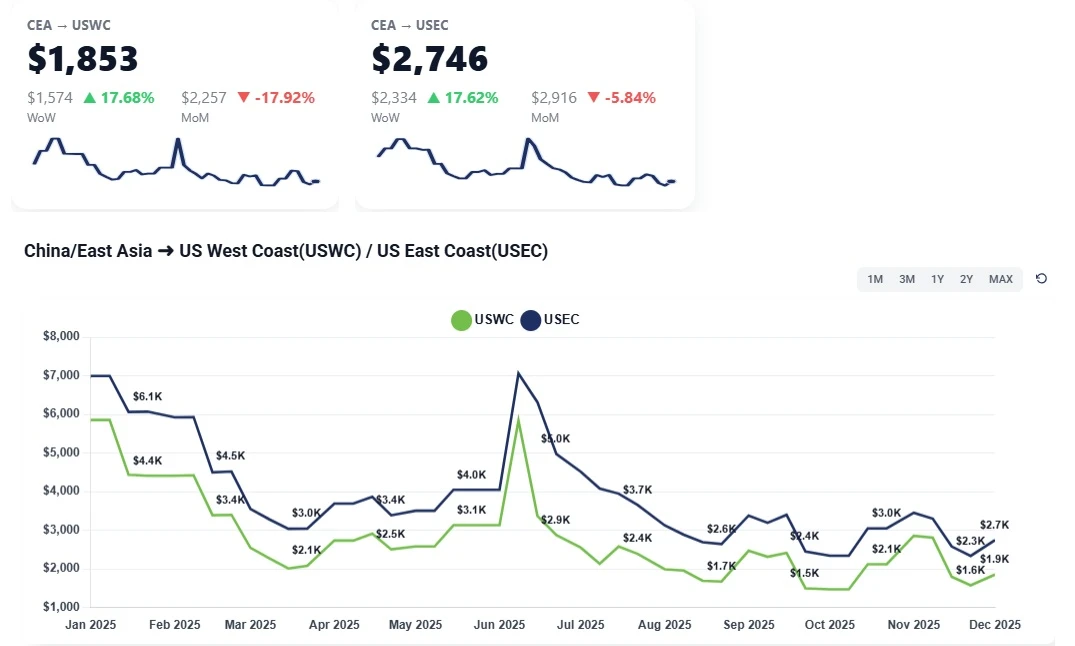
China–US West and East Coast Rates Hold Flat After Short-Lived December Rate Spike - TFX Update wk. December 1, 2025
Weekly ocean freight update on China–US West and East Coast lanes as an early December GRI fades, leaving spot rates near November levels amid weak demand.

USWC Up & USEC Down, Supply and Demand Imbalances Persist & More - TFX Update: wk. July 21st, 2025
FEU & TEU rates change slightly week-over-week, importers that can afford to keep importing are continuning to do so while those that are hamstrung by tariffs are sidelined and the August 1st tariff deadline is one week away.