- Home
- >
- News
- >
- China-US Ocean Rates Hold Steady as Post-Holiday Space Tightens - TFX Update wk. October 12, 2026
China-US Ocean Rates Hold Steady as Post-Holiday Space Tightens - TFX Update wk. October 12, 2026
The Lead:
Mid-October 2026 saw the global trading landscape focus heavily on technical compliance and long-term litigation management. U.S. Customs and Border Protection launched Phase 3 of its automated CAPE portal to process remaining back-duty refunds from struck-down tariffs, even as the US Court of International Trade froze pending Section 122 importer lawsuits while appellate courts review executive authority. Concurrently, cross-border supply chains operating under Washington's centralized trade architecture shifted attention to auto manufacturing, with industry leaders launching urgent campaigns in Detroit to avert a proposed 50% automotive tariff hike threatened for early 2027.
This Week’s Ocean, Air & Freight Markets
China-US Ocean Freight Market:
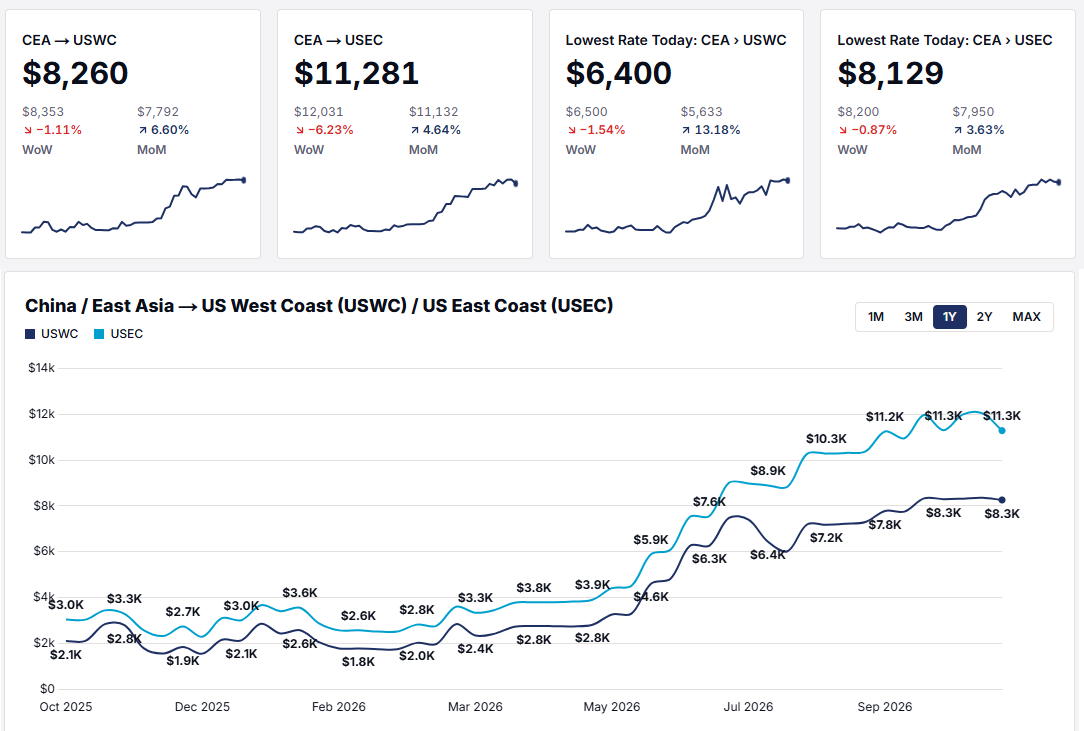
China to US ocean freight rates remain unchanged week over week as carriers extend first-half October pricing. However, space has become harder to secure following China’s National Day holiday, making booking lead times and schedule reliability more pressing concerns.
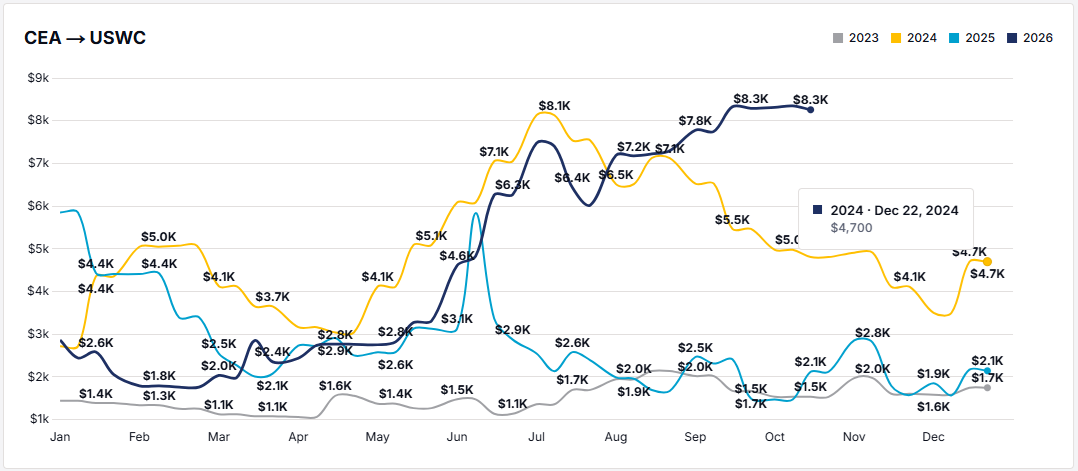
CEA to USWC: Standard market rates are hovering around $8,000/FEU. However, secondary volume discount rates are available at $6,900 to $7,000/FEU for multi-container commitments. Rates have remained unchanged relative to the first half of the month.
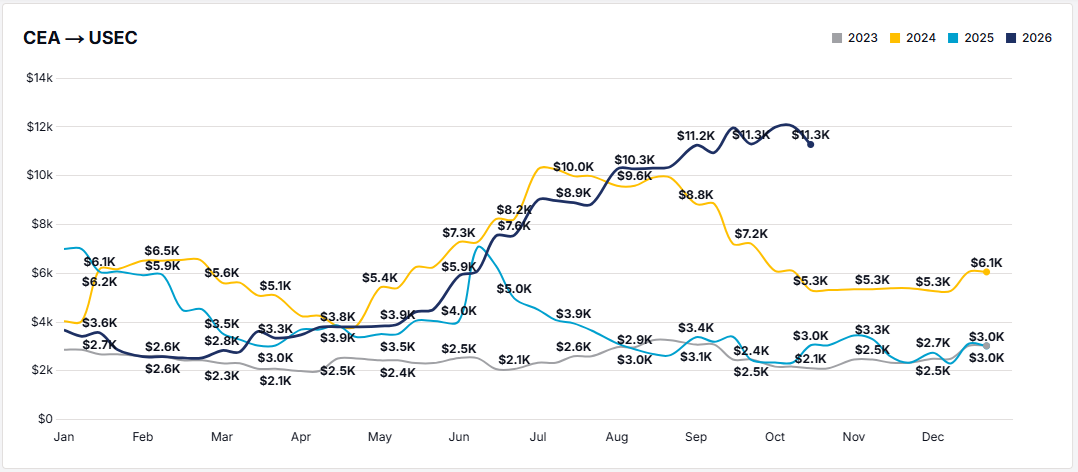
CEA to USEC: Rates continue to hold in the $9,000+/FEU range. Special blended rates for higher-volume bookings are holding near $8,450/FEU. As with the West Coast, rates have shown no net increase or decrease week-over-week.
Freight Right’s Lowest Rate indicators are finding that importers can find spot rates as low as $6,400 from China to US West Coast and $8,129 from China to US East Coast. Talk to your freight forwarder about options available to you.
Read more about the state of the ocean freight spot market with Freight Right’s TrueFreight Index.
A Closer Look:
Carriers continue to limit capacity. Vessel removals and service adjustments over recent months are keeping space tight. Limited availability does not necessarily indicate stronger overall demand.
Post-holiday backlogs are taking priority. Containers rolled before or during the holiday are filling available slots, leaving fewer opportunities for new bookings.
Blended rates keep selected offers below standard pricing. Partners combine standard-priced allocations with lower-priced volume allocations to offer a reduced average rate.
Schedule changes are adding costs and uncertainty. Departures and container receiving windows can shift by several days. Loaded containers may need temporary storage and additional trucking when terminals postpone acceptance.
US drayage costs are increasing. The discussion reports tighter trucking capacity and higher fuel-related costs. Transloading and warehousing rates remain relatively stable, but delays can still increase total storage and handling charges.
Looking Ahead:
Space constraints are expected to continue through the end of October as carriers clear holiday backlogs. Booking at least two weeks before the intended departure is increasingly necessary, though it does not guarantee space or prevent a rollover.
Rates could remain near current levels into November and December if carriers continue to control capacity, even without a substantial increase in demand. A further increase ahead of Chinese New Year is possible, but this week’s discussion does not confirm a new ocean rate increase.
For shippers, the immediate priority is building more time into shipment plans. Departure dates, terminal receiving windows, and transshipment connections remain subject to change. If a delay moves a container into a new pricing period, a future rate increase could also affect the final cost.
Paying the current market rate does not guarantee priority loading or an on-time departure. Confirm space, rate validity, and receiving dates before arranging container pickup, and allow additional time for shipments with firm delivery deadlines.
China-US Air Freight Market:
China to US air freight rates rose sharply after the National Day holiday, reversing the usual seasonal pattern. Airlines typically offer lower prices during and immediately after the October 1-7 break to fill space. This year, capacity remained tight during the holiday, and the market has seen two to three rounds of price increases since factories resumed work on October 8th.
CEA to USWC: Rates are trending higher, with further increases expected this week. The Week 41 sheet lists standard-density carton rates to LAX at approximately 5.85–7.69 per kg, depending on origin and routing. Comparable SFO rates range from approximately 5.85–6.77 per kg.
CEA to USEC: East Coast services face the same upward pressure. Standard-density carton rates to JFK range from approximately 6.88–8.00 per kg, with direct Shanghai–JFK service at the upper end.
A Closer Look:
Holiday flight cancellations reduced capacity. Airlines proactively canceled flights during National Day, keeping available cargo space tight despite the factory shutdown.
Higher fuel prices added cost pressure. Rising October fuel costs contributed to higher pricing on China-US services.
High-tech shipments increased after the holiday. Chips and other technology products began shipping as factories resumed operations, adding demand to an already constrained market.
Repeated increases followed the factory restart. Since October 8th, the US route has seen 2 to 3 rounds of rate increases, with further increases expected this week.
Year-end demand is approaching. Black Friday, Christmas, and other holiday shipments are expected to sustain demand through November and December.
Looking Ahead:
Based on this week’s market report, upward rate pressure is expected to continue through the end of December. Reduced airline capacity, higher fuel costs, and growing technology shipments are coinciding with the traditional peak season for US-bound exports.
Shippers should book early, confirm space alongside pricing, and budget for further increases. Direct and connecting services already show meaningful price differences, making routing flexibility useful where delivery schedules allow. Quotes should be reconfirmed before booking as airlines continue to adjust rates.
In the News:
AP News: WTO raises merchandise trade growth forecast to 3.9% as AI boom offsets hit from Middle East
https://apnews.com/article/wto-trade-forecast-ai-iran-energy-0264048f0b90979cbc1c1122b5fb3ffe
Reuters: AI boom bolstered growth in global trade, benefiting China and India, IMF says
https://www.reuters.com/world/asia-pacific/ai-boom-bolstered-growth-global-trade-benefiting-china-india-imf-says-2026-10-13/
ABC News: China and EU trade envoys seek ways to ease tensions over growing imbalances
https://abcnews.com/Business/wireStory/china-eu-trade-envoys-seek-ways-ease-tensions-137120728
Bloomberg: WTO Lifts Goods Trade Outlook as AI Demand Outweighs War Strains
https://www.bloomberg.com/news/articles/2026-10-08/wto-lifts-goods-trade-outlook-as-ai-demand-outweighs-war-strains
NYTimes: Europe’s Trade Tensions With China Are Coming to a Head
https://www.nytimes.com/2026/10/07/business/china-europe-trade-issues.html
More News

China Holiday Rush Tightens Ocean Freight Space to the US - TFX Update wk. September 21, 2026
China to US ocean freight rates remain steady, but vessel rolls, booking cancellations, and tight pre-holiday space are creating major shipping risks ahead of China’s October shutdown.

Golden Week Ocean Rates Hold Steady as Carriers Extend Pricing Into Mid-October - TFX Update wk. September 28, 2026
Ocean freight rates hold steady ahead of Golden Week as carriers extend rates through October 14th. Discover key transpacific market trends and forecast post-holiday congestion risks.

Last-Minute Sailing Cancellations Push April Cargo into May - TFX Update wk. April 20, 2026
Carriers use aggressive blank sailings to maintain China-US rates at $2,700, while shippers withhold volume in anticipation of a May price drop. Explore the impact of fuel surcharges and booking rolls on your supply chain.

CEA-US Rates Hold Steady at Breakeven Levels - TFX Update wk. February 9, 2026
Ocean rates hold steady at $1,400-$1,600 for USWC as China’s pre-holiday shipping window closes. Explore the impact of high trucking costs and the upcoming total market shutdown.
Ocean Rates Rise Again as China Holiday Squeezes Capacity - TFX Update wk. September 14, 2026
China to US ocean freight rates rise $500–$600 as blank sailings, tight capacity and unstable vessel schedules intensify ahead of China’s October holiday.

Transpacific Ocean Freight Rates Hold High as Peak Season Nears Early Close - TFX Update wk. September 7, 2026
China to US ocean freight rates remain elevated in September, with USWC rates near $7,000 and USEC rates at $8,000–$9,000 amid strong demand, tight space and vessel delays.
China-US Ocean Spot Rates Hold Steady: Early Booking Urged for Q4 Recovery - TFX Update wk.October 5, 2026
Track China to US West and East Coast ocean freight rate trends during Golden Week. Discover key market drivers, Q4 booking recommendations, and air freight forecasts.

China-US Ocean Rates Hold Steady at $3K/$4K Baseline Ahead of Threatened June Spikes - TFX Update wk. May 25, 2026
Ocean freight rates hold steady, but massive June GRIs loom. Discover how carrier blank sailings and terminal capacity constraints are driving up transpacific shipping costs.
Space Tightens on China-US Routes Despite Weak Underlying Volume - TFX Update wk. April 13, 2026
Explore how aggressive blank sailings and new blended rate strategies are stabilizing CEA to USWC/USEC shipping costs despite weak demand. Stay informed on current ocean freight market updates and rate changes.
China-US Ocean Rates Ease Again as Post-Peak Lull Deepens - TFX Update wk. November 10, 2025
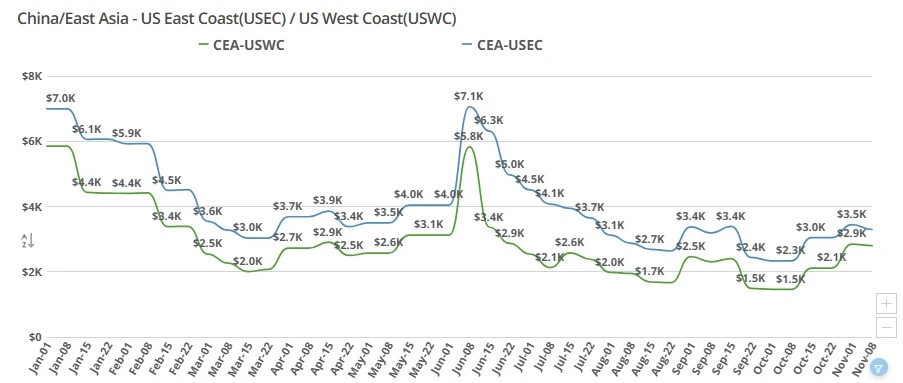
Transpacific ocean freight rates continue to decline as post-peak demand cools. China–US West Coast rates near $1,700, East Coast around $2,600 per FEU.