- Home
- >
- News
- >
- China Holiday Rush Tightens Ocean Freight Space to the US - TFX Update wk. September 21, 2026
China Holiday Rush Tightens Ocean Freight Space to the US - TFX Update wk. September 21, 2026
Key Takeaways
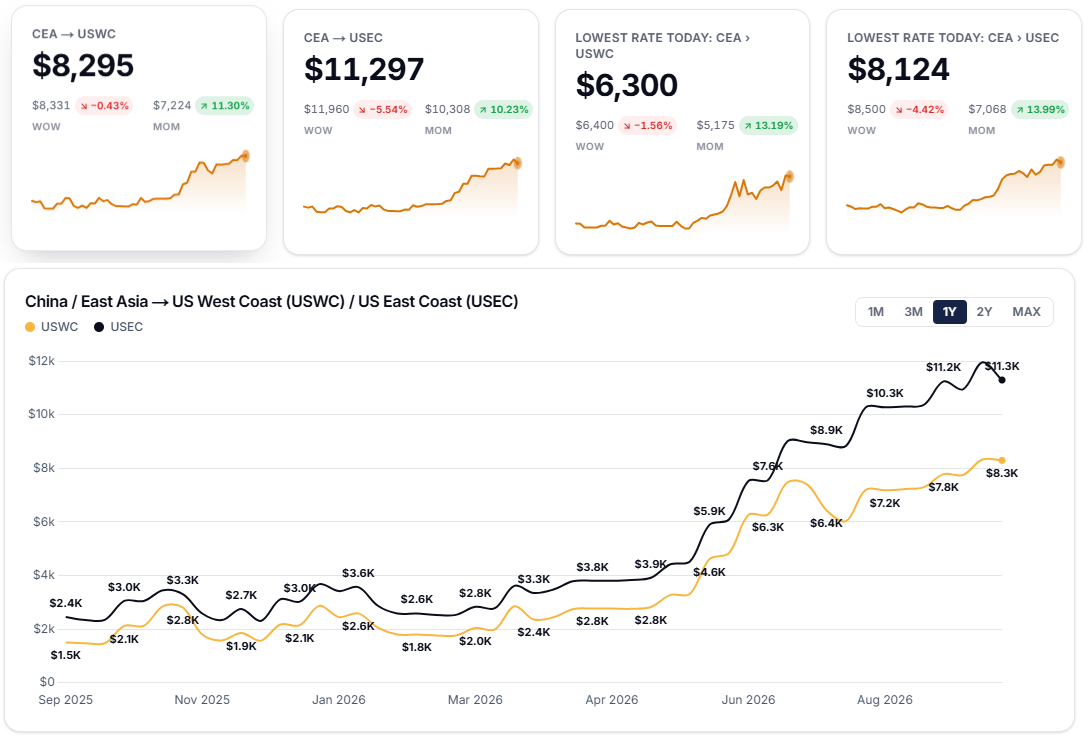
Rates remain high. China–US West Coast rates are above $8,000/FEU, while East Coast averages remain near $10,000/FEU.
Space is the bigger issue. Carriers are rolling and canceling bookings as available vessel capacity and weight limits tighten.
Schedules are unreliable. Early or late arrivals are causing missed terminal gate-in windows, stranded containers, and added costs.
Golden Week is driving urgency. Cargo that misses late-September sailings could be delayed until the second week of October or later.
Secure workable bookings now. For time-sensitive holiday inventory, confirmed space and realistic sailing dates matter more than the lowest spot rate.
The Lead:
The third week of September saw tactical shifts within the ongoing North American trade war as modified US Section 338 lists took effect, removing bulk inputs like cement while adding targeted finished goods like ATVs and paper products. The logistical weight of this centralized trade architecture was countered by financial relief as CBP disclosed the approval of $122 billion in back-tariff refunds via the Court of International Trade.
As customs enforcement tightened via mandatory new Importer of Record verification protocols, both Washington and Ottawa signaled a potential opening for diplomatic de-escalation ahead of pending September 29 import bans on Canadian alcohol and dairy.
This Week’s Ocean, Air & Freight Markets
China-US Ocean Freight Market:
Ocean freight rates from China to the US remained broadly stable week over week, though the market is becoming more difficult to manage operationally.
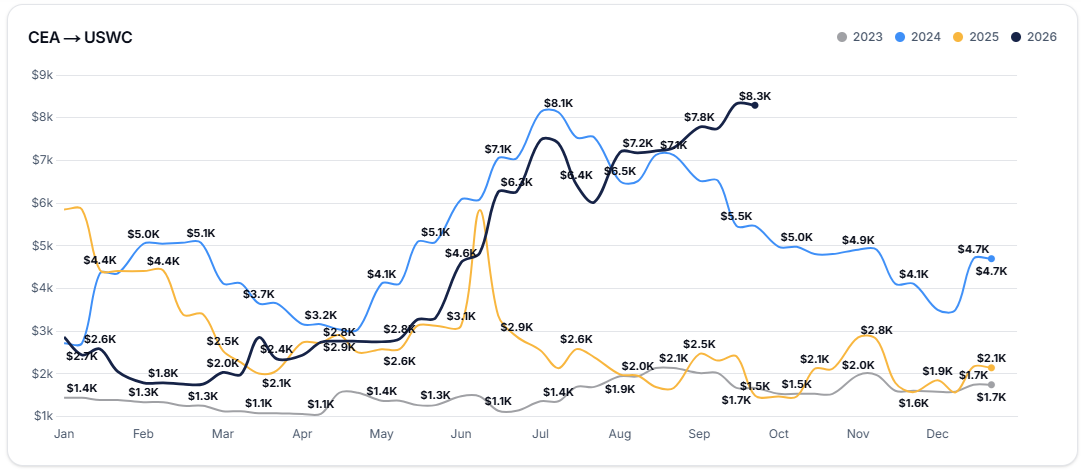
CEA to USWC: Spot rates are holding steady at averages above $8,000 / FEU. While promotional/discounted space can occasionally be found in the $6,000 – $7,000 / FEU range, overall vessel capacity remains tight, keeping effective market rates elevated.
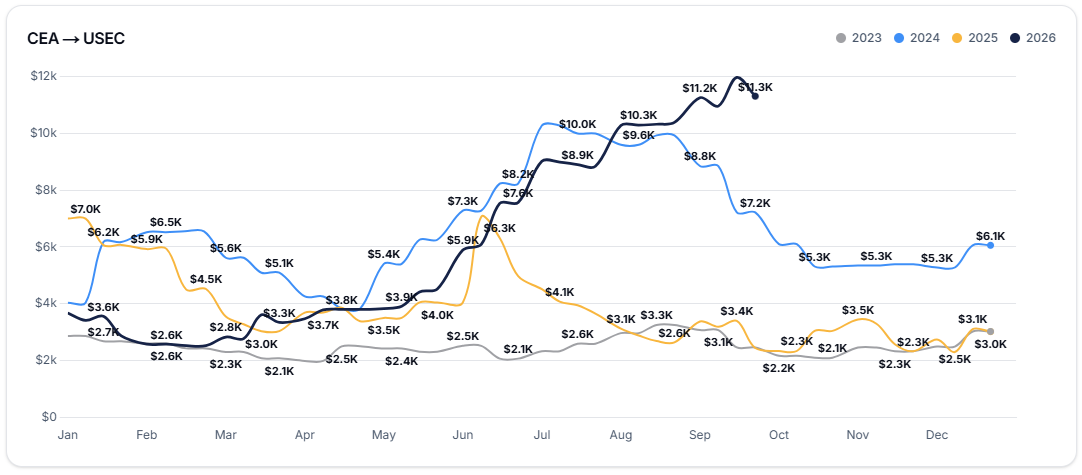
CEA to USEC: Rates remain stable at averages around $10,000 / FEU. Mid-market promotional offers hover near $9,000 / FEU, but availability on these discounted tiers is severely constrained.
Freight Right’s Lowest Rate indicators are finding that importers can find spot rates as low as $6,300 from China to US West Coast and $8,100 from China to US East Coast. Talk to your freight forwarder about options available to you.
Read more about the state of the ocean freight spot market with Freight Right’s TrueFreight Index.
What Happened This Past Week
Severe Carrier Schedule Instability: Vessel schedules have become highly volatile. Ships are arriving unpredictably, sometimes three to four days early, and other times several days late, disrupting port operations and terminal reception windows.
Escalating Rolled Bookings & Cancellations: Carriers are increasingly rolling bookings or outright canceling confirmed slots, citing vessel space and weight limitations.
Pre-Golden Week Cargo Rush: With China’s Golden Week national holiday taking place from October 1st to October 7th, shippers are scrambling during the final working days of September to clear cargo out of origin ports before factories and trucking networks shut down entirely.
Terminal & Equipment Bottlenecks: Delayed vessel schedules are causing containers to miss strict origin terminal gate-in windows. Loaded containers are being stranded at trucker yards, incurring additional storage, drayage, and carrier demurrage fees.
Looking Ahead:
Space constraints and schedule volatility will likely remain the main concern through the end of September. China’s National Day holiday will significantly reduce trucking, terminal, and origin operations from October 1 through October 7, meaning cargo that misses the final pre-holiday sailings could face delays into the second week of October.
Rates may increase further for urgently needed cargo as carriers prioritize higher-paying bookings. Importers with Amazon, Walmart, or other holiday-season delivery deadlines should treat confirmed space and realistic sailing schedules as more important than finding the lowest possible rate. Cargo departing after the holiday may have difficulty meeting final holiday inventory cutoffs, particularly for East Coast destinations.
Schedule reliability and confirmed vessel space are likely to remain more important than headline freight rates through the end of September and into China’s National Day holiday period.
As trucking and terminal capacity decline ahead of the holiday, shipments that miss their intended sailing may not simply move a few days later. Some cargo could miss the available pre-holiday window entirely and be pushed to the following week or beyond.
Importers should plan for greater variability in departure dates and build additional time into origin transportation, terminal delivery, and inventory schedules. Where delivery deadlines are firm, securing workable space and maintaining flexibility around sailing dates may be more important than waiting for the lowest available rate.
China-US Air Freight Market:
Air freight demand from China is increasing unevenly as the October holiday approaches. South China is seeing the strongest pressure, while East and North China remain more balanced for now.
CEA to USWC: Rates into Los Angeles and San Francisco are firming, driven by increasingly tight space from South China gateways, including Guangzhou and Shenzhen. East China origins, including Shanghai, Nanjing, and Ezhou, are seeing only mild demand growth, so capacity remains more available. Rates are expected to increase as pre-holiday cargo volumes build.
CEA to USEC: Rates into New York and other East Coast gateways are stable to slightly higher week over week. South China space is tightening first, while Beijing still has capacity for some late-September departures. As more cargo moves through East and North China airports ahead of the holiday, rates are likely to continue rising.
What Happened This Past Week
PEK still needs volume for some late-September flights, creating booking opportunities from North China.
Shippers are beginning to move cargo ahead of the Mid-Autumn Festival and National Day shutdowns.
Airlines are expected to begin offering lower holiday-period spot rates around Wednesday, which may create short-term savings for flexible shipments.
Looking Ahead:
Pre-holiday demand should continue to build, especially as East and North China flights begin to fill. This is likely to push rates higher across China to US West Coast and East Coast lanes over the next one to two weeks.
At the same time, lower spot rates offered for the holiday period may provide a cost-saving option for cargo that can move during the shutdown window. Shippers with fixed pre-holiday delivery needs should secure space early, while flexible shippers should monitor holiday-rate opportunities closely.
Holiday Notice: Mid-Autumn Festival: September 25. China National Day Holiday: October 1–7.
In the News:
WSJ: Global Trading System Facing Fragmentation or Revamp At ‘Critical Juncture,’ WTO Says
https://www.wsj.com/economy/trade/global-trading-system-facing-fragmentation-or-revamp-at-critical-juncture-wto-says-1efc56e2
Reuters: India-New Zealand free trade pact to come into force on October 20 after ratification
https://www.reuters.com/world/india/india-new-zealand-free-trade-pact-come-into-force-october-20-2026-09-21/
Reuters: How Trump and Xi went from tariff war to trade truce
https://www.reuters.com/business/aerospace-defense/how-trump-xi-went-tariff-war-trade-truce-2026-09-21/
Bloomberg: EU, Philippines Strike Free-Trade Deal as US Tariffs Spur Diversification
https://www.bloomberg.com/news/articles/2026-09-22/eu-philippines-strike-free-trade-deal-as-us-tariffs-spur-diversification
NYTimes: India Is Again Squeezed Between the Threat of Trump Tariffs and Russian Oil
https://www.nytimes.com/2026/09/19/business/india-russia-sanctions-oil.html
More News

Last-Minute Sailing Cancellations Push April Cargo into May - TFX Update wk. April 20, 2026
Carriers use aggressive blank sailings to maintain China-US rates at $2,700, while shippers withhold volume in anticipation of a May price drop. Explore the impact of fuel surcharges and booking rolls on your supply chain.
Ocean Rates Rise Again as China Holiday Squeezes Capacity - TFX Update wk. September 14, 2026
China to US ocean freight rates rise $500–$600 as blank sailings, tight capacity and unstable vessel schedules intensify ahead of China’s October holiday.

CEA-US Rates Hold Steady at Breakeven Levels - TFX Update wk. February 9, 2026
Ocean rates hold steady at $1,400-$1,600 for USWC as China’s pre-holiday shipping window closes. Explore the impact of high trucking costs and the upcoming total market shutdown.
Ocean Spot Rates Rise $700–$900; Air Freight Climbs on Apple Charters and Tariff Rush - TFX Update wk. October 13, 2025
Transpacific ocean and air rates jump as carriers pull capacity, Apple charters tighten space, and shippers rush to beat U.S. tariff deadlines

Transpacific Ocean Freight Rates Hold High as Peak Season Nears Early Close - TFX Update wk. September 7, 2026
China to US ocean freight rates remain elevated in September, with USWC rates near $7,000 and USEC rates at $8,000–$9,000 amid strong demand, tight space and vessel delays.
Carriers Rollback September's GRI and Competition Among Forwarders Heats Up - TFX Update wk. September 15, 2025
China–US freight rates spiked up to $900 to start September but,in a rare move, promptly rolled back to pre-GRI amounts this week to entice bookings.

China-US Ocean Rates Hold Steady at $3K/$4K Baseline Ahead of Threatened June Spikes - TFX Update wk. May 25, 2026
Ocean freight rates hold steady, but massive June GRIs loom. Discover how carrier blank sailings and terminal capacity constraints are driving up transpacific shipping costs.

Capacity Management & Holiday Rush Drive Transpacific Freight Rates Higher - TFX Update wk. August 31, 2026
Discover why strategic blank sailings and early holiday inventory shipments are driving Transpacific container rates up to $10k per FEU this September
Space Tightens on China-US Routes Despite Weak Underlying Volume - TFX Update wk. April 13, 2026
Explore how aggressive blank sailings and new blended rate strategies are stabilizing CEA to USWC/USEC shipping costs despite weak demand. Stay informed on current ocean freight market updates and rate changes.
Spot Rates Dip Below 2024 Levels as Blank Sailings Ramp Up - TFX Update wk. August 18, 2025
China-US freight rates dip to $1,520/FEU as carriers cut prices and blank sailings set up a $1,000 September GRI amid weak demand and tariff risks.