- Home
- >
- News
- >
- China–US Ocean Freight Market Holds Firm, but Promotional Rates Gain Traction - TFX Update wk. June 22, 2026
China–US Ocean Freight Market Holds Firm, but Promotional Rates Gain Traction - TFX Update wk. June 22, 2026
The Lead:
Last week, global trade policy activity centered on efforts to stabilize key economic relationships while new tariff and enforcement risks continued to develop. The European Parliament approved the EU-US tariff agreement, helping preserve a 15% tariff framework for most EU exports to the United States while expanding access for U.S. industrial, agricultural, and seafood products. At the same time, the EU and UK prepared for a July summit aimed at easing post-Brexit trade frictions, particularly in food and agricultural goods. In North America, the United States and Mexico advanced USMCA review discussions covering rules of origin, steel, aluminum, autos, agriculture, labor, and economic security. However, tensions also increased as USTR launched a Section 301 investigation into Germany’s pharmaceutical pricing policies, raising the possibility of future trade retaliation. In Asia, the United States and India moved toward further trade negotiations, with India emphasizing the importance of reaching a deal quickly to strengthen its tariff position relative to regional competitors. Overall, the week reflected a mix of negotiated tariff management, regional trade realignment, and targeted enforcement actions shaping global trade policy.
This Week’s Ocean, Air & Freight Markets
China-US Ocean Freight Market:
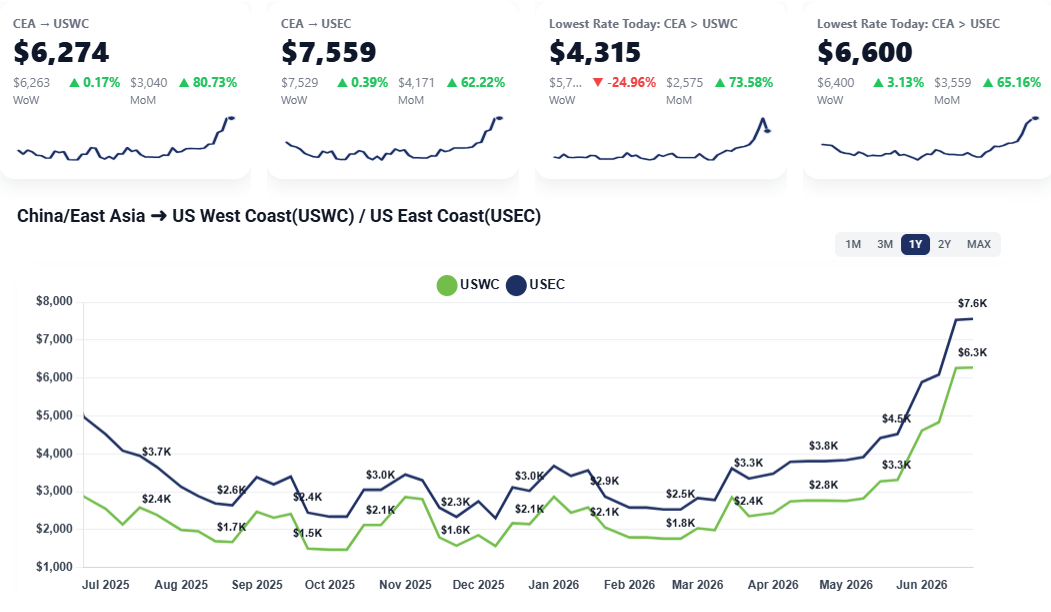
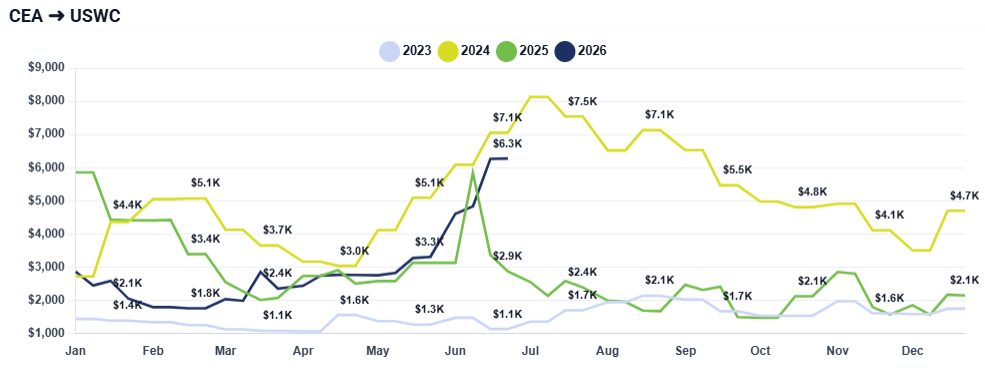
CEA to USWC: Rates remained elevated this week, with standard market levels still pushing above $6,000 per container. However, carriers and agents are increasingly making deal or promotional rate structures available, allowing some shipments to move closer to the $5,700–$5,800 range when volume, allocation, or carrier-ratio requirements can be met.
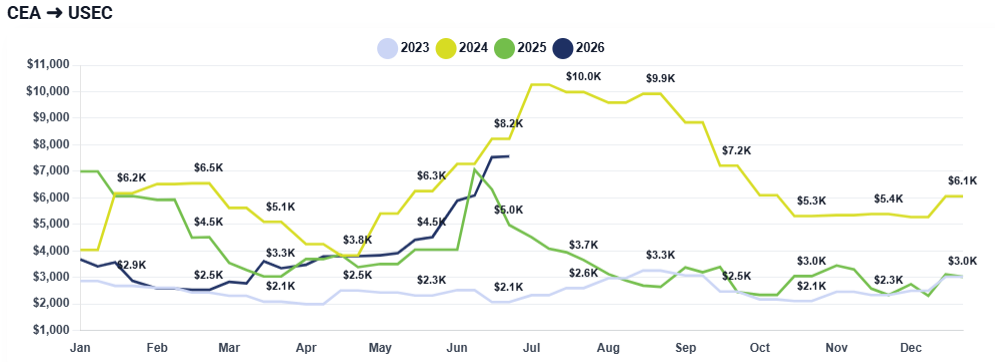
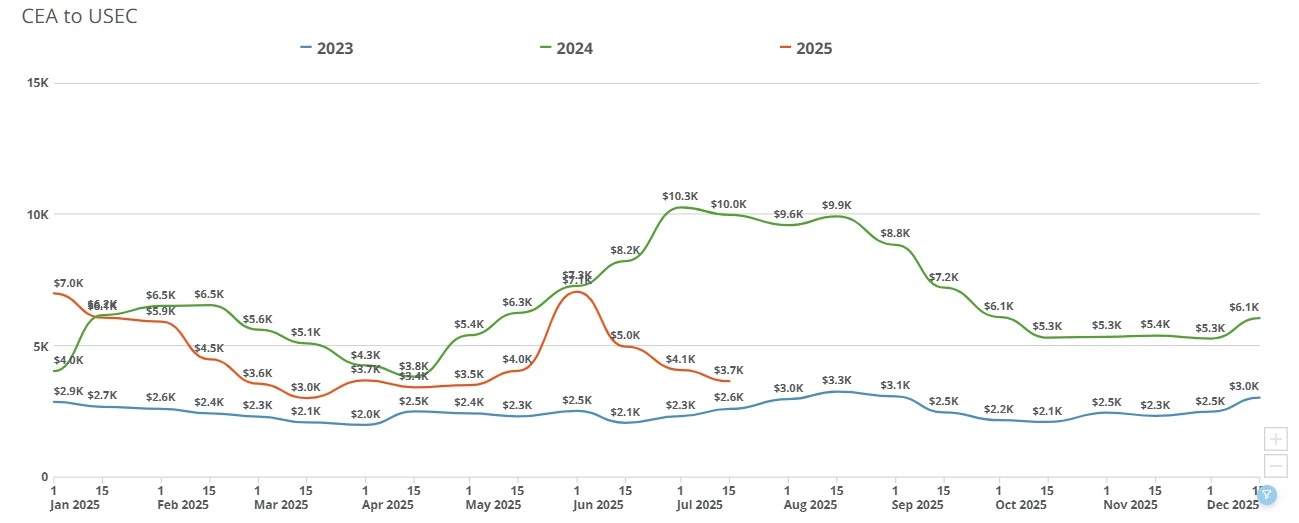
CEA to USEC: market appears broadly unchanged week over week, with no major new rate movement called out this week. The overall pricing environment remains firm, but the most visible competitive pressure is showing up on the West Coast, where high spot levels are beginning to push some importers to pause or delay non-urgent cargo.
Freight Right’s Lowest Rate indicators are finding that importers can find spot rates as low as $4,315 from China to US West Coast and $6,600 from China to US East Coast. Talk to your freight forwarder about options available to you.
Read more about the state of the ocean freight spot market with Freight Right’s TrueFreight Index.
What Happened This Past Week
End-of-Month Volume Depletion: As June comes to a close, the initial wave of urgent peak-season cargo has already sailed. The remaining leftover volume in the market is less time-sensitive, leaving forwarders fighting harder over a smaller pool of active shippers.
Stricter Carrier Ratio Deals: To guarantee vessel occupancy while capitalizing on high spot rates, carriers are tying low, fixed-contract space (~$3,000) to standard market-rate space. These ratios have become significantly tougher for forwarders, escalating from a 1:1 requirement to 1:3, 1:4, or even 1:5, effectively dragging the blended deal price up closer to the standard spot market.
Aggressive Forwarder Competition: Because space is tight but active customer volume is pausing, freight forwarders are aggressively passing these blended carrier deals directly to shippers. Profit margins are being squeezed as forwarders use these discounts defensively to prevent clients from cross-shopping.
Looking Ahead:
The market is likely to stay firm into July, with continued pressure on space and rates. However, the tone is shifting. Importers are no longer simply accepting higher prices across the board; more are weighing whether to ship now or wait. That customer hesitation is forcing forwarders to be more strategic with deal rates, relationship management, and urgency-based messaging.
If July brings another general rate increase or further tightening, the current “ship now before it gets worse” message may continue to be effective. But if customer pushback grows, we could see more selective discounting or promotional structures used to protect volume, even while headline market rates remain elevated.
In the News:
WSJ: See the Global Chokepoints That Carry Much of the World’s Trade
https://www.wsj.com/world/see-the-global-chokepoints-that-carry-much-of-the-worlds-trade-9683adf2
CNBC: Bruegel’s Wolff says G7 seeks global trade rebalancing
https://www.cnbc.com/video/2026/06/16/g7-leaders-looking-to-achieve-a-global-trade-rebalancing--bruegel.html
Bloomberg: Trump’s New US Tariff Wall Shakes Up Winners, Losers Lineup
https://www.bloomberg.com/news/articles/2026-06-22/trump-builds-a-new-us-tariff-wall-in-shakeup-of-winners-losers
Reuters: India seeks tariff advantage over peers in push to finalise US trade deal
https://www.reuters.com/world/india/india-seeks-tariff-advantage-over-peers-push-finalise-us-trade-deal-2026-06-22/
ABC News: China Shock 2.0: Surging Chinese exports threaten Europe's economy, raising concern
https://abcnews.com/Business/wireStory/china-shock-20-surging-chinese-exports-threaten-europes-133910524
More News
Ocean Freight Rates Hold Firm as Carriers Defend Pricing Into 2026 Contract Season - TFX Update wk. December 29, 2025
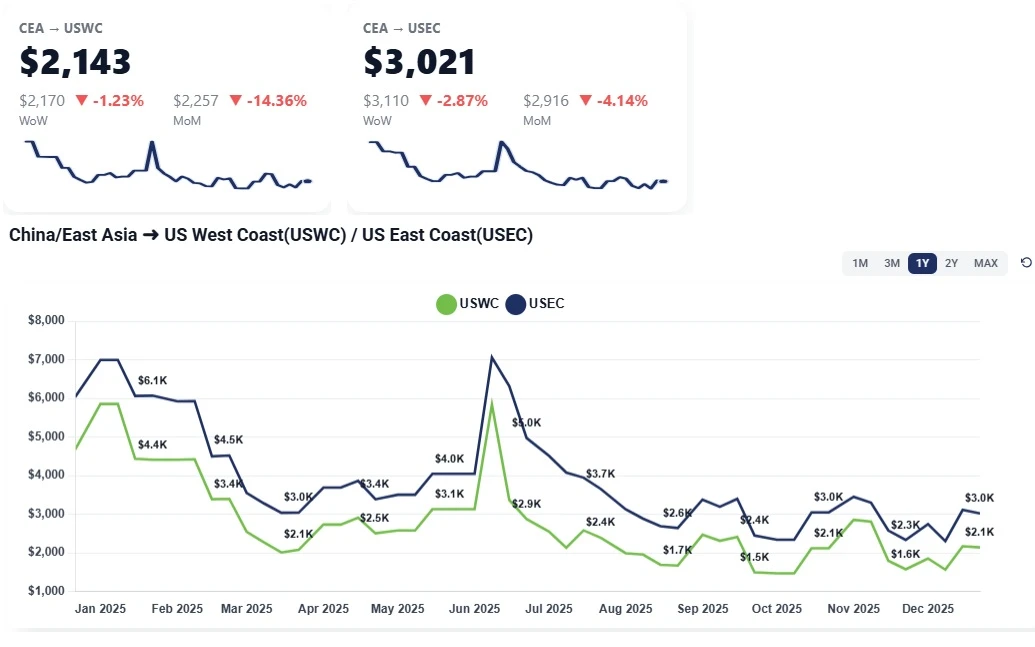
Transpacific ocean freight rates from China to the US West and East Coasts remained elevated week over week as carriers held firm through the holiday slowdown, positioning pricing ahead of Chinese New Year and upcoming contract season negotiations.

Importers Race Against July Tariff Deadlines, Throwing Supply Chains Into Chaos - TFX Update wk. June 8, 2026
Ocean freight rates skyrocket past $6,000 to USWC and $7,000 to USEC. Discover how carrier blank sailings, space deficits, and tariff front-loading are driving this early peak season crunch.
Ocean Freight Market Enters Holding Pattern Ahead of September - TFX Update wk. August 17, 2026
China-US ocean freight rates remain elevated in mid-August, with West Coast discounts emerging while East Coast pricing stays firm. See what carrier capacity cuts, blank sailings and demand trends could mean for September.
Carriers Prepare August GRIs Following Sharp West Coast Rate Decline - TFX Update wk. July 27, 2026
China to US ocean freight rates declined again this week, led by sharp drops on West Coast routes while East Coast pricing remained relatively resilient. Learn what's driving the market correction, August rate increases, and what to expect as peak shippin
Wait-and-See Grips Importers As Rates Remain Unchanged - TFX Update: wk. July 28st, 2025
As the deadline before reciprocal tariffs take place, the Trump administration continues to make deals with nations around the world. Importers are back to taking a wait-and-see approach while rates USWC and USEC remain unchanged.

Transpacific Ocean Freight Rates Hold High as Peak Season Nears Early Close - TFX Update wk. September 7, 2026
China to US ocean freight rates remain elevated in September, with USWC rates near $7,000 and USEC rates at $8,000–$9,000 amid strong demand, tight space and vessel delays.

China-US Ocean Rates Hold Steady at $3K/$4K Baseline Ahead of Threatened June Spikes - TFX Update wk. May 25, 2026
Ocean freight rates hold steady, but massive June GRIs loom. Discover how carrier blank sailings and terminal capacity constraints are driving up transpacific shipping costs.

Carriers Hold Firm on Fuel Surcharges Despite Emerging US-Iran Peace Plans - TFX Update wk. June 15, 2026
Transpacific ocean freight rates soared past $6,000 to the USWC and hit the mid-$7,000s to the USEC. Discover how front-loading and severe space constraints are driving this week's market update.
Tariff Refunds Cushion US Importers Amid Sustained Transpacific Spot Rates - TFX Update wk. August 10, 2026
China-US ocean freight rates remain stable through late August 2026, with USWC rates holding above $7,000/FEU. Discover how aggressive carrier blank sailings and importer tariff refund cushions are sustaining transpacific rate levels ahead of the Q4 holid

Months after IEEPA tariffs were struck down, some refunds remain caught between Customs and the courts
IEEPA tariff refunds remain complicated for some importers. Learn how CAPE phases, liquidation, protests and CIT actions affect refund options and timing.