- Home
- >
- News
- >
- Carriers Prepare August GRIs Following Sharp West Coast Rate Decline - TFX Update wk. July 27, 2026
Carriers Prepare August GRIs Following Sharp West Coast Rate Decline - TFX Update wk. July 27, 2026
The Lead:
The final week of July 2026 completed the US transition toward a permanent, investigation-justified centralized trade architecture. As the statutory 150-day clock on the temporary Section 122 import surcharges expired on July 24, Washington immediately activated its Section 301 forced-labor tariff framework across 60 economies.
By establishing a two-tiered duty structure (10% or 12.5%) tied directly to foreign labor compliance, the US eliminated temporary emergency surcharges without lowering its baseline border barrier. This regulatory pivot has solidified a new global cost structure, cementing supply chain alignment and forced-labor enforcement as prerequisite conditions for accessing the American market.
This Week’s Ocean, Air & Freight Markets
China-US Ocean Freight Market:
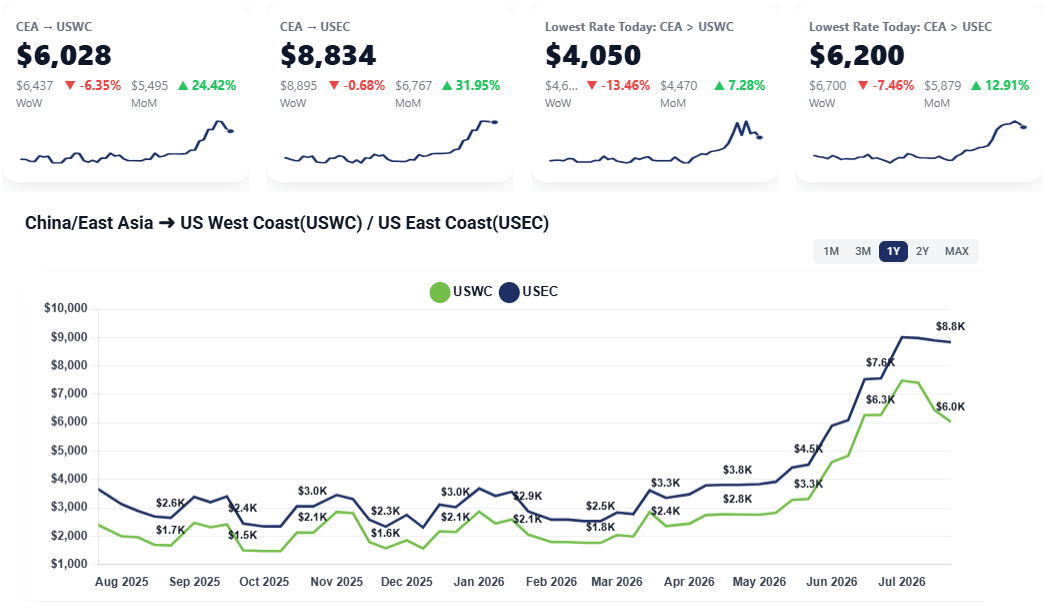
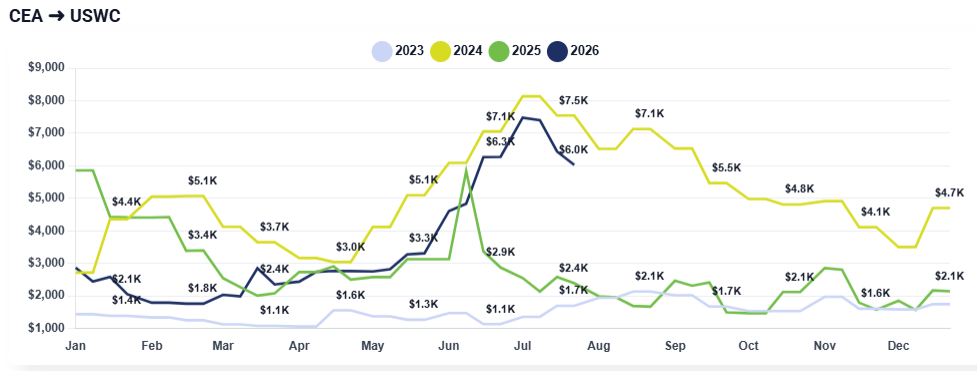
CEA to USWC: Spot rates continued to soften this week, with widely available rates now averaging around $5,500–$5,600 per container, down roughly $2,000 week over week. While some carriers are offering rates as low as $4,600–$4,700, and isolated quotes near $2,500 have surfaced, those lower prices remain limited and are not broadly available.
Overall, the market appears to be undergoing a correction after several months of sustained increases.
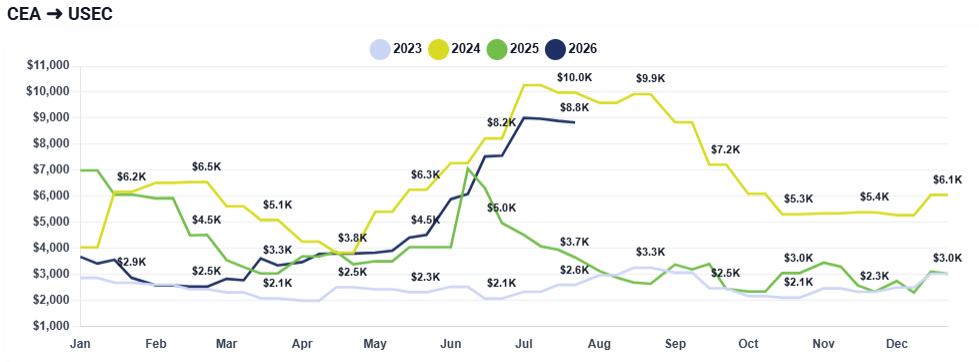
CEA to USEC: East Coast rates also declined but at a much slower pace. Spot pricing remains close to $9,000 per container, representing an estimated $1,000 week-over-week decrease.
Compared to the West Coast, carriers have maintained stronger pricing discipline on East Coast services, resulting in a more stable rate environment despite the broader market correction.
Read more about the state of the ocean freight spot market with Freight Right’s TrueFreight Index.
What Happened This Past Week
Market Correction & Carrier Demand Stimulation: Following aggressive, consecutive rate increases since late April and May, ocean carriers allowed rates to fall to stimulate market demand and bring pricing back to temporary market equilibrium.
Tariff Stabilization: Recent tariff adjustments—such as labor-related policy shifts moving duties from 10% to 12.5% on imports from China and Southeast Asia—caused brief market hesitation. However, because a 2.5% increase is modest, the tariff environment is expected to remain stable for at least the next three months.
Consistent Booking Volumes: Ocean booking volumes have remained steady week-over-week. While there is no sudden surge or drop, baseline cargo demand from origins remains solid and consistent.
Regional Disparity: Carriers lowered West Coast pricing far more aggressively to capture available volume, while East Coast space and demand dynamics supported higher price retention.
Looking Ahead:
The market is entering the traditional peak shipping season, with August and September expected to be the strongest months for outbound demand from Asia. Although ocean rates have corrected over the past two weeks, carriers are already preparing another round of GRIs beginning August 1.
Whether those increases hold will largely depend on sustained cargo volumes. If demand remains steady as importers continue shipping under the now-clearer tariff environment, carriers may be able to maintain rates near current levels or modestly higher. However, if demand fails to strengthen, the market could quickly settle back toward today's pricing after a brief August spike.
One notable trend to watch is the extended peak season. Instead of the traditional surge followed by a rapid decline, this year's peak may stretch longer due to the resetting of tariff policies and more evenly distributed shipping activity throughout the summer. Meanwhile, air freight typically reacts later than ocean freight, meaning any meaningful increase in air rates could materialize rapidly as August progresses.
In the News:
CNBC: Why Trump’s new tariff blitz is very different this time around
https://www.cnbc.com/2026/07/27/donald-trump-tariffs-trade-war-iran.html
Bloomberg: Global Trade Faces More Shipping Disruptions in the Mideast
https://www.bloomberg.com/news/newsletters/2026-07-23/houthi-attacks-on-shipping-in-the-red-sea
Washington Post: Canadian visits to U.S. plummet amid Trump tariffs, ‘51st state’ talk
https://www.washingtonpost.com/world/2026/07/27/canadian-visits-us-plummet-amid-trump-tariffs-51st-state-talk/
NY Times: New U.S. Tariffs Aimed at Over 80 Countries Go Into Effect
https://www.nytimes.com/2026/07/23/business/economy/trump-tariffs.html
Financial Times: Europe wins and Brazil loses in Trump tariff overhaul
https://abcnews.com/Politics/trump-slaps-additional-50-tariff-canadian-goods/story?id=134929955
More News
China-US Ocean Rates Ease Again as Post-Peak Lull Deepens - TFX Update wk. November 10, 2025
Transpacific ocean freight rates continue to decline as post-peak demand cools. China–US West Coast rates near $1,700, East Coast around $2,600 per FEU.

China–US Ocean Freight Market Holds Firm, but Promotional Rates Gain Traction - TFX Update wk. June 22, 2026
China–US ocean freight rates remain elevated, with CEA to USWC pricing above $6,000 while promotional carrier deals help some shipments move lower. Learn what is driving rates and what to expect heading into July.
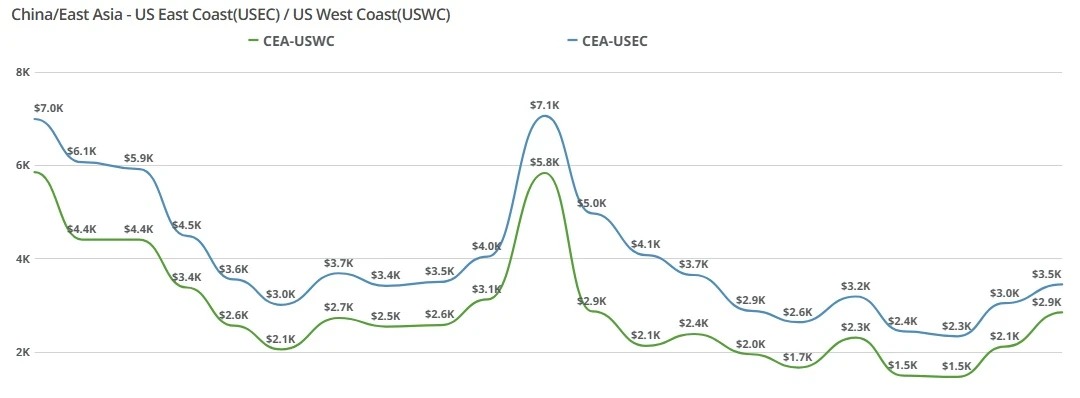
Freight Market Correction Deepens on CEA-US Routes After November GRI - TFX Update wk. November 3, 2025
China–US ocean freight rates fall as carriers discount to fill space. CEA-USWC down $400-$500; CEA-USEC near $2,800. See what’s driving the drop and what’s next.
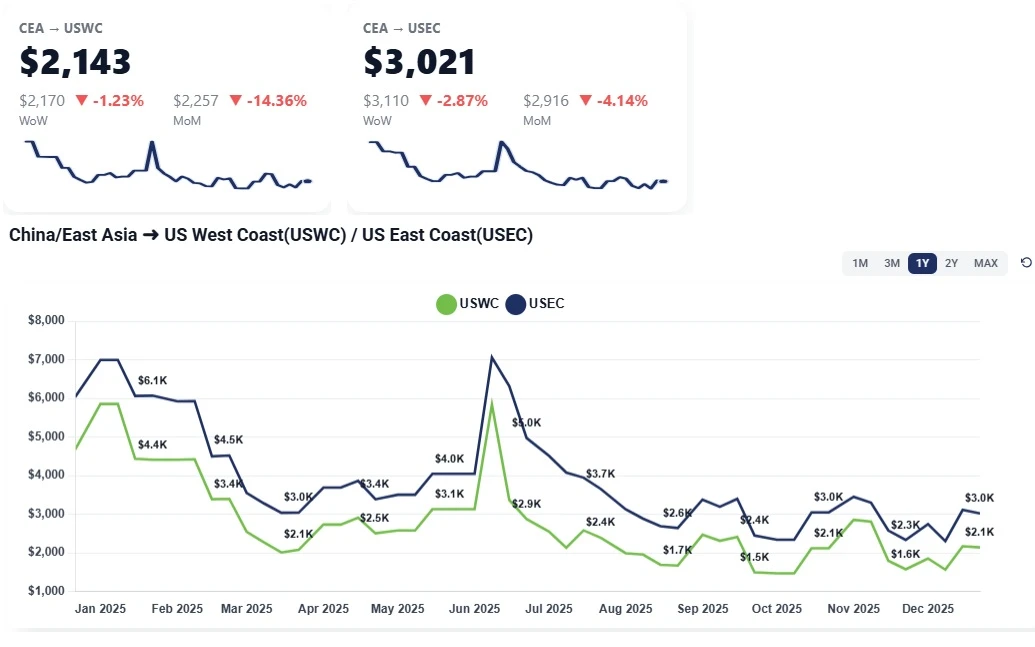
Ocean Freight Rates Hold Firm as Carriers Defend Pricing Into 2026 Contract Season - TFX Update wk. December 29, 2025
Transpacific ocean freight rates from China to the US West and East Coasts remained elevated week over week as carriers held firm through the holiday slowdown, positioning pricing ahead of Chinese New Year and upcoming contract season negotiations.
Carriers Begin Small Rate Cuts as Transpacific Market Loses Momentum - TFX Update wk. July 6, 2026
China–US ocean freight rates from CEA to the US West Coast and East Coast softened slightly week over week as demand remained low, carriers tested modest reductions, and the market appeared to reach a near-term rate ceiling.

Carriers Push Back with GRIs, but Market Fundamentals Push Harder - TFX Update wk. January 12, 2026
China–US ocean freight rates fell week-over-week as weak January demand erased early GRIs. See what’s driving transpacific pricing and where rates may head next.
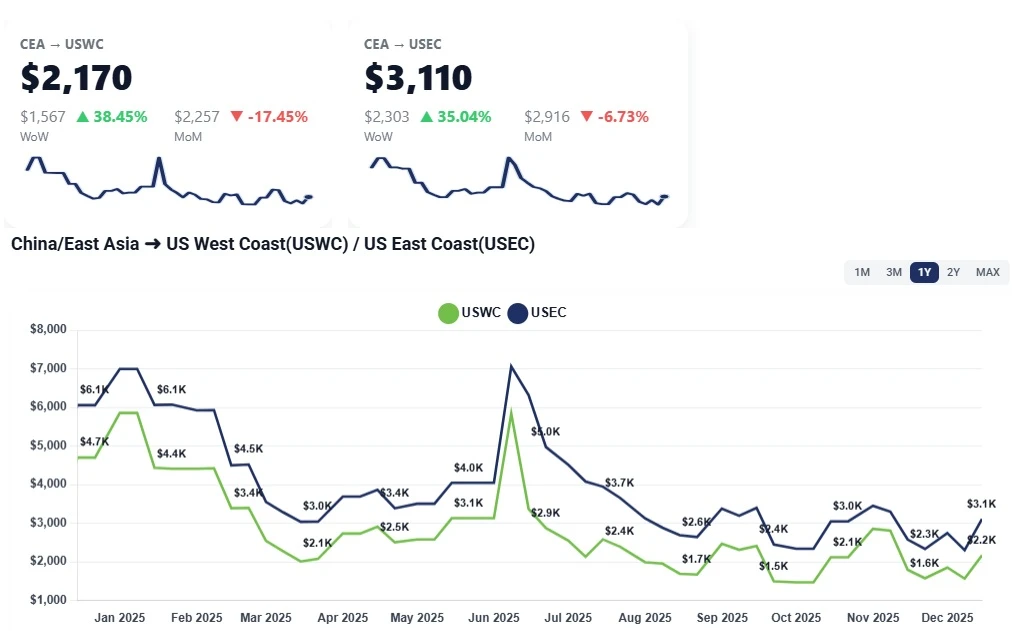
Transpacific Rates Pop Again: Carriers Push Mid-December Increases Into January - TFX Update wk. December 15, 2025
China–US ocean freight rates rose WoW: USWC near $2.1K/FEU and USEC near $2.9–$3.0K as carriers end fixed extensions and hold firm into January.
East Coast Premium Narrows: China–US Ocean Market Turns More Competitive - TFX Update wk. November 17, 2025
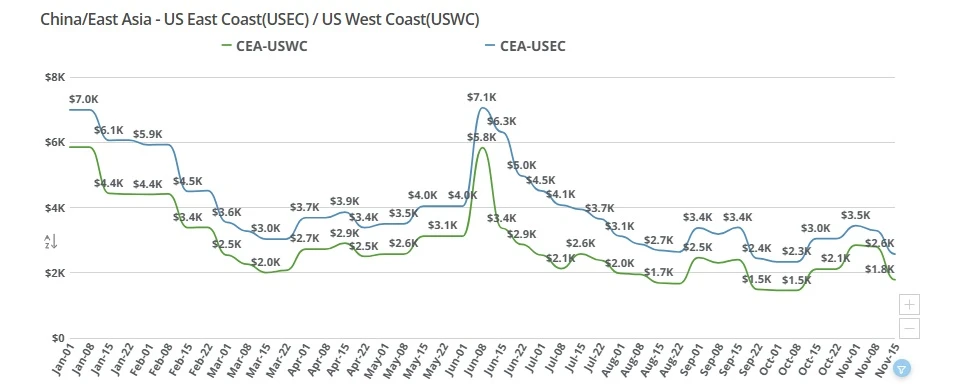
China-US ocean freight rates continue to decline, with the East Coast premium narrowing as carriers compete for limited volume. Get the key market drivers and outlook in this week’s update.
Holiday Pause Masks January Price Pressure on China–US Lanes - TFX Update wk. December 22, 2025
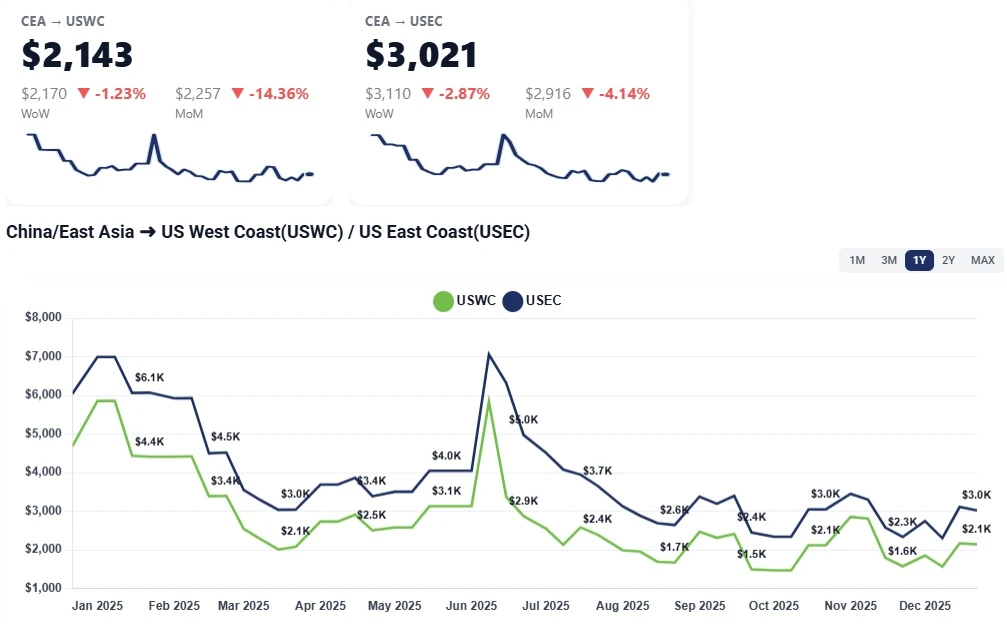
China–US ocean freight rates to the West and East Coasts held steady this week amid a holiday slowdown. Learn what’s driving the flat market and why January GRIs could push prices higher.

Ocean Freight Market Enters Holding Pattern Ahead of September - TFX Update wk. August 17, 2026
China-US ocean freight rates remain elevated in mid-August, with West Coast discounts emerging while East Coast pricing stays firm. See what carrier capacity cuts, blank sailings and demand trends could mean for September.