- Home
- >
- News
- >
- Ocean Freight Rates Retreat as Tariff Uncertainty Freezes Import Demand - TFX Update wk. July 13, 2026
Ocean Freight Rates Retreat as Tariff Uncertainty Freezes Import Demand - TFX Update wk. July 13, 2026
The Lead:
Last week was defined by the transition from temporary, emergency US surcharges toward a permanent, investigation-justified centralized trade architecture. The USTR’s launch of public hearings for the 60-nation forced labor tariffs signaled that Washington will lock in a new double-digit baseline duty structure before its temporary Section 122 fees expire.
This unyielding protectionist environment, spurred by prior legal constraints like the Court of International Trade's invalidation of universal tariffs, has forced close trading partners like Canada and Cambodia to rapidly rewrite their domestic import laws to claim US compliance exemptions. However, as the joint IMF-WTO summit confirmed that global commerce is becoming deeply uneven under these measures, the week closed with clear signs that the high compliance costs of the US metal multiplier are driving a major manufacturing migration away from secondary regional partners, fundamentally squeezing the North American supply chain.
This Week’s Ocean, Air & Freight Markets
China-US Ocean Freight Market:
CEA to USWC: Spot rates eased this week, falling from the mid-$7,000 range to the mid-$6,000 range. Carriers have reintroduced fixed-rate space and special-rate allocations, bringing pricing down by approximately $1,000 per container from the early July peak.
Despite the lower pricing, booking volumes remain soft as many importers continue delaying shipments while waiting for greater clarity on US tariff policy.
CEA to USEC: Rates to the East Coast, however, declined more moderately, with carriers offering more competitive pricing and improved space availability to stimulate demand. While pricing remains elevated compared to historical norms, the week-over-week decline reflects weakening booking activity rather than increased capacity constraints.
Importers continue adopting a wait-and-see approach, limiting any meaningful rebound in demand despite lower freight costs.
Freight Right’s Lowest Rate indicators are finding that importers can find spot rates as low as $4,680 from China to US West Coast and $6,700 from China to US East Coast. Talk to your freight forwarder about options available to you.
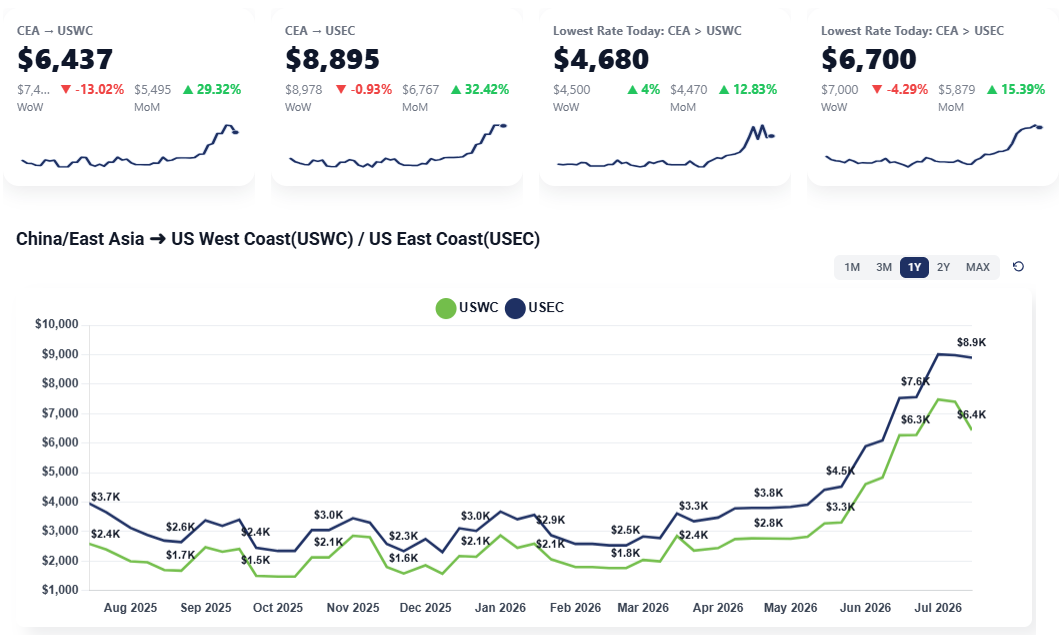
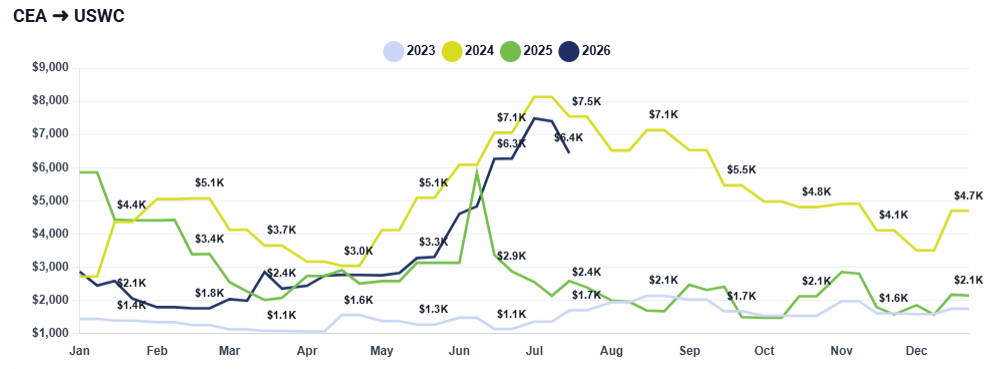
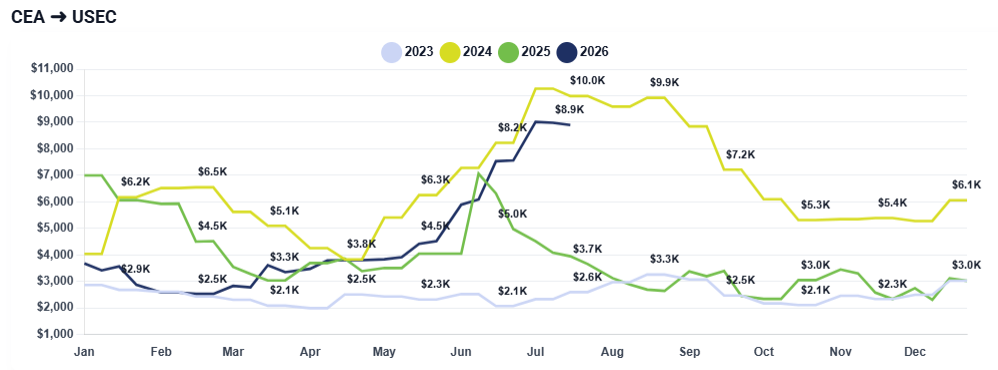
Read more about the state of the ocean freight spot market with Freight Right’s TrueFreight Index.
What Happened This Past Week
Tariff uncertainty is delaying imports. Many importers are postponing customs clearance, or delaying shipments altogether, until there is greater certainty about what happens after the current tariff period expires.
Lower prices are not translating into higher volumes. Despite the rate reductions, freight forwarders are not seeing any meaningful increase in booking activity, suggesting importers remain focused on policy risk rather than transportation costs.
Middle East tensions have not yet impacted rates. Although geopolitical risks remain, market participants believe any effect from oil prices or shipping disruptions would likely take several weeks to filter into ocean freight pricing and may be muted given rates are already at elevated levels.
Peak season may have already occurred. Many importers accelerated shipments during May and June to stay ahead of tariff deadlines, effectively pulling forward the traditional late-summer peak season.
Looking Ahead:
The next two weeks are likely to determine the direction of the trans-Pacific market. If tariff uncertainty is resolved with lower or eliminated duties, import demand could quickly rebound, potentially creating an extended peak season through August and September and pushing ocean rates higher again.
However, if tariffs remain in place, or increase, market participants expect booking volumes to weaken further, putting additional downward pressure on freight rates. With many importers already frontloading inventory earlier this year, the industry may ultimately experience another year without a traditional peak season, instead seeing demand shift around trade policy developments rather than seasonal retail cycles.
In the News:
The Guardian: US refunds $81bn in Trump tariffs after supreme court ruled them illegal
https://www.theguardian.com/us-news/2026/jul/14/trump-tariffs-us-refunds
Bloomberg: How Trump’s Zest for Tariffs Pits US Industries Against Each Other
https://www.bloomberg.com/news/newsletters/2026-07-14/trump-and-antidumping-tariffs
Reuters: IMF lowers 2026 global growth forecast to 3%, sees rebound in 2027
https://www.reuters.com/world/china/imf-edges-2026-global-growth-forecast-lower-3-sees-rebound-2027-2026-07-08/
CNBC: China exports in June rise at fastest pace since 2021 as AI boom, tariff rush lift trade
https://www.cnbc.com/2026/07/14/china-june-trade-data-exports-imports.html
CNN: After a year of tariffs, automakers are still resistant to moving production to the US
https://edition.cnn.com/2026/07/12/business/tariffs-automakers-new-factories
More News
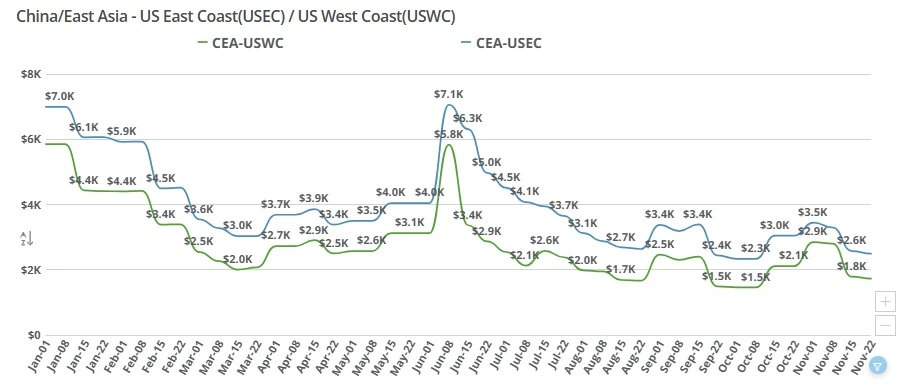
Spot Rates Plunge on Both Coasts With Short Holiday Week and Weak Imports - TFX Update wk. November 24, 2025
Transpacific ocean freight rates dropped sharply this week as weak import demand and the Thanksgiving holiday slowdown pushed China–US West and East Coast spot prices to new lows. Get the latest market drivers and outlook.

Ocean Freight Rates Double Since March as Carriers Aggressively Squeeze Capacity - TFX Update wk. May 18, 2026
Ocean freight rates double for USWC and USEC as carrier capacity cuts trigger severe space shortages and rolled cargo. Read the latest weekly freight market update on rising spot rates, premium expedited shipping surges, and the June GRI outlook.
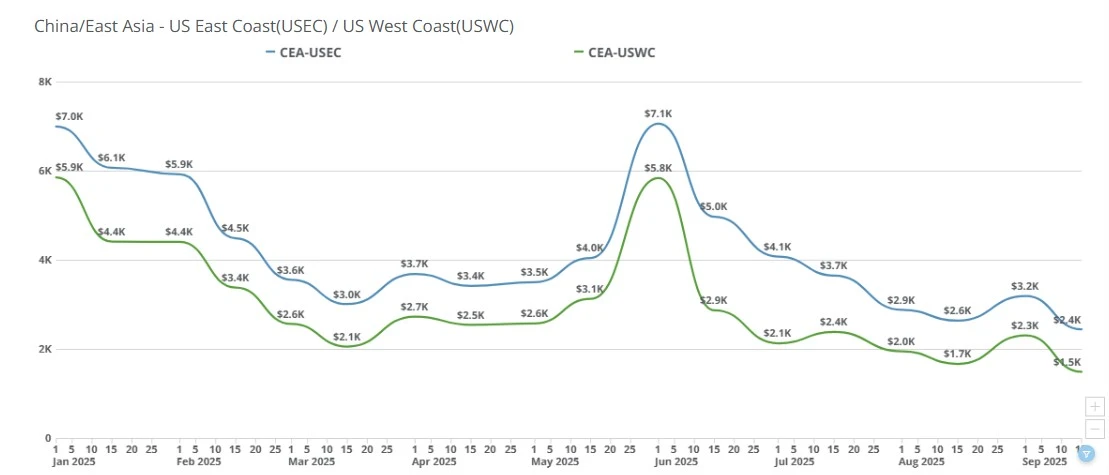
Spot Prices Ease on CEA to USWC, CEA to USEC; Forwarders Cut Margins to Win Cargo - TFX Update wk. September 22, 2025
China–US ocean spot rates eased WoW as early-September GRIs faded. USWC nears trough, USEC softens, and fierce forwarder pricing persists ahead of Golden Week.
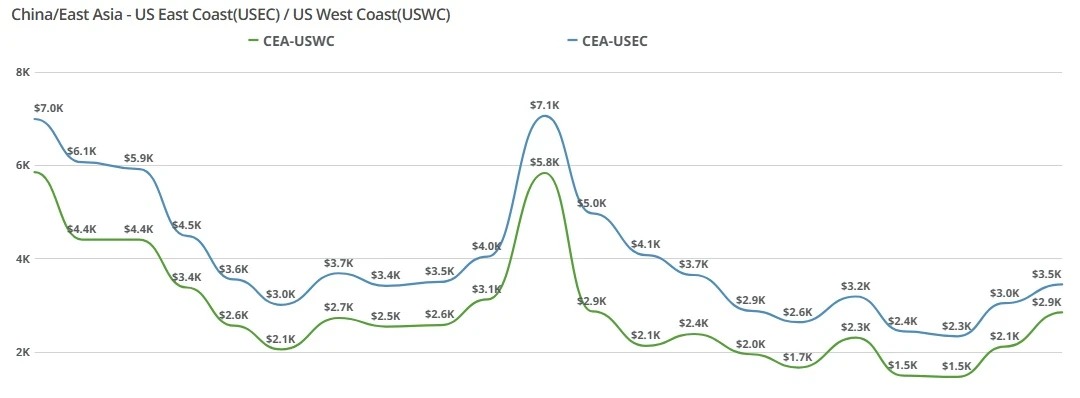
Freight Market Correction Deepens on CEA-US Routes After November GRI - TFX Update wk. November 3, 2025
China–US ocean freight rates fall as carriers discount to fill space. CEA-USWC down $400-$500; CEA-USEC near $2,800. See what’s driving the drop and what’s next.

Looming Tariffs and Softening Volumes Push Ocean Rates Down - TFX Update wk. July 20, 2026
Track weekly ocean freight rate trends for China to USWC and USEC. Read key insights on carrier rate adjustments, tariff updates, and shipping forecasts.

Transpacific Ocean Freight Rates Hold High as Peak Season Nears Early Close - TFX Update wk. September 7, 2026
China to US ocean freight rates remain elevated in September, with USWC rates near $7,000 and USEC rates at $8,000–$9,000 amid strong demand, tight space and vessel delays.
Carriers Begin Small Rate Cuts as Transpacific Market Loses Momentum - TFX Update wk. July 6, 2026
China–US ocean freight rates from CEA to the US West Coast and East Coast softened slightly week over week as demand remained low, carriers tested modest reductions, and the market appeared to reach a near-term rate ceiling.

China–US Ocean Freight Market Holds Firm, but Promotional Rates Gain Traction - TFX Update wk. June 22, 2026
China–US ocean freight rates remain elevated, with CEA to USWC pricing above $6,000 while promotional carrier deals help some shipments move lower. Learn what is driving rates and what to expect heading into July.
Carriers Push Back with GRIs, but Market Fundamentals Push Harder - TFX Update wk. January 12, 2026
China–US ocean freight rates fell week-over-week as weak January demand erased early GRIs. See what’s driving transpacific pricing and where rates may head next.

Importers Race Against July Tariff Deadlines, Throwing Supply Chains Into Chaos - TFX Update wk. June 8, 2026
Ocean freight rates skyrocket past $6,000 to USWC and $7,000 to USEC. Discover how carrier blank sailings, space deficits, and tariff front-loading are driving this early peak season crunch.